From Madrid: Madrid is better than Paris. That’s my advertising slogan for this great city. Instead of Midnight in Paris, Woody Allen should make a movie called Daylight in Madrid. Rather than showcasing Paris with the writer Hemingway, the bullfighter Belmonte, the artists Dali and Picasso, and the greatest filmmaker ever, Luis Buñuel, Woody Allen should showcase them all in Madrid where the world is real, and law and order keeps the dodgy people on their toes.
In Madrid, the city where the best stadium is a bullfighting ring, there is no room for Wokeness. Not only can you eat beef, but during the bullfighting season, you can eat carne de toro de lidia, the meat of the bull killed in the bullfight.
There are no bugs on the menu here because Madrid is a city forged in a history of excellence that refuses to cater for the tastes of dilettantes who don’t have the ticker to defend their own countries. Real (Royal) Madrid can literally be interpreted as ‘real’ Madrid.
Let me explain.
There are some people who regularly eat fast food hamburgers, but these same people would never kill the cow that provided the beef they greedily consume.
We have become so sanitised to our food production there are two kinds of food naivety. The first is that slaughtering animals for our meat, once part of Old Testament sacrificial procedures, is somehow grotesque. The other is that animals have rights, and we should never kill animals for our mortal sustenance.
Creating fake meat in laboratories or eating locusts is somehow deemed to be morally superior. But not in Madrid where the creation and consumption of food is an art form of the highest order.
It is often argued that knowledge can take us only so far, and then faith fills the gap. On the Iberian Peninsula, faith dominates all aspects of life, but not by compromising Enlightenment thinking.
Enlightenment thinking was about accepting what science could demonstrate, and not clinging to dogma where the evidence opposed contemporary orthodoxy.
In the 1997 cult movie, Starship Troopers, extraterrestrial bugs are the mortal enemies of humans. There’s a scene where:
‘…extremists disregarded federal warnings and established Port Joe Smith, deep inside the arachnid quarantine zone. Too late, they realised that Dantana had already been chosen by other colonists, arachnids.’
Rather than accepting the reality, the zealots put their faith in pacifism and paid a mortal price for their naivety.
I haven’t witnessed anti-colonial sentiment in Madrid.
A protest from the teacher’s union starts at the famous ‘Bear and the Strawberry Tree’ statue with drums beating and flags waving as they set out on their march. The police in full riot gear are ready nearby, but it reminds me of Korea where the protesters, often including nuns in their garb, march along the set route in their thousands while the police presence is rarely needed rather than for the symbolism of order it provides.
None of that happens in Australia. The protesters do whatever they want (if they are on the left side of things) while the police stand inefficaciously by. Not so in Madrid.
Many illegal street vendors set up their makeshift stalls on inverted parachutes, ready to pull their wares off the street and disappear into the crowd as the police drive by, only to reappear the moment the police are gone. The street sellers are far from brazen, and a sense of order prevails.
It is not like the stables area near the pyramids at Giza where the beggars appear in their hundreds like unstoppable zombies. Or London, one can assume from the recent two-tier policing accusations. But the police are clearly still in control in Madrid. They have not compromised on traditional policing.
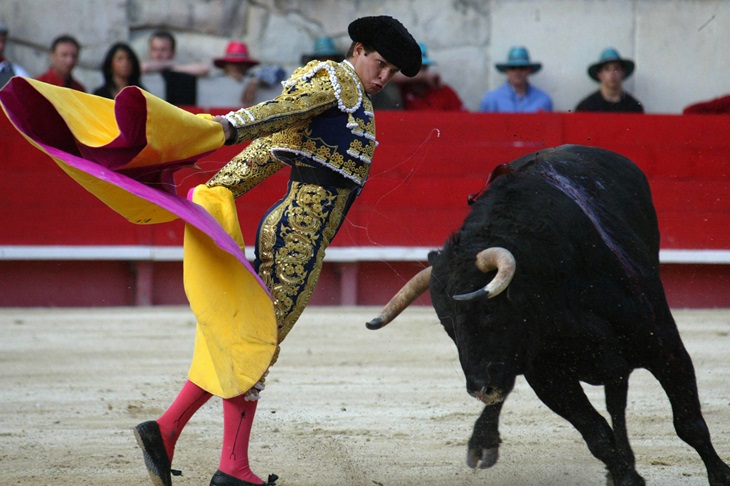
Which brings me to bullfighting. The art of bullfighting reminds me of the now-Woke The Economist’s Big Mac Index. Big Macs are standard products that incorporate numerous industry inputs including transport, energy, primary production, and so on, that enable a comparative idea of national economies.
Similarly, bullfighting brings together the arts, music, costume, dance, primary production and animal husbandry, spectacles, tradition, religion, and so many other aspects of Spanish culture it is hard to fathom. Of course, animal rights activists want to see it banned.
The reality is very different in Madrid. The Plaza de Toros de Las Ventas de Madrid (the Las Ventas Bullring in Madrid) defies the identity politics of Spain’s EU membership. A quote displayed in the bullfighting museum reads (word to the effect of) one cannot understand the history of Spain without understanding the history of bullfighting, or vice versa. It is part and parcel of Spain’s national identity, and it defies the Woke meta-identity the EU has tried to superimpose over Europe.
In Starship Troopers, the men and women were equal as citizens who are differentiated from civilians in that:
A citizen has the courage to make the safety of the human race their personal responsibility.
Like the fictitious Mobile Infantry, women are first among equals as matadors in Spain.
However, instead of saving us from the bugs, the World Economic Forum and its EU pundits would rather have us eat bugs at the expense of our cultural heritage. They are cowards who want to take away what it is to be human – to respect life while also being conscious of its fickleness.
For me, Madrid’s history stands as a beacon of hope for Western Civilisation. It is prepared to defend Enlightenment thinking without compromising its cultural heritage.
While bullfighting may not be for everyone, at least the practice gives the bulls a fighting chance. Those who eat fast food hamburgers without a second thought are effectively outsourcing their relationship to the very animals they consume.

Photo provided by author.
Eating bugs or proteins grown in a laboratory to spare ‘the planet’ only removes us further from the human condition. And while no amount of victimhood will spare humans from their fate, the further we remove ourselves from the reality of our mortality, the less respect we have for the world in which we live, which includes the animals the God of Genesis gave us stewardship over.
For me, the bullfight is a symbolic practice that, while not for many Westerners, brings to light the absurdity of death that Albert Camus discussed in The Myth of Sisyphus and how we refuse to acknowledge our inevitable end. As an aficionado of bullfighting, Hemingway knew this instinctively.
Angela Alaimo O’Donnell, a professor of American Catholic Studies at Fordham University, explained Hemingway’s (and my) fascination with bullfighting best:
‘As with any tragedy, it is hard to watch. We feel compassion for the bull – in part because we understand that the bull is us. The bullfight enacts the human drama each of us participates in. We all enter the arena of life unspeakably beautiful, and none of us gets out alive.’
The current push to save the planet denies our humanity. It wants us to ‘eat ze bugs’ and to be happy. But the pursuit of happiness is not the pursuit of an emotion. Otherwise, there are plenty of drugs that could make us happy for a time. Rather, the pursuit of happiness is to live a good life, in accordance with our own ideas of virtuousness, as opposed to signalling to others that we are living in accordance with contemporary trends of morality.
My experiences in Spain have taught me that the bullfight is about embracing faith and courage while living with the knowledge that we must live well in order to die well. Eating bugs is not living well. But in Madrid, you can choose to eat the brave bulls and bring some daylight to the Woke nonsense that has been served up to us over the last few years.
It’s well worth the long trip from Australia.