I’m in charge of streaming in our household – someone must be. Luckily, there is a joint preference for contemporary crime dramas, even if they involve solving cold cases. It’s one thing the BBC still does well, by and large. We also love a bit of Nordic noir.
Almost without exception, however, the makers of these series can’t resist the temptation to include some cringeworthy back story about one or more of the detectives solving the case. Do we really care that they are having marital difficulties? Do we really care that one of the kids has gone off the rails? Get on with solving the crime, I say. It just looks like unnecessary padding.
Sadly, far too many politicians have entered the field of recounting their tragic/uplifting/moving back story. Mind you, Kamala Harris, current US presidential candidate, moves her back story around depending on her audience. Some days she is just a middle-class kid; the next, she is a working-class kid. (Her mother was a medical research scientist, her father an economics professor – sounds solidly middle-class.)
She also has some bizarre story about the woman who looked after her and her sister while her mother went to work. Evidently, this woman also ran a small business – I’m not sure when she had the time – which means that Kamala understands small business. Sure.
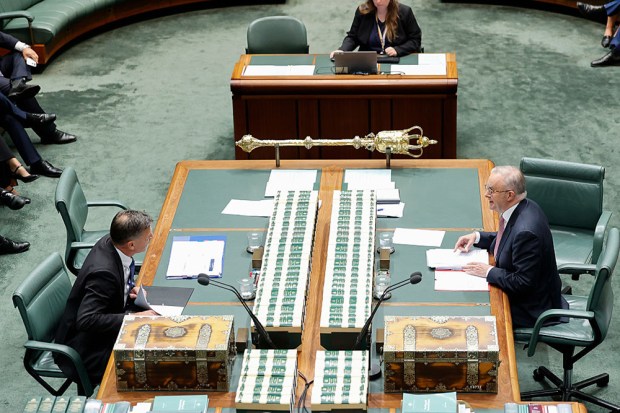
The back story has become a part of the kitbag of too many politicians here. How many times have we heard about Albo living in public housing as his single mother struggled to make ends meet?
The messages are twofold: with grit, determination, a loving mother and a supportive state, even a boy like Albo can make good. Secondly, public housing is a plus rather than a minus, notwithstanding the evidence that public housing estates are far too often hubs for crime and drug-dealing and the employment rate among tenants is very low.
Of course, everyone has a right to bang on about their background if they want to. But the real problem for politicians is that they too often use their very narrow, individual circumstances to inform themselves about policy, ignoring wide consultation, research and the consideration of all options.
One of the most egregious examples of the tedious and irksome back story is from federal Education Minister, Jason Clare, who comes from western Sydney. He is very proud of the fact that he is the first member of his family to attend university. He undertook a double degree at the University of New South Wales in arts and law before he became an advisor to Bob Carr, Labor premier of NSW. So, well done, Jase. But what he doesn’t seem to appreciate is that university is not for everyone. Many young people, including those who live in his electorate in western Sydney, would be much better served by pursuing a trade, particularly one in the construction industry. Jase is also very big on equity of access, irrespective of the record of the applicants or their capacity to pass the required subjects.
Jase commissioned the Australian Universities Accord which unsurprisingly recommended, in view of the minister’s circumstances, that the participation of those aged 25 to 34 years of age in university education be lifted from the current rate of 45 per cent – which seems extremely high – to 55 per cent by the middle of the century. In addition, those groups currently most under-represented in higher education should increase ‘to achieve parity across the Australian population’. So much for universities being centres of excellence.
It doesn’t seem to occur to our hero from western Sydney that the country will not be well served by having more graduates in Sociology, Cultural Studies or Chinese Medicine. Give us more plumbers, electricians, carpenters and brickies any day.
It’s worth observing here that many jobs that now require a university degree were once done by school-leavers. This is the case, for example, in accounting and bookkeeping. There was generally a lot of training given on the job and the holders of these positions often progressed quickly. Interestingly, the accounting profession is currently considering reverting to this model, at least partially, much to the chagrin of university accounting departments.
The real message that Jase should be giving young people is that university is not for everyone and that there are great futures in a range of occupations, particularly in the trades. But this just doesn’t fit with his back story.
If that anecdote doesn’t make you recoil, let me recount another aspect of Jason Clare’s back story. Evidently, his son Jack was thrilled to learn that his parents were presenting him with a new brother named Atticus. Now, Jack is a childcare centre attendee and his response to the news was that he must tell his favourite childcare worker, Kellie, about the new arrival.
The reaction of Jase was quite heart-warming. This incident had made him appreciate the sense of community that childcare imparts as well as clearly demonstrating the benefits of childcare on children. (Sample size = 1).
Now I don’t know about you, but this is not my experience of childcare. In many inner-city childcare centres, most of the staff don’t really speak English. No doubt they would have nodded politely when hearing Jack’s news, but that’s about it. There is also a rapid turnover of staff such that, half the time, the children never get to know any of the carers.
But this is not in keeping with Jase’s (or Labor’s) political position on the topic. Parents must be highly subsidised to dump their children in childcare centres, the more hours each week the better. This is so the women can work and help the economy. But it’s also good for the children – or so the ‘experts’ tell us who refuse to accept the fact correlation does not necessarily imply causation.
The fact that the best studies around tell a completely different story is ignored. There has been close to free universal childcare in Quebec, Canada for many years. The quality of the care does vary, and all the best options are snaffled by high-income earners. (You probably get the drift of the key problem with many studies: the children of high-income earners do better in life, the children go to high-quality childcare centres. It’s just a pity about the others.)
It’s clear that long day care is statistically associated with a range of social problems for many of the children attending and that these problems persist into the teenage years. They include anxiety, hyperactivity and aggression. Jase might want to talk to Kellie about these findings.
Politicians really shouldn’t use their (mostly uninteresting) back stories as a prime determinant of policy positions, particularly as these positions generally include spending great dollops of taxpayer dollars. File the stories in the bottom drawer and get on with using best practice means of settling on policies, including the option of leaving well enough alone.
Got something to add? Join the discussion and comment below.
You might disagree with half of it, but you’ll enjoy reading all of it. Try your first month for free, then just $2 a week for the remainder of your first year.