The wheels are falling off Mr Bowen’s energy policy as the Albanese government heads downhill like an out-of-control billy cart. Mr Bowen’s energy policy can be summed up as ‘not Mr Dutton’s policy’. That’s the extent of the substance to it, as each day brings more bad news for the 82 per cent renewables charade. Meanwhile, the rest of the world is turning to nuclear to meet future demand.
Rather than remove the prohibition on nuclear to enable market testing, the Albanese government will publicly fund a government-dominated inquiry to discredit the opposition’s nuclear energy plan. The aim is to ‘clear the decks’ for an election next year, rather than to deliver cheaper, cleaner energy for Australian households.
The Albanese government has gone on a crusade against nuclear. How Mr Bowen will produce costings for Mr Dutton’s plan when he is yet to provide costings for his own plan is anybody’s guess. This government is clearly afraid of nuclear and will do anything to put it down rather than face facts.
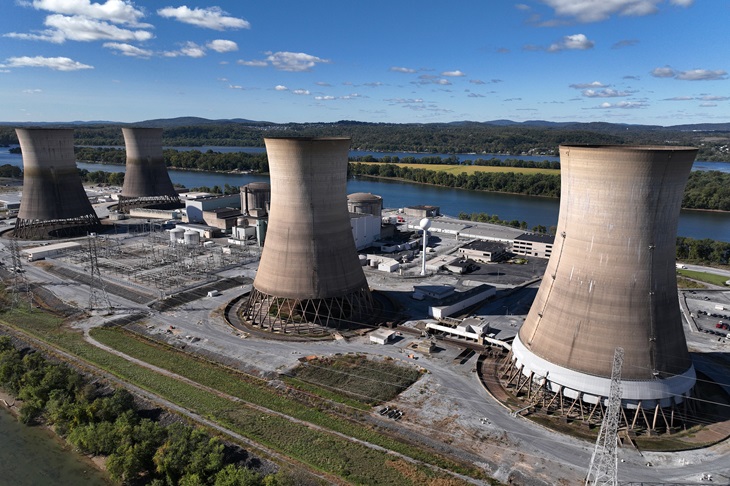
Microsoft is on the way to securing the Three Mile Island reactor to power a data centre. The reactor was the scene of the worst commercial nuclear accident in US history in 1979. Midnight Oil sang about it with the scaremongering lines, ‘And when the stuff gets in, you cannot get it out.’ Microsoft plans to restart Three Mile Island’s Unit 1, not Unit 2 which suffered the meltdown.
Both Google and Amazon plan to use nuclear energy to power their data centres, too. Artificial intelligence and data centres are driving up energy use and the trend is only likely to continue. How wind, solar, and batteries will be enough for Australia’s future needs is not clear from Mr Bowen’s policy.
In Australia, two major green hydrogen plans have recently fallen through.
Further, two major investors in the unpopular Illawarra Wind Zone have pulled the pin on deploying offshore wind turbines. The move comes amid community concerns over the size of the zone and the proximity to the coast. The smaller zone was part of a political compromise that apparently didn’t sit well with investors.
In the US, the Department of Energy has announced US$900 million to support small nuclear reactors. President Biden’s administration:
‘…believes nuclear power is critical in the fight against climate change because it generates electricity virtually free from emissions, and that US nuclear power capacity must triple to meet emissions goals.’
This is a blow to Mr Bowen who has mocked nuclear energy on a daily basis for some time.
The biggest problem with Mr Bowen’s energy policy is that the evidence doesn’t support his assurances. For example, the Australian Energy Regulator (AER) stated last week that the:
‘…cost of wholesale electricity rose during winter as periods of depressed renewable energy generation coincided with soaring demand for power in bitterly cold weather, data.’
Further, and although wholesale electricity costs were less compared to the previous quarter, the year-on-year costs were much higher. According to the AER:
‘Year-on-year prices were significantly higher across all regions, with Tasmania up 290 per cent, Victoria up 114 per cent and South Australia up 76 per cent.’
The $275 saving is long down amid such lofty numbers.
Unsuitable weather conditions for renewables generation in July and early August coinciding with increased demand was at the heart of the problem. Talk of batteries and pumped hydro (Snowy 2.0 is way behind its timeline and several times over its budget) are fantasy at this stage, with the reliance being placed on extending coal-fired power stations and increasing the amount of electricity generated by gas-fired stations.
Gas, too, is expected to remain at elevated prices for several years.
Yet the problem was recently exacerbated by wind drought – what Germans refer to as ‘dunkelflaute’ – and also that wind and solar projects are taking too long. So, any criticism of nuclear denies the lessons from overseas while pretending the current renewables rollout is progressing well.
Can renewables meet current demand? And can renewables scale-up like nuclear can? (As Microsoft, Amazon, and Google are betting on.)
The short answer is no. The long answer is that Mr Bowen’s Plan A is failing rapidly, and, by his own admission, he has no Plan B.
It will take more than hot air to fix Australia’s energy woes. It would seem that only a change of government will solve the crisis Mr Bowen got us into.
Dr Michael de Percy @FlaneurPolitiq is a political scientist and political commentator. He is a Fellow of the Royal Society of Arts, a Chartered Fellow of the Chartered Institute of Logistics and Transport (CILTA), and a Member of the Royal Society of NSW. He is National Vice President of the Telecommunications Association, Chairman of the ACT and Southern NSW Chapter of CILTA, and a member of the Australian Nuclear Association. Michael is a graduate of the Royal Military College, Duntroon and was appointed to the College of Experts at the Australian Research Council in 2022. All opinions in this article are the author’s own and are not intended to reflect the views of any other person or organisation.