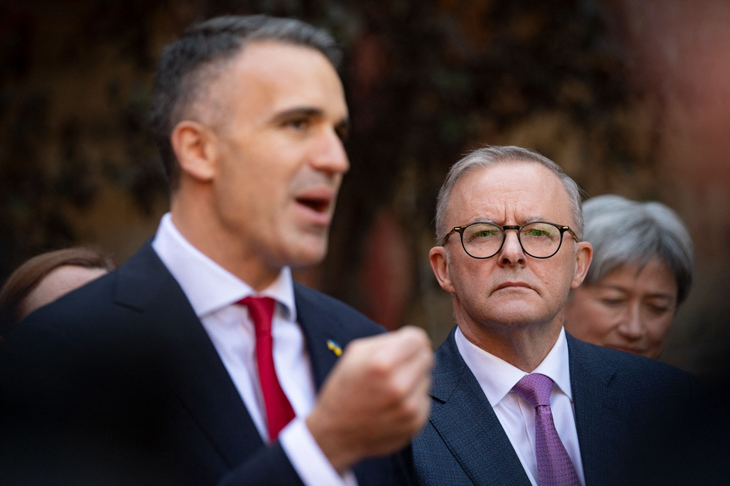
Prime Minister Anthony Albanese will not be pleased to hear that nuclear power should not be blocked ‘just because there’s a few lefties who are going to be opposed to it for old-school, nostalgic reasons’.
That comment came last week not from Ted O’Brien, the federal Coalition’s shadow minister for climate change and energy but from Peter Malinauskas, the telegenic Labor Premier of South Australia.
Malinauskas first broke ranks with the federal Labor party over its delusional energy policy last December saying that he hoped that the construction of nuclear submarines in South Australia would ‘bust a few myths’ about nuclear power and the ‘ill-founded’ ‘ideological opposition’ to it.
Malinauskas won plaudits from such unlikely bedfellows as the Nationals former deputy prime minister Barnaby Joyce who congratulated him for ‘going down the path of common sense’ and from key Labor allies in the right-aligned Australian Workers Union who said it was time to reconsider Australia’s ban on a civil energy nuclear energy industry as well as from the left-wing CFMEU which has said that small modular nuclear reactors should replace the aging coal-fired power plants in the Latrobe Valley in Victoria.
Albanese petulantly referred to the comments as a ‘distraction’ and later the same week Malinauskas graciously said, ‘I didn’t seek to suggest that nuclear power should be part of the mix in our nation’. Albanese responded with the mixture of ignorance and arrogance that characterises his key policy positions saying he had a ‘great deal of respect for Mali but everyone’s entitled to get one or two things wrong’.
That’s rich. It was Mr Albanese and his benighted Climate Change and Energy Minister Chris Bowen who promised an impossible cut of $275 in electricity bills by 2025, who backed Australian green hydrogen, which Andrew Twiggy Forrest now says is too expensive, who backed Australia making solar panels only to have the company lay off staff and who announced a venture with Ampol to provide vehicle chargers only to have the company back down on the promise because of difficulties connecting chargers to the grid.
In early April, Malinauskas again voiced his support for nuclear power pointing out that whether or not there is a nuclear power industry in Australia it would be impossible to decarbonise electricity globally without nuclear power and South Australia was proud to assist in that process with the export of uranium.
He’s right. Australia has almost one third of the world’s known uranium reserves and is the third-largest producer contributing about 10 per cent of global production.
Whether nuclear power ‘is going to make power prices cheaper or more expensive in this country is what I think we should be debating’ Malinauskas said.
It’s no wonder that Malinauskas is sensitive to the cost of electricity given that South Australia, which got more than 60 per cent of its electricity from solar and wind over the last 12 months, has the most expensive retail electricity in Australia.
That was not the end of the matter. Last week, Malinauskas once again weighed in to the debate not just speaking up for nuclear power but for gas which he said was ‘mission-critical’ to back up renewables taking the opportunity to comment that federal planning laws are ‘diabolical’.
South Australia gets more than 30 per cent of its electricity from gas which is essential since, as Malinauskas put it, ‘renewables can’t offer a genuine contract to the market without a firming service to back them up’.
The reality is that despite its investment in renewables and gas, South Australia needs a reliable source of base load power. Without one, it is forced to fill the gap with increasingly costly imports from its neighbours who are busily shutting down their only sources of reliable base load power.
With its huge uranium deposits, a conventional nuclear power plant would make South Australia not just energy independent but a net energy exporter.
While the initial capital costs of building a nuclear power plant are high, once completed the cost of running the plant is minimal as is the waste generated. With its geological and geopolitical stability South Australia could reasonably hope to see out the century without having to worry again about energy.
The critical lesson that Europe and the world should have learnt from the last three years is that national security is hostage to energy security.
Ukraine has denied a report in the Wall Street Journal this week which alleged that Ukrainian nationals were responsible for the explosions in September 2022 that damaged the multi-billion-dollar Nord Stream gas pipelines that transported cheap Russian gas to Germany under the Baltic and on which Germany relied for its economic competitiveness and prosperity.
The German economy has been in severe trouble ever since the pipelines were sabotaged and the cost of energy shot through the roof.
It would be a mistake however to attribute the sclerosis in the German economy just to the scarcity of cheap gas. Everywhere the highly subsidised green energy transition is showing signs of imminent collapse. Anaemic demand for electric vehicles has hit battery manufacturers with shares in one manufacturer down by 80 per cent. One of the country’s largest heat pump manufacturers announced job layoffs because, despite generous subsidies, only 90,000 heat pumps have been sold against a target of half a million. Siemens Energy has announced big losses as demand plummets for wind turbines.
As if all this weren’t bad enough, this week a German energy utility pledged one billion euros to build pipelines to carry green hydrogen. Yet that is just a drop in the ocean. The pipeline network will cost 20 billion euros and the renewable energy required to power electrolysis could bring the cost up to 80 billion euros for 10 gigawatts of production capacity.
Yet as a director at PwC in Germany for Clean Hydrogen and Alternative Fuels told Reuters, ‘The business case for German hydrogen projects is not easy.’ That’s because the banks are asking for secure returns and if there is no prospect of those, investments will not be made.
The bitter irony is that the cheapest way for Germany to produce the abundant low-emissions energy needed to produce ‘green’ hydrogen would have been from its nuclear power plants. Yet eight of its operating reactors were permanently shut down following the Fukushima nuclear power plant disaster in 2011.
In 2021, nuclear power still provided more than 13 per cent of German electricity at six power plants but three were switched off at the end of that year and the other three were shut down in April 2023.
The Grafenrheinfeld nuclear power plant was once a symbol of Germany’s energy independence. The decision to blow up its cooling towers this week is merely a postscript on an economic suicide note that has been written by the German Greens over several decades.
Australia does not have to follow Germany over this cliff. Leftists governments in Britain and Canada have embraced nuclear power. When we come to this fork in the road let’s hope we follow Malinauskas not Albanese.
Got something to add? Join the discussion and comment below.
You might disagree with half of it, but you’ll enjoy reading all of it. Try your first month for free, then just $2 a week for the remainder of your first year.