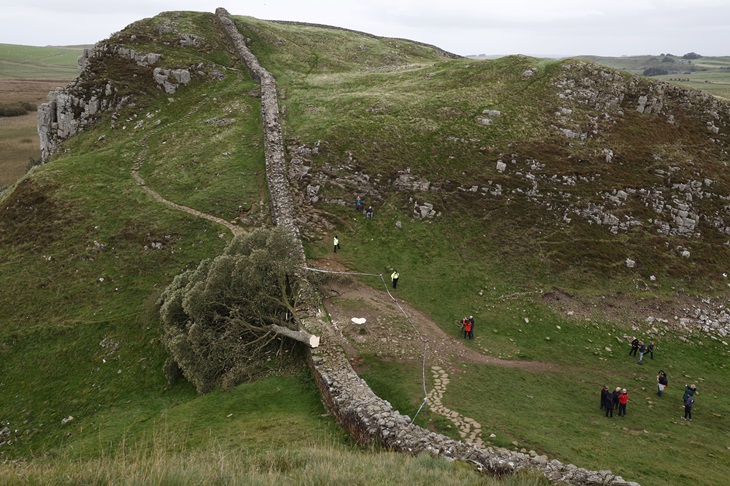
Last September, the British people woke to a crime that seemed to echo across the United Kingdom.
The Sycamore Gap Tree, which grew in a dip of Hadrian’s Wall, had been cut down overnight; a well-known icon of northern England, it had been made internationally famous by several Hollywood films.
For what reason vandals committed this crime, no one seems to really know. The response, however, was overwhelming.
The BBC reported that people across Britain had been left ‘stunned’ and ‘devastated’ by the act. Groups held vigils for the tree as the National Trust rushed to take saplings from the sycamore’s branches. These were later cradled by Dame Judi Dench and presented to King Charles on Celebration Day.
The Spectator held a poem competition in memory of the tree; Sean Thomas, writing in the days following, said that he felt sick and ‘nor was I alone in this nausea’. He knew of people who ‘literally cried when they heard the news and saw the horrible photos’.
Exactly four weeks after the Sycamore Gap Tree was lopped, a felled trunk was driven on a flatbed truck through the centre of Hobart.
This tree didn’t have a localised name, nor a cult following of celebrities, artisans and royals. It was a swamp ash (Eucalypus regnans), the largest flowering plant in the world and, with a trunk diameter of twelve feet, was estimated to be older than the tree that had grown in the dip of Hadrian’s Wall.
Perhaps this could have been seen as a southern hemisphere Sycamore, but it hardly made the news. Nor did another, similarly aged tree that was driven out of the Florentine Valley, south-west of Hobart, last August. Then there was the giant swamp ash burnt to death by a post-logging fire near Hopetoun in early May.
Those Brits in thrall to Sycamore Gap may be surprised to know that cases like these are a common occurrence in Tasmania. Trees, some of which date back to the time of the Medicis, are destroyed across the island and then carted out for woodchips or pulp.
Although this process still takes place on the mainland, Tasmania alone is worth considering: even if you have no appreciation for the age and beauty of these forests, is there any reason for the island state to cut them down?
Wheel this question out to local and federal politicians alike and you tend to get the same responses: the need to keep heritage industries alive, the desire for jobs at a time when cost of living is biting, the fact that vast amounts of Tasmania’s environment has already been locked up in reserves.
But it’s hard to put a PR spin on logging when the industry simply is not viable. In this regard, it seems that there is not even a discussion to be had: for years, analysts have shown that almost all of Australia’s timber needs are met by plantation forests and that there are hardly any jobs at all in the industry compared to other sectors.
Victoria announced the abandonment of native logging last year – seven years earlier than previously forecast – as it simply could not justify propping up the industry. Western Australia followed the same line, stopping the harvest of its marri and karri forests, although its jarrah forests continue to be levelled for the bauxite-rich soils they grow in.
In Tasmania, it’s well known that successive governments have had to subsidise logging for a long time. Last year, The Australia Institute put forward that between 1997 and 2017, Tasmania’s state-owned forestry industry delivered a cash loss of $454 million.
Figures like these are often dismissed as misconstrued, blown-out, serving Greenie interests and putting jobs at risk. And yet, we’ve now reached a stage where the pro-business lobby isn’t holding back, either.
The Blueprint Institute, a self-described ‘economically conservative’ think tank, produces research that is ‘consistent with market principles and informed by rigorous economic analysis’.
At the end of last year, Blueprint released a paper that modelled alternative land use techniques against continued logging in Tasmania. The report confirmed that ‘state governments across the political spectrum hold a long and unenviable record of channelling taxpayer funds to subsidise and prop up failing and unprofitable state-owned forestry firms’. It then contended that if native logging ceased in 2025 instead of the theoretical year of 2049 and pivoted to alternate land uses, the result would be one of positive net present value, ‘even when factoring in the estimated cost of providing a transitional package to the broader forestry industry’.
The report recommended that the Tasmanian government ‘immediately cease’ all government subsidies to the native timber industry and end native forest logging by 2025.
Despite how explicit this advice is, it does not appear like the state government is willing to even consider such a move; both major parties continue on a unity ticket to perpetuate forestry. Jeremy Rockliff’s incumbent Liberals have declared themselves ‘the strongest supporters of Tasmania’s high-value native forestry industry, backing in Tasmanian sawmillers, contractors, and local jobs’.
This is a far cry from another island on the far side of the world, which is not able to discuss the future of its forests because they are not there any more. The UK is now one of the more urbanised nations on Earth and tree cover is hard to come by.
The contemporary landscape-poet of the British, Robert Macfarlane, once dedicated a full-length book to the search for wild places in the United Kingdom, describing the dense forests of the past as the deepwood, when Britain was covered by a ‘dominion of trees’. Macfarlane concedes in his book that the deepwood is ‘vanished’ in the British Isles, reflecting, rather movingly, that ‘we are still haunted by the idea of it’.
In Tasmania, we are seeing such forests vanish each week. Perhaps, one day, the people of this island in the Southern Ocean will look back like their English counterparts, still haunted by the shadow of a single sycamore, and wonder for what justifiable reason they could have allowed their trees to be cut down.