I can still remember the first time I heard big band jazz. I was in my twenties (too long ago!) and a friend was driving us to the beach. He had the radio on – it must have been the ABC – and out came Perry Como singing ‘I wonder who’s kissing her now’ with the Ted Weems Orchestra in 1947. It was a moment I have never forgotten. Being only familiar with rock music, it was unlike anything I had heard before: the beguiling swing, the punch of the ensemble, the caressing vocal. I have been a jazz and big band aficionado ever since.
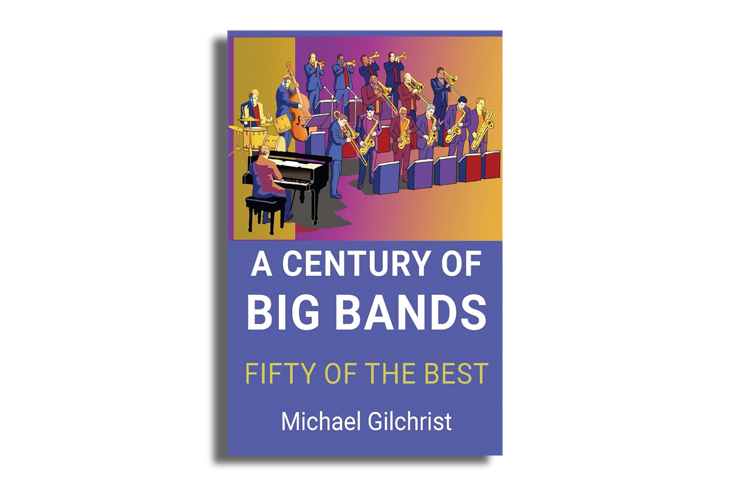
As such, I read Michael Gilchrist’s A Century of Big Bands: Fifty of the Best with particular interest. Gilchrist has spent a lifetime listening to big band recordings and attending live performances, including regular pilgrimages to New York. He observes that, ‘Few musical experiences can be more stimulating than hearing a big band live, up close, with no heavy amplification or special effects to mask any musical limitations. The raw, undiluted sounds of brass, reeds and rhythm are more than sufficient.’
The encyclopaedic nature of Gilchrist’s knowledge is evident in the book – definitive is the only word to describe it. He is up-front about the fact that the bands he writes about are personal favourites. Some choices are predictable, others more surprising. The big bands are inextricably linked with jazz, but some, like Glenn Miller, were more oriented towards popular music. Both ends of the spectrum are represented. The portraits of each band are historically comprehensive, crisply written, and the musical judgements astute. A useful feature of the book is an informative introduction discussing the history and nature of big bands.
‘Jazz’ is not an artistic or chronologically homogenous term. In terms of style, it has amazing variety and depth. On one level, there is the visceral power and vitality of the Basie and Goodman bands in full cry. But jazz also swings at low tempos, for example, the impressionistic pianism of Bill Evans, the semi-classicism of Keith Jarrett and the ethereal musings of Miles Davis.
One of the extraordinary things about jazz is the way it constantly renewed itself for most of the 20th century. Just as amazing is that each new style produced an array of brilliant musicians.
In the 1920s, it was New Orleans style, based on collective small ensemble improvisation. Out of that came Louis Armstrong, who invented the soloist. The next decade was dominated by the big band sound. As Gilchrist says, ‘Over an all too brief period during the 1930s and 1940s, American big bands dominated the world of popular music, as was the case with American movies and popular culture generally. In what became known as the swing era, big bands filled dance halls and theatres and dominated the airwaves.’
The late 1940s saw the emergence of a radical style called bebop. It was furious and frantic, with vestigial arrangements. In the 1950s, jazz was dominated by New York hard bop, a genre associated the big beat, the blues and instrumental virtuosi such as Art Blakey, John Coltrane and Sonny Rollins. On the West Coast, the rival ‘cool school’ developed, pioneered by Chet Baker, Stan Getz and Gerry Mulligan. Mulligan’s Concert Jazz Band was ‘one of the outstanding big bands to emerge in the 1960s’.
Gilchrist wisely accommodates the developmental nature of jazz by organising his book chronologically. He begins with Paul Whiteman, known in the 1920s as the King of Jazz, whose aim was to fuse jazz and classical elements in his music which he did with varying degrees of success.
With Fletcher Henderson in the 1920s and 1930s we come to the golden age of the big bands. As Gilchrist notes, Henderson helped to establish ‘the formula for swing music with bands broken into sections of brass and reeds which worked together to create a unique sound. Sometimes, the sections would play in call-and-response style, and at other times one section would play supporting riffs behind the other’.
It was Benny Goodman who inaugurated the swing era and became its king. Gilchrist says of the racism that so marred the lives of black jazz musicians, ‘This big band hot style was far from new, having been performed by African American bands for years prior to Goodman’s breakthrough. However, these lacked the media exposure of white bands due to widespread racial prejudice, even outside the Deep South. Goodman was in a position to translate the earlier hot styles to a wider audience.’ Swing inaugurated the era of band leaders as star instrumentalists. Goodman’s main rival was fellow clarinettist Artie Shaw. In terms of virtuosity, honours were about even. Both bands were immensely popular and left an impressive musical legacy.
Count Basie led one of the most popular bands of the Swing era. It was notable for ‘infectious rhythmic beat, enthusiastic, disciplined section work, and a long list of talented jazz soloists’.
In the view of many, including this author, the greatest jazz musician of them all was Duke Ellington. In Gilchrist’s assessment, Ellington was ‘in a category of his own, avoiding labels like jazz and swing and following his own path. His compositions and arrangements reflected an array of outstanding, distinctive instrumentalists.… Together with his alter ego, Billy Strayhorn (after 1939), he created unique orchestral colours. Musically speaking, Ellington remains unsurpassed among all the big bands of the past century’.
In the post-war years, the big bands fell on hard times due to changing economics and fashions. One of the few that was successful in this era was that of Dizzy Gillespie. He led a big band that successfully incorporated bebop arrangements featuring his stratospheric trumpet solos.
Commenting on the bands of more recent decades, Gilchrist says, ‘While full-time touring big bands no longer number in their hundreds worldwide, many continued to find audiences in the decades up to the present.’
I can but conclude by echoing Gilchrist’s advice. ‘For those looking for more instrumental variety than the recent decades’ wall-to-wall guitars of country, pop and rock, the big bands of the past 100 years are well worth investigating.’
Got something to add? Join the discussion and comment below.
You might disagree with half of it, but you’ll enjoy reading all of it. Try your first month for free, then just $2 a week for the remainder of your first year.