For years I’ve played this game with a good mate, that is, to see who can simplify their life the most. We have a long history of text messages cataloguing the culling of DVDs, books, ties, T-shirts, and generally the removal of distractions, mainly subscriptions and odd hobbies.
As a result of the process I’ve gone from about 1,000 books to just six, three of which are softbacks. The intensity of the competition ebbs and flows.
For me, it was most manic when the family moved to Melbourne for a few years, as I used it as an opportunity to do an extremely deep cull of stuff.
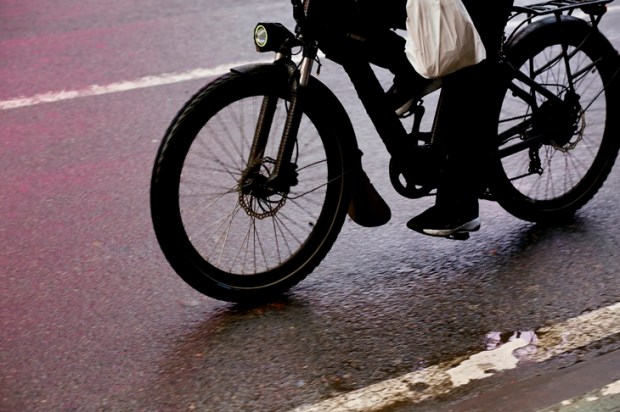
To guide the whole culling process, I aimed to reduce my personal things to just a bicycle and a USB stick, the latter being the means with which I would save every paper document I needed in the form of a scanned image.
Once this vision was set, I went about dramatic culling, exceeding other simplification strategies such as those proffered by Japanese organisation guru, Marie Kondo. She advises people to keep only the things that are useful and spark joy.
It was through implementing the principle of eliminating everything other than a bike and USB which resulted in mistakes. I discarded things that I needed to purchase again shortly after and I lost sentimental items which I now regret.
A lot of people struggle to get rid of books. But what was most painful for me was to pass on to neighbours my beautifully engineered woodworking tools, many of which were made by a Canadian company called Veritas, and included sliding bevels, chisels, set squares, fine-toothed saws, mallets, and planes.
Two full weekends were spent scanning all the documents I owned, saving them to a work computer hard drive, and then transferring each image to a single USB thumb drive.
To see all those boxes of old paper reduce to a small piece of plastic was incredibly freeing.
Once I’d released myself from woodworking tools and documents, I was sort of encouraging myself to just go further where I could, to dispose of anything that I came across when walking around, to endow others with this relief. Even with things that strictly belonged to my wife and kids.
I had this notion that they would ultimately appreciate it if I first made some hard simplification choices on their behalf, thinking that before they got into it, they would need an electric shock to jolt their mindset. (I’m now divorced.)
Eventually I realised that my simplification ideas were morphing from bold yet useful, to something more reflecting mania. My own insight came when I caught myself obsessively deliberating over what to do with my second last paper document, my original birth certificate.
I remember pacing the room doing a cost/benefit analysis on whether to shred it, and was conceiving what scenarios might arise in which I would definitely need it.
What opportunities might be lost? Would future grandkids want to hold it?
I was pained at the idea of keeping it as doing so would violate the no-paper principle which I set down at the outset. I’d heard so many examples of people trying to eliminate the ‘stuff’ in their lives, yet they seemed to stumble so early, giving up, and not even able to eliminate a random decorative spoon celebrating Cape Tribulation.
In the end, I stayed true to the simplicity principle and reduced the birth certificate to confetti through the shredder.
Then I turned my attention to the last paper-based document I owned, my passport. I remember finding it galling that there was no escaping the requirement to physically bear it when travelling overseas. How could I get on an international flight?
And how could I prove my identity to anyone, especially since I would no longer have a birth certificate and you sometimes need more than just your plastic NSW driver’s licence?
So, with some pain at breaching the principle, it alone became the surviving piece of paper.
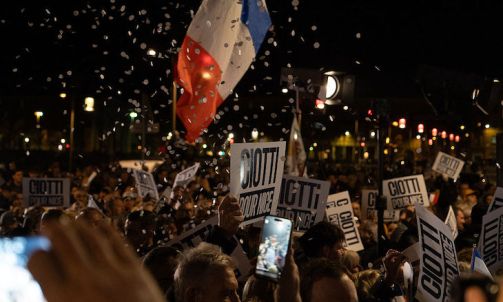
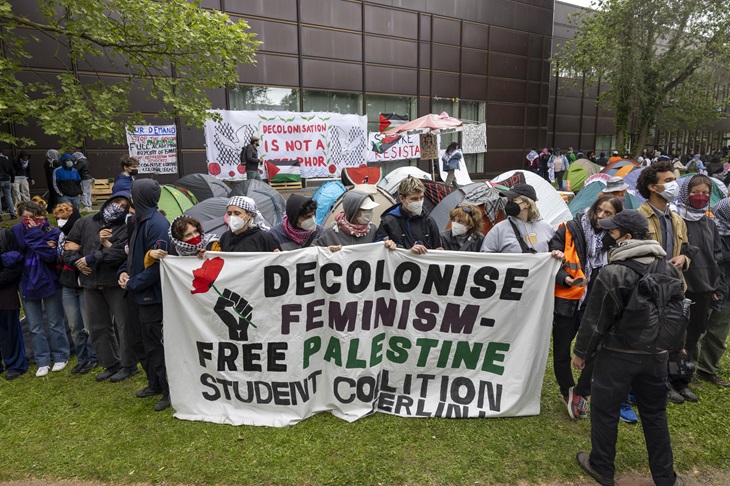
I’ve been thinking of this historic period of personal mania when trying to understand what I’m witnessing with the bizarre pro-Hamas protesters, often disguising their terror support under banners of ‘free Palestine’ or ‘anti-Zionism’ slogans.
‘Queers for Palestine’ is one movement that’s been energised. What contortion of the mind would lead gay people to prefer a Palestinian state ruled by Sharia Law (including rules such as throwing gays off buildings) over secular Israel?
The delusion reminded me of those bizarre Black Lives Matter Riots in the US, where some scenes involved rioters screaming ‘racist pigs’ at police. In one memorable moment, white-skinned rioters hissed racism and spat at a line of police, yet every single officer was black.
Then there are the university administration staff. Apart from enrolling students for courses, is there any greater task for a university administrator than safeguarding the primary goal of a university, that of the inquiry for truth?
And yet the very places that are established to let ideas to be freely expressed, all have instituted policies to offer students safe space refuge from the damage that may occur to them from exposure to ‘unsafe’ ideas, such as that one suggesting at birth you are either male or female.
How do these strange twists manifest? I’m not sure anyone has discovered their source.
Is there some parallel with my own period of mania, when it was that my mind had decided the difference between a simple decluttered life and one that was too complicated, hinged on whether or not my birth certificate should exist in paper form?
At least I reached a moment of clarity when things had gone too far. You get the sense with these pro-Hamas protesters that no amount of crazy thinking will result in self-awareness and appropriately moderated behaviour.
Nick Hossack is a public policy consultant. He is former policy director at the Australian Bankers’ Association and former adviser to Prime Minister John Howard.