In the past 50 years, not much has changed in terms of protests, with a few notable exceptions. Generally speaking, it is still the same upper-middle-class pastime your affluent friends engage in when the skiing trip to Val d’Isère gets cancelled. You show up at the designated time, collect a ‘down with this sort of thing’ sign, and march ritualistically along a state-approved route and start shouting slogans until you get bored or make out with someone. I say this as a former indoctrinated left-wing student who discovered that getting involved in politics was the only way to get to know a girl I liked.
Nonetheless, there has been a shift (or should that be a revolution) in the activism world regarding fashion sense. This, of course, only applies to socially acceptable forms of protest; we can ignore the Canadian truckers with their flannel shirts and mesh caps because they appear to be the ‘wrong’ kind of activism. I might be wrong, but working-class protesters are not normally known for having a sartorial sense of clothing. Call me cynical, but making sure your family has enough to eat is more important than looking good. However, as a result of the pro-Palestinian protests that have taken over the Western world, streets have turned into catwalks and university campuses into the activist equivalent of the Met Gala. Alongside the bike locks and superglue, one thing every aspiring roadside revolutionary must have inside their hand-stitched organic hemp tote bag is a mask.
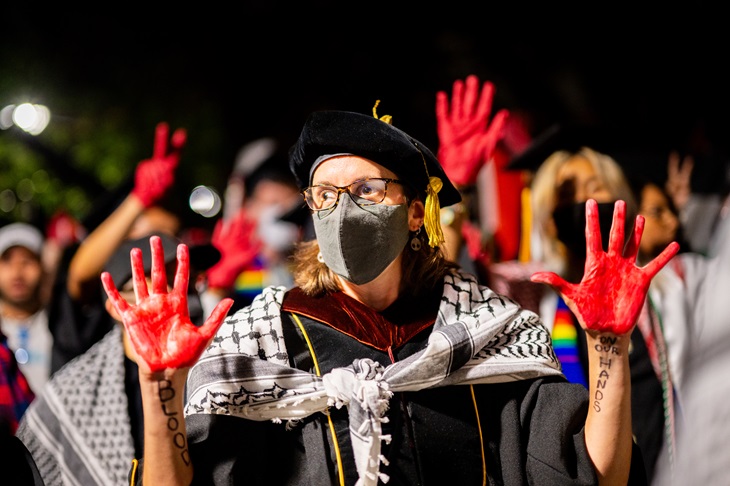
The BBC informs us that the protesters are nonviolent. And for purposes of clarification, I am sure plenty of people who attend these marches are peaceful. But it begs the question: why do so many have black masks covering their faces? Sure, it could be a Covid thing, but for these revolutionaries, fighting oppression in a land 3,000 miles away is more important than getting sick. I’d argue that it looks intimidating and is the perfect way to hide your identity.
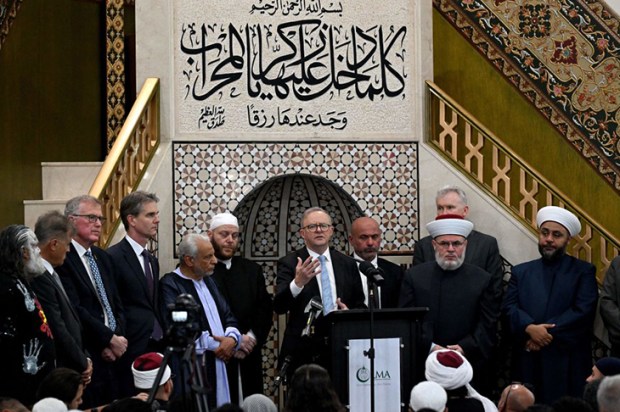
It’s not just masks that seem to be de rigueur at these protests. There’s another far more popular item of clothing draped over the shoulders of the modern activist. It’s the keffiyeh, a traditional Palestinian scarf often worn as a headdress. Spend a few minutes at a protest, and you’ll notice it is being worn by a lot of students – many of whom are white. At the weekend, Greta Thunberg was photographed wearing one while being led away by two Swedish police officers after protesting Israel’s inclusion in the Eurovision Song Contest.
Have we forgotten the sin of cultural appropriation? We were told that wearing the traditional clothing of other ethnic groups is offensive and racist. It wasn’t that long ago when the right-on howled in indignation against white men with their hair in cornrows or white women dressed in kimonos. In 2015, for example, the students’ union at my local university declared that it was insensitive to wear a sombrero. A few years later, the University of Kent declared it unacceptable to dress as a Native American.
How things change. Now it is perfectly acceptable for white Westerners to sport Arab attire, just as long as the activist is adhering to the right cause – in this case, their hatred of Israel.
It’s easy to see why they do it. Masks and keffiyehs are radical chic. The cause is fashionable. In addition to progressive activism’s ad hoc nature, it violates the unwritten laws governing social justice ideology. They should notify the rest of us in the future by sending out a press release. When the rules are constantly changing, it is impossible to have a fair fight.