With the Chinese Year of the Dragon soon to dawn, President Xi Jinping will be praying it comes to the rescue of his beleaguered nation. After all, the waning Year of the Rabbit, the sign of good luck, prosperity, and success, delivered anything but.
Indeed, President Xi starts the new year tormented by a dilemma. Whether to follow Vladimir Lenin’s instruction that communism can only ‘fulfil its role if it is organised in a totally centralised fashion, if its iron discipline is as rigorous as that of any army and, if its central organisation has sweeping powers, to allow it to exert uncontested authority…’ or, reintroduce the reforms of paramount leader Deng Xiaoping, which decentralised the state economy by replacing central planning with market forces, breaking up collective farms and state-run enterprises, and allowing businesses to pursue their own objectives and methods.
Over 40 years, Deng’s reforms lifted nearly 800 million Chinese out of poverty. However, Deng also set China’s entrepreneurial class on a fateful collision course with the Party’s leadership. Growing prosperity diminished the Party’s importance and market solutions clashed with central planning. So in 2013, Communist party leaders turned to princeling and Marxist-Leninist Xi Jinping for survival.
Faithful to the communist doctrine, Xi quickly consolidated his authority. Through multiple purges, he made it clear that no one was safe.
He stepped up his campaign to curtail the rapidly growing influence of the country’s biggest corporations. His ruthless ‘anti-corruption’ drive saw more than two million officials and business leaders punished. A risk-averse, innovation-stifling, ‘must please Beijing’ culture followed.
Xi introduced a social credit system to govern people’s behaviour. For three years he used Covid and ever-oppressive lockdowns to remind people of the need for obedience. A crippled economy and 1.41 million deaths later, the public concluded it was all for nothing. Soon, the increasing number of plant closures and growing ranks of unpaid workers turned puzzlement into anger.
Most worrying for Xi, is China’s ageing population. Indeed, in 2022, the nation’s population actually declined. This is a direct legacy of the one-child experiment. Recent shifts to a two and, now, a three-child policy, have had no effect. Birth rates are at 1950 levels.
It’s hardly surprising. With youth unemployment believed to be approaching 30 per cent, (Beijing stopped releasing numbers last August after the figure reached 21.3 per cent), rising living costs, not to mention a male-dominated gender gap, kids aren’t having kids.
Another worry is the fallout from China’s property meltdown. State-backed real estate companies contributed to a property bubble that built some 50 million empty dwellings. Local governments helped fuel the speculation to the point that real estate and property development accounted for 31 per cent of China’s economy. Now, a potentially lethal $12.5 trillion of debt is held by banks and local government financing vehicles, secured by properties that are rapidly declining in value. At 360 per cent of GDP, China’s debt load has reached crisis proportions.
But ineptitude, corruption, and capital misallocations were not confined to property. Central planning failure has seen massive over-investment in vanity projects like under-utilised air and sea ports, empty expressways, and bridges to nowhere.
The cement and steel industries have benefited but are now saddled with significant excess capacity and squeezed margins.
For the moment, opposition remains mainly silent and underground. Public protests can lead to long prison terms. Social media is heavily censored, with political approval required for public commentary. Community activities and social groups are strictly regulated and monitored by authorities.
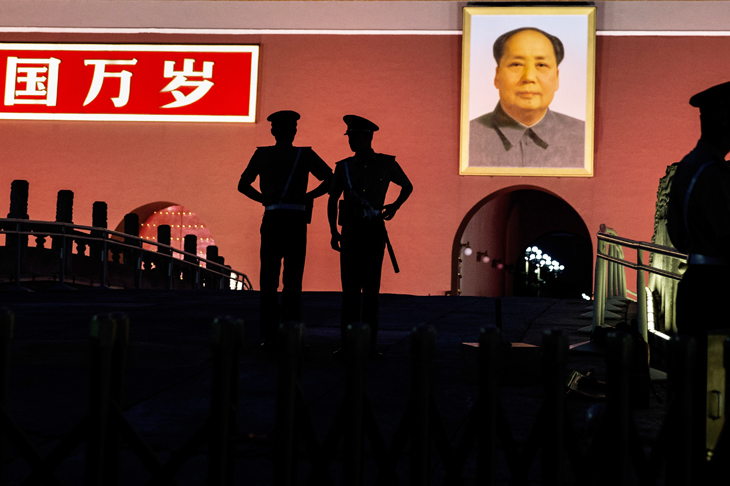
In a speech to mark 130 years since Mao Zedong’s birth, Xi signalled that he would continue to follow Lenin not Deng using poetic licence when he said that the late leader was a ‘spiritual treasure’ and that, ‘Mao devoted his life to achieving national prosperity, rejuvenating the Chinese nation, and promoting people’s well-being.’ In so saying, Xi airbrushed from history Mao’s catastrophic Great Leap Forward, which led to the loss of some 40 million lives, and Deng Xiaoping’s capitalist reforms, which actually did achieve relative prosperity.
Xi talked about ‘Chinese modernisation’, which the People’s Daily interpreted as containing unique features including ‘common prosperity’ and peaceful development. Yet, after a decade at the helm, Xi has delivered neither. His economic directives have slowed growth and destroyed wealth and, rather than being peaceful, he has been overbearing at home and abroad.
The upshot of his meddling is that globally China is no longer seen as a commercial world-beater. When it comes to supply chains, business is turning increasingly to places like India. Conspicuously, Italy, the only G7 member to join Beijing’s Belt and Road Initiative, has quit. This decision signals a hardening of European attitudes to China and its global ambitions. This prompted a scarcely veiled threat to anyone contemplating the ‘smearing and undermining of co-operation on the joint construction of the Belt and Road’.
Once again, we are witnessing the fatal conceit of central planning. It is reminiscent of the Soviet Union before its ultimate collapse. Then, useful idiot intellectuals and journalists were widely tipping Moscow would soon overtake Washington for global supremacy. Relying on an arrogant belief in the superiority of elitist rule and a loathing of genuine liberal democracies, they ignored the reality around them choosing hope over experience.
So it is with today’s delusional commentary on China. What is different now is that the West is well down the socialist road itself. Leftist activists have successfully pushed identity politics and created division. They have undermined free market capitalism by promoting bigger government and cronyism. Ironically, widening wealth gaps and slower growth have made central planning seem more appealing.
Lenin was right. The survival of the communist state depends on the world embracing communism. With China facing potentially insurmountable problems and growing unrest at home, and Western resilience weakened, a desperate Xi will stop at nothing to achieve global hegemony. As Winston Churchill astutely observed, ‘Even a cornered rat is dangerous.’
Got something to add? Join the discussion and comment below.
You might disagree with half of it, but you’ll enjoy reading all of it. Try your first month for free, then just $2 a week for the remainder of your first year.