Wide awake at 3 am, in submission to the gods of jet lag, seemed an apt moment to jot down first impressions of a few days in Buenos Aires, attendant as I was for the inauguration – ‘incuncion’ – of Argentina’s newly minted radical libertarian President Javier Milei.
I am carrying the bags of the Libertarian Party MP in the NSW Parliament, Hon John Ruddick, MLC, whose question without notice to the Hon Daniel Mookhey, MLC, ‘Is the NSW Treasury following the anarcho-capitalist experiment in Argentina?’ was followed by supplementary advice on the pregnant potential of Milei’s bold ideas for the NSW economy, concluding:
It’s no longer ‘don’t cry for me’, it’s now ‘inspire me, Argentina!’
While the Treasurer gave a respectful and surprisingly well-informed response (he is easily the best performer in the NSW Labor government), ripples in another pond directed our path. The question was somehow picked up and replayed on a Buenos Aires nightly TV bulletin and from there reached half a million on social media.
Following the iron law of numbers in politics, or perhaps touched by a fan down under, this chance incident elicited a personal invite for Ruddick to attend the inauguration but not dropping until 7 pm Thursday December 7, 2023, for a ceremony on Sunday the 10th.
Could it be done so fast?
As the Libertarian Party’s NSW President, it seemed a clear matter of duty to join our MP as witness and aide de camp to the historic occasion – completely selfless on my part as usual.
With only the gentlest nudge to Foreign Minister (Chancellor) Diana Mondino to produce a +1 invite, instilling in Ruddick et moi the grand illusion of men from the East, called by a star to a birth, not in Bethlehem, but Bueno Aires. With the standard alacrity and skill of our The Australian Libertarian Party’s national secretary, Jordan Ditloff, less than two hours after Ruddick’s invitation arrived, we found in our Signal chat, booked flights, itinerary, and hotel reservations. Wheels-up 15 hours later for a week in Argentina…
The first hop Sydney to Santiago (no direct flights), spans the Earth’s largest ocean, 14 hours non-stop, at 900 kilometres an hour, against the planet’s rotation, but with the prevailing wind, climbing 11 kilometres to thin air, minus 46 degrees C, the vastness of the ocean eclipsed only by the 4,200,000,000 cubic km volume of Earth’s atmosphere, revealing the child-like vanity of belief that humans control our planet’s temperature.
On arrival, we found the connecting flight to Buenos Aires had vanished, thankfully before take off not after, which forced a delay and diversion via São Paulo, Brazil, meaning three Latin countries on one day and a 36-hour journey door-to-door. We solicited the cab driver’s view on his country’s new leader. Sporting plaintive ignorance of each other’s only language, he still gave a clear and concise view, beginning with the thumbs down. ‘Extremo. Poor will be poorer, rich richer. Prices up half in one week.’ The driver is an omen of the task faced by Milei, who may have received the ‘hospital pass’ in rugby – a shared passion of our two countries – where the outside centre catches the ball at the very moment of impact with a prop forward at speed. The falls he must climb are steep, high, hard, and wet, with danger on all sides, above and below, like Father Gabriel from the film The Mission.
1880 Argentina was the world’s sixth richest country per capita, today its 8 million private sector workers must feed themselves, their families, and 20 million public servants, retired pensioners, and 7 per cent jobless. That ratio is the Gordian Knot, the diabolical trap into which the nation has fallen. With fertility below replacement, the few young professionals of talent and ambition tend to leave in search of a better deal, sharpening the fiscal pincer for those who remain on a minimum wage of AU$ 510.65 per month. 40 per cent of the country lives in poverty, and like the sans culottes of the French Revolution, the Argentine descamisados (without shirts) have raised a curious eyebrow to the crazy anarcho-capitalist – something different at least, their plight can’t be much worse.
One does not win a Noble Prize for insight to observe Buenos Aires as a mix of charm and malaise. There is much to love. Bertrand Russell’s The Problem of China says the crimes and misdemeanours of a foreign place always strike one more vividly than domestic sins, to which we are inured by habit and familiarity. One’s first impression of Buenos Aires is the grandeur and elegance of the many old buildings, both commercial and civic, whose French, Italian, Spanish, and English architects, at the top of their game in the late 19th Century and first half of the 20th Century, wrought art in stone, with Greek friezes, Corinthian columns, elaborate and intricate masonry and mosaic tiled floors, speaking the eloquence of abundant productive surplus. In the next moment, we are engulfed in a cloud of seeing and knowing the period of plenty is past. The relaxed throngs on broad streets are likewise ageing and, not unlike we tourists, in general disrepair. The post-Covid ubiquity of Lululemon and Sweaty Betty, in Australian streets and malls, is entirely absent in Buenos Aires, perhaps a quaint remnant of Roman Catholic modesty that prefers to retain a little mystery around the shape of a lady’s bum crack.
Beneath the grand colonnades, in front of imposing brass and iron doors, we find the office worker dragging on a Marlboro at 10 cents a stick, shockingly, without the benefit of graphic health warnings from Australia’s then Health Minister, Nanny Nicola Roxon. Not far away is the homeless man or woman, (hard to say with the grinding elements of indigence and addiction), asleep or comatose under a blanket of newspaper, cardboard, and hessian bags. The rough sleepers are not yet everywhere, like the more progressive Democrat cities of Los Angeles, Chicago, and New York, but with a frequency that needs a bit of getting used to for an innocent Australian who takes a wild guess that the cobbled rock pavement of a CBD street is not well designed as a mattress. The grand stone buildings hold more than a hint of mockery, as if to announce a verdict from ancestors who built an El Dorado – their less virile and entrepreneurial descendants inherit, but cannot upkeep… Glancing through an open door we find a jaded security guard behind an unlit desk, trudging to work each day, grateful for a minimum wage, hoping nothing will happen and, it would seem, his hopes are mostly fulfilled. A strangely seductive shop filled with antique locks and big brass keys, is not without function and custom, as an anxious waitress later attracts my gaze, points her middle and index fingers to her own eyes and then at my iPhone, left carelessly on an alfresco table.
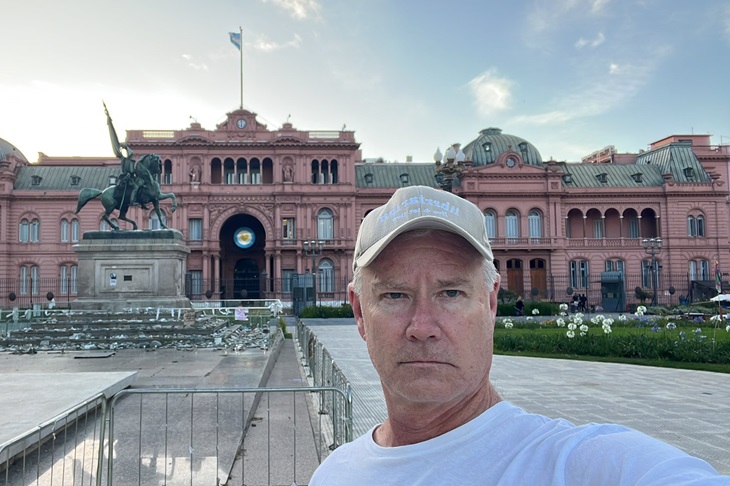
Dawn at the Casa Rosada (the pink house). New global HQ of #Libertarians. #Milei@libertariansNSW pic.twitter.com/kBnm8ceuj1
— Ross Cameron (@RossCameron4) December 9, 2023
Yet the kiosk operators, barmen, currency traders, taxi drivers, even gypsy-like street vendors, were unfailingly honest, indeed generous to a fault in their dealings with Ruddick and me. One taxi driver who got lost and delayed our arrival at a scheduled meeting with the famous Grover Norquist, Washington political mover and shaker also here to witness the birth, insisted we pay him nothing at all for fare, a negotiating position that required some effort to dislodge.
Buenos Aires reminds one at times of the older retired lawyer, shambling a bit stooped on a cane, but with an inner rectitude, on streets he once strode, to a monthly lunch at the club, arthritic and shrunken with age, now swallowed in a suit too big but whose straightened budget prevents its replacement. He is still possessed of wit and memory, keen for a reason to take part, despite the growing cost and hardship, to fight mortality as a decent man should. In a metropolis of 3 million, and a state of 13 million, everything is there but nothing seems to work quite properly.
After securing guests for my (amazing) weekly radio show, I cancel the broadcast for want of a solid broadband connection from my city hotel. The suite is welcoming enough but the one power socket is placed by the door – none by the bedside – so we move from the bed to the wall and back on rotation to keep the phone and laptop fed, signal dropping in and out, like some crazed addict, desperate to retrieve a draft email, with spectres of a future dystopia when we will all stare out of windows, yelling at the clouds to break or the wind to blow, to reboot a lifeless device. Burger King – not unreasonably – the only joint open for a 2 am feed – will sell you a burger and Coke but no ice, no straw, and no fizz. Back at the hotel bar, Pablo will cheerfully serve up a Campari spritz with flat champagne. Perhaps we must all prepare for a life without fizz until a truce is declared in the war on carbon dioxide, in which good cause Javier Milei has announced Argentina’s planned evacuation from the Paris Climate Cash Racket.
One of the great strengths of Argentina is cheap, plentiful fresh food from the vast tracts of rich soil under cultivation, laid out like a game of Tetris from 30,000 feet. We dined the first night on the Paso del Bajo, the Darling Harbour of Buenos Aires, with a broker mate of Ruddick’s who married an Argentine and returned with her, and now, four kids, to a gated community an hour from the CBD. Our host suggests a cocktail, ‘It’ll set you back US five bucks…’ before spelling out the sumptuous array of steak options, with a helpful chart on the menu showing from which quarter, joint or rib the noble beast gave up its flesh. Their choice to migrate was based in part on a currency and cost of living arbitrage. He runs a thriving financial planning shop in Australia, with the back office in Ukraine.
‘Industry regulation used to require an in-person meeting to sell financial advice but Covid killed all that. Now I earn my coin in Aussie dollars and spend it in pesos. My wife and I can go out for dinner once a week, to a restaurant like this, with parking, three courses, a nice bottle of wine and a babysitter for less than US$70.’
There are secrets to treating with the fast-eroding currency that expats understand. A golfer playing 18 holes buys lunch before hitting off and eats on return. Never book the hotel room yourselves – there is a rate for locals and a rate for tourists. Likewise, never use your Australian credit card if you can avoid it – pay in cash with pesos. There is no ‘mortgage’ market in Argentina, since no bank will lend a million pesos, knowing the receivables will shortly dive in value. Likewise, almost it is impossible to persuade a foreign investor to risk capital if he knows, whatever he pays for the stake, will be worth some fraction the next day, regardless of the asset’s performance.
The cobbled streets and shaded lanes give up their secrets over a languid stroll, like the Historia Literatura Antiguos, on the corner of Bolivar and Adolfo Alsin, whose wizened keeper greets an English speaker with a desultory wave towards marble stairs and wrought iron bannister leading to the foreign language section below. Older Argentines still bear a grudge against the English over the Falklands War, which makes it all the more daring and eccentric that Milei would name one of his five English Bulldogs ‘Margaret’ after the Baroness, out of respect for the Iron Lady’s economic reforms. Some titles slouch perpendicular against others horizontal, as if too tired to stand, amidst the pleasing universal scent of old books, gently spiced with an open pot of glue, being brushed to the spine of some rare tome by a loving curator. I pick up The Hundred Best English Essays, 1929, edited by the Earl of Birkenhead, PC DL, which falls open at the Creation of Matter by Sir Issac Newton, and lose myself in, I guess, the greatest mind since Aristotle, before heading back upstairs with my treasure and its companion, The 500 Best English Letters, in hardback with original dust covers for the princely sum of AU$12. I step back onto the street, not lost to the irony of an Australian in Buenos Aires buying English books, feeling some shame at the worlds lost to every monolinguist, admiring Sigmund Freud, who learned Spanish for the pleasure of reading Don Quixote in the original sonorous syllables of Miguel de Cervantes.
It is nice to find a more natural and relaxed relationship between the sexes, so unlike our own, which insists the correct form of address by any femme to a male is the accusative. President Kennedy introduced himself to France at the Hall of Mirrors, Versailles, in 1961, as ‘…the man who accompanied Jacqueline Kennedy to Paris’ and it might be said of Juan Dominique Peron, that he accompanied Evita to the presidency but there is a growing awareness that Peronist collectivism – making every Argentine responsible for everything, but no one responsible for anything – is the central disaster of modern Argentina. The ritual sacrifice of Luis Rubiales, President of the Spanish Football Federation, for one exuberant but unasked kiss to his team’s winning captain, suggests Latin America is not far behind, and may look forward to the great dividend of #MeToo, millions of women returning unloved from jobs they hate to small, sterile apartments, which is problematic for Milei, as for every Western nation, in desperate need of youthful taxpayers. Likewise absent is the new plaything of the progressive class, the obsession with race – in a place where 52 per cent carry the gene of an indigenous ancestor, 2 per cent ‘identify’ as indigenous.
Into this mix of mess and moment, strides the magnetic, eccentric, crude libertarian, Javier Milei, whose first credential is a granite-like belief he can turn the ship around, synchronise the Argentine shamble to his own fast pace, return the element of spontaneity that stops his motorcade to console a lost dog. That conviction is proving contagious, especially among young Argentines, who have bet in their millions on an outsider anarcho non-politician, for many, it feels, as the last roll of dice on their country. He bears the great asset for a retail politician, of a shock of hair as densely plied as the Egyptian linen on the bed of King Charles III – resplendent side burns suggest a 70s porn star.
It is hard to find the right adjective to describe Milei.
His critics may choose others but this libertarian fanboy sees a searingly frank, lucid, emphatic, erudite, comedic, fearless, theatric, crash or crash-through natural leader. His slim chance of success is bolstered by a first miracle of election. Milei stunned Latin America and, if not for the studied silence of our Statist media dollies, would have shocked the world, with an out-of-nowhere win in the final presidential run off, hauling 55.95 per cent over the line – a figure emblazoned on tee shirts in the style of Che Guevara – ironic, since no leader could more detest Marxism. Milei refers to Pope Francis as ‘a f-ing communist’, inline with his rather clinical advice to critics, ‘You can shove the State up your arse.’
The outlines of ‘Mileism’ cannot really be drawn without sibling DNA – the sister Karina, who seems the wave to his particle, as if one soul may reside in two bodies at one time. As much as he is loud, conspicuous, theatric, impulsive, she is mute, elusive, restrained, and strategic – they say, just as brilliant, more pragmatic, Karina is a sounding board, alter ego and brains trust of the movement. Karina is credited with weaving the varied strands of a centre-right coalition that parlayed four seats of the fledgling La Libertard Avanza (Freedom Advances), into a 40 per cent opposition voting block in the National Congress. Still, her brother will lead a minority government reliant on persuasion, skill, and diplomacy for every vote. Their first challenge is to hold the ground so recently won, to cement the coalition will be hard enough and then like Oliver Twist to ask for a second miracle, to lift its ranks to a working majority in the congressional elections in two year’s time. Liberty sprint towards that landmark, a mere 24 months, since a sharp reversal at that time could easily bring the whole dream to an end.
Close observer and ESEADE University economics professor Ivan Cachanosky, says that like George Washington, his defining personality trait is that ‘Javier cannot lie’. This is part of what makes him so strange and fresh, in a country where leaders and voters have tacitly agreed, since the Peron blunder, the country’s problems can’t be solved, so each party has engaged in different versions of the lie that they intend to solve anything, while arguing in reality, over speed of decline and who will bear the hardest hits of inflation, deficit, new taxes and in what sequence the surrender should take place. Milei’s acceptance speech, like his campaign, is a new language of unflinching honesty. ‘There is no money.’
But having sworn to cut off his arm before raising taxes, the edict of his Economics Minister on day two of the administration does include a 2.5 per cent contribution to savings from new taxes, including restoring a credit card transaction charge the Argentine Taxpayers Association, the beleaguered Contribuentes, had fought hard to repeal – while Javier’s arm remains attached. He has sworn to remove Argentina from the Paris Climate Accord but replacing one climate envoy with another, seems to be in no rush. The experiment is a race against time, a test of the patience of the South American temperament. Can the wearied masses bear even the first increase in pain all parties agree must come before any hope that Theseus can attempt to slay the beast of inflation? Can his coalition hold under the strain of ‘100 years of mistakes by the political class’?
Hesiod says the Muses ordained him their poet in a dream:
‘So said the ready-voiced daughters of great Zeus, and they plucked and gave me a rod, a shoot of sturdy laurel, a marvellous thing, and breathed into me a divine voice to celebrate things that shall be and things that were aforetime; and they bade me sing of the race of the blessed gods…’
Margaret Thatcher quoted Chatham, ‘I know that I can save this country and no one else can.’ Milei speaks of an experience of communion in which God revealed his destiny to lead Argentina. Like Father Gabriel in The Mission, climbing The Falls to the notes of Ennio Morricone, Javier Milei is on a spiritual quest. He calls on Argentina to ‘leap into the void’ while assuring, ‘light prevails over darkness’.
Waiting in line with Ruddick and a group of Brazilian MPs to greet the ethereal Chancellor Diana, her feet seem barely to touch the ground, she smiles, ‘Welcome! You have come a long way.’ Then as she is whisked away to a thousand guests at the international reception, turns and hands us each a message, embroidered on a baseball cap, LAS FUERZAS DEL CIELO (‘The Forces of Heaven’).
My taxi driver on the return airport journey was the mirror of his colleague on arrival. Carlos was ‘how you say, retired’, as a company auditor, now driving five or six days a week to make up the gap between what his pension was worth yesterday and what it will buy today. He is learned, reflective, informed, giving me the sequence of migration waves by source from 1880, noting the close parallels between the Australian and Argentine economies until the 1930s. He is proud of the Argentine invention of the ballpoint pen, the heart bypass, surround sound, singing the praises of the regions, ‘I travel at home’, the places he has stayed and wants me to explore.
Approaching the terminal I ask, ‘And what do you make of Milei?’
Carlos gives a silent nod, as if in confession. ‘We know something must change. Argentines will be patient, will give him some time. There will be pain, we don’t know how much, how long we can last. There must be something between what a man says and what he does. That is what Milei brings.’