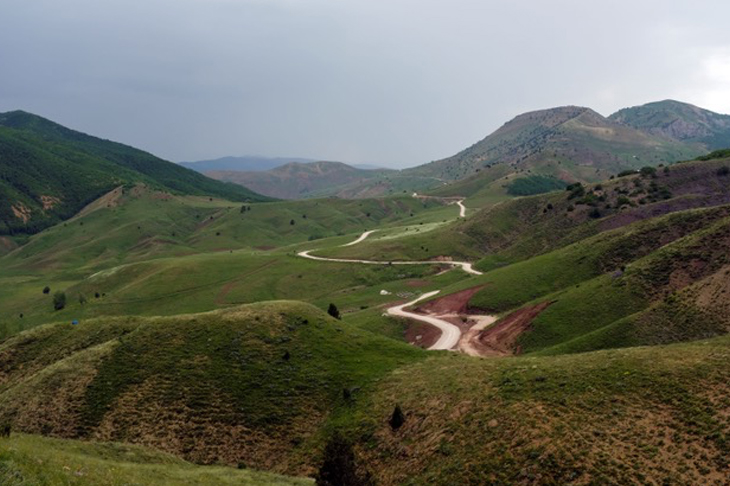
Western Turkey has experienced crustal stretching resulting in the sliding down of uplifted basement blocks. Continued stretching has produced a series of seven flat-bottomed graben valleys separated by rugged mountains of older basement rock.
The graben contain a great thickness of water-worn sediment and braided streams that are continually changing course. The valleys are the agricultural heart of western Turkey and produce fruit, wine, grain and nuts. The edges of the graben are active faults characterised by frequent earthquakes, geysers, hot springs and boiling mud pools. Sulphurous gases fill the air. The valley walls are rocky, steep and forested. The hills and thyme-covered slopes are grazed by sheep that provide milk, yoghurt, cheese and Işkender kebab, all with a distinct thyme taste.
Hot sulphur-rich geothermal fluids can carry large amounts of metals in solution, most commonly gold, antimony, arsenic and mercury. If these fluids are suddenly boiled or chemically react with limestone, coal or salts, then a gold deposit may form.
I was attracted to these graben because, in the long ago in this area, King Croesus built a fabulously wealthy empire based on gold. Ruins of his city of Sardis were nearby. The King’s gold derived from the alluvial sediments on the floor of the graben and sluicing kept thousands of slaves employed, fed and watered. In those times, rainfall and temperature were higher than now and there was more water for sluicing. There was presumably little gold left in the valleys as slave power was cheap and efficient. In relative terms, the price of gold has not changed. A troy ounce of gold for the last few thousand years is still worth a week of a carpenter’s time.
After investigation, it became clear that the gold derived from dissected terraces of older partially consolidated gravels draped half-way up the walls of the graben. These gravels were once flat lying sediments on the valley floor, now they are steeply tilted well above the valley floor as a result of very rapid land rise.
In some areas, the land rises and falls very quickly. On the southern coast of Turkey, subsidence has drowned the ancient city of Lydia. It’s now a few metres underwater. The Roman port city of Efeses is 15 kilometres inland as a result of uplift. There can be no understanding of sea-level change without an understanding of land-level changes, which can be very rapid. If someone claims that sea level is rising, ask whether the land level rise or fall has been used in the calculations and why sea-level change is not the same worldwide.
The alluvial gold mined by King Croesus undoubtedly came from the hills. But which hills? Boulders in the gravel showed where to look for the primary gold sources. They were fractured cooked up limestones perched high above the valley floor at the boundary between the graben and the basement rocks. It was here that hot acid gold-bearing fluids chemically reacted with limestone and precipitated gold. This gold is normally invisible and grows into larger grains in alluvial sediments.
I climbed up donkey tracks to the part of the scarp I thought was shedding gold into the valley during aeons of uplift, weathering and erosion. I was wrong. However, I found old pits, abandoned crushers, an inoperative mercury distillation plant and large dumps of waste that had been roasted. Mercury is used to recover fine gold as an amalgam during gold mining and it is used to trigger explosions. Mercury in nature can be a gold-mercury amalgam. A village had been built on the area flattened out by the old mercury mining and distillation activities. For centuries the village was able to feed itself from employment in the mercury mines. The village probably provided the mercury for the shells during the Turkish defence of Gallipoli.
The village dwellings were made of mercury-bearing stone. The tracks were cobbled with roaster tailings and the village water well was an old shaft. It would have cost a few thousand dollars for a new well and a one-kilometre-long poly pipe distant from the mercury mines to take non-toxic water to the village. This was money the village didn’t have. It had its normal quota of ferocious-looking cowardly wolf dogs, elderly men sitting in the sun, old humped women carrying the firewood and doing the heavy work, deep mud and dung, and goat and sheep pens constructed from sticks and stones.
I sought an interview with the village mufti to explain why I’m in the area. After the necessary niceties, the village mufti instructed a boy, no older than eight years old, to be my guide. No guide was necessary as I was looking at rocks in a five kilometre radius around the village but my arrival presented a commercial opportunity for the village.
My guide was a charming kid. He was a typical village boy with a shaved head, ear-to-ear smile, ill-fitting mud-caked hand-me-downs and plastic shoes with no socks. He knew every one of the old mercury mines in his playground and proudly took me to every old shaft, pit, costean, ore dump and prominent outcrop.
My guide had severe brain damage, typical of congenital mercury poisoning. He was constantly shaking, had slurred unintelligible speech, deformed digits and ears, and constant salivation. He showed passing interest in my maps, compass and GPS and was absolutely fascinated with my geology pick. He would keenly watch how I would select partially silicified limestones, break off a number of chips, write in my notebook, place these rock specimens in a cloth sample bag and label the bag with an ink pen.
He indicated that he would like to collect my samples for me. I gave him my pick and, after attacking every rock within sight, I managed to coerce him into sampling only the rocks which I considered were of geological interest. This resulted in collection of far too many samples and, as it transpired from later chemical analyses, they were of no interest. This is not unusual in mineral exploration.
Some of the mountain streams had long tapering ice crystals that had grown from the banks to the centre of the stream. Water flowed along the centre of the stream. Because I had often seen the same texture in quartz veins which formed from silica-saturated hot fluids flowing up fractures in rocks, I took a number of photographs.
My little guide then took me to every icicle, every ice waterfall, every ice-laden stream and indicated that these sites were far better for photography. All I wanted was one photograph of an analogue of a quartz vein for teaching but he thought I was interested in photographing ice. I shared my lunch with this lovely kid next to an ice-laden stream in the sun and out of the wind. He beamed when I took his photograph.
When back at the village, I paid the mufti for the boy’s services and gave my little guide some money. Custom required me to have çay with the mufti and senior village men using mercury-contaminated water. Boiling water to make tea does not get rid of mercury. Upon my departure after just one very small glass of tea, I asked the mufti to find my guide. I gave him my geology pick as a present which he took with a high-pitched yelp of joy and ran down the village donkey track swinging my pick around his head. He was happy.
The village will continue to look after my little mate for the duration of his shortened life.
Got something to add? Join the discussion and comment below.
You might disagree with half of it, but you’ll enjoy reading all of it. Try your first month for free, then just $2 a week for the remainder of your first year.