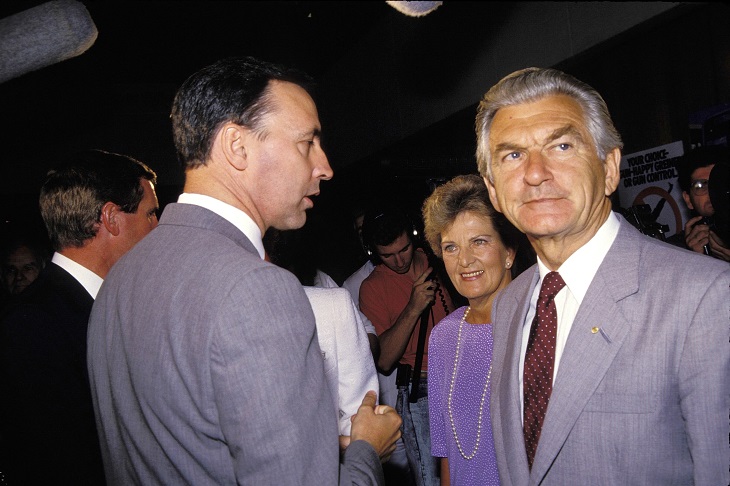
When Bob Hawke died, I received a phone call from an old family friend who jokingly reminded me to put in a claim on Hawke’s estate.
My maternal grandparents owned a hotel in Melbourne’s Lygon Street, in the suburb of Carleton in the 1970s. Each weekday afternoon it filled up with men wanting to sink as much beer as they could.
It was quite close to the headquarters of the Australian Council of Trade Unions (ACTU), so it was a regular haunt for them, including their infamous president, Robert Hawke.
They had a darts board at the hotel, and even though there could be well over one hundred beer drinkers scattered through the bar area, when Hawke took his turn at the target, the whole place would go quiet. He was a reasonable player apparently, but it was more the sheer intensity of his concentration that everyone felt and which immediately hushed the crowd.
Bob’s pre-politics drinking is well known and documented, and it was people like my small business grandparents who were at the pointy end of it. One afternoon, after many beers, Bob couldn’t be bothered trudging all the way to the bathroom and instead just stepped into a corner and unzipped his pants.
The carpet was replaced as soon as possible and the bill was sent to the ACTU, but the payment remains outstanding. Still, after so many years, I didn’t think it fair to make a claim on Bob’s family for our ex-Prime Minister’s larrikin moment.
It is not really clear why larrikin behaviour such as that practiced by Hawke has all but vanished in Australian life, let alone stopped being celebrated as quintessentially Australian culture.
It is speculated that interest in test cricket has been revived after the latest Ashes series in England where Australia retained the urn, but a fair assessment is that England was the better side.
Three factors seem to account for this renewed interest. The first is that controversial stumping of Bairstow, a legal but embarrassing low, but an incident making its way into the banter of respective Prime Ministers, with Rishi Sunak telling us he had forgotten to bring his sandpaper.
The second factor was the rain, which shattered England’s chances in the fourth test. It seemed so apt and ironic that miserable, English weather should be the decisive factor in the series.
But by far the most important factor was the incident of the pasty-faced drunks of the Marylebone Cricket Club (MCC) who chanted ‘cheats’ when the Australian players were walking through the Long Room.
All the serious media commentators were outraged over that incident, and there was, of course, the typical overreaction by cricket authorities. The Australian delegation made official complaints; then the MCC chairman suspended three members and introduced new safety protocols, such as expanding the roped-off area where players walk through to get to the dressing room.
This event caused me to go back and read some history of misbehaviour, which in turn led me to the colourful past of the notorious Bay 13 at the Southern end of the Melbourne Cricket Ground (MCG), now part of the Shane Warne Stand.
Bay 13 was notorious for its drunken larrikin mob behaviour. The crowd there had a hatred of the MCG members’ stand, as the suited spectators at the opposite end would not participate in Mexican waves or partake in the crowd bouncing of beach balls. Bay 13 was known for mimicking the Merv Hughes stretches when he was warming up to bowl.
On one ‘boiling’ hot day of cricket, the Bay 13 crowd came alive when a hot-looking woman stood up to leave her seat. She was slim, and had skimpy, high-cut jean shorts. Her looks knowingly attracted collective attention.
But a drunk male in the crowd saw an opportunity for stardom, and managed to steal some of this crowd’s attention. What ensued was a tit-for-tat strip competition.
To regain the audience, the woman removed her singlet. In response, the male took off his shirt, revealing layers of white fat flesh.
Then the woman then upped the ante, taking off her shorts, which then made the bloke take off his. Both were now in their underwear. After the briefest of pauses, the woman made the decisive move – she took off her bra.
The crowd went crazy. At that point, the police descended and escorted her from the stadium.
In another Bay 13 folklore incident, a large overweight woman had smuggled into the ground a lot of longneck beer bottles. When she rose from her seat, the blokes in Bay 13 would stand up solemnly and spread their arms out horizontally from their body, like Jesus on the cross. This is the cricket umpire’s action to signal a ‘wide’.
The crowd was applying this gesture whenever the large woman rose from her seat.
A favourite son of Bay 13, when fielding at third man down on the boundary, observed a large woman. When he saw her get up out of her seat, he turned around and, playing to the crowd, signalled a wide. At first, the woman went along with the joke. Yet as she drank more, her mood darkened, and soon enough, she responded by pegging empty longnecks at the yobos in Bay 13. Once again, the police descended, grabbed her, and escorted her from the ground.
These old classic Australian sporting scenes have now been stamped out in the new era of hypersensitivity.
Crowds now are closely monitored and tactics are used to keep everyone passive and safe.
The character of Bay 13 was ruined in 2008, when the area was redesigned, with restrictions imposed on general admission. In 2019, a new concept known as Boundary Social was introduced, charging spectators high ticket prices in return for access to gourmet foods and other so-called benefits.
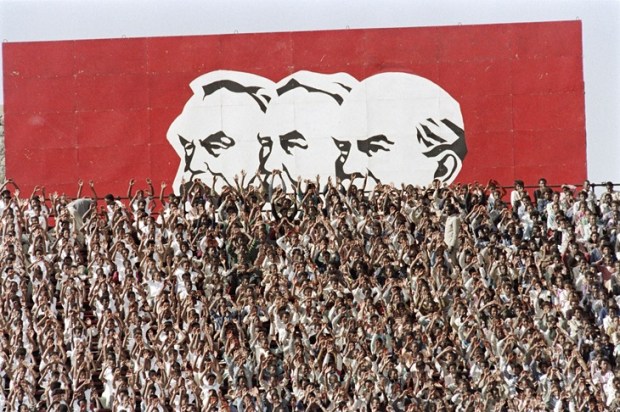
It has all been done to make things ‘family friendly’, ‘safe’, and ‘respectful’. We’re all now in effect controlled as if we were good, little well-behaved Chinese citizens, fearing the underhand secret tactics of officials in the Communist Party.
How strange it is that the only larrikin colour in cricket these days comes not from those in ‘general admission’ but from the brattish private member drunks, in the rarefied rooms of the Marylebone Cricket Club.
Nick Hossack is a public policy consultant. He is former policy director at the Australian Bankers’ Association and former adviser to Prime Minister John Howard.