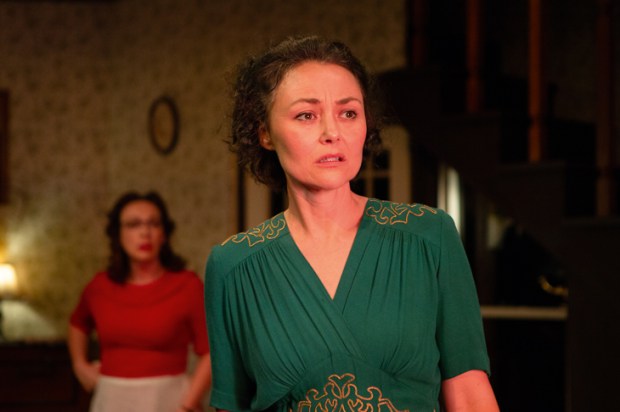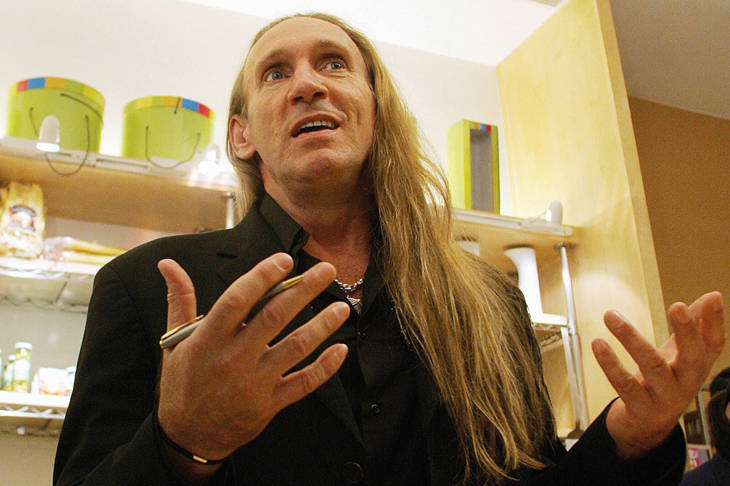
How fascinating it is to see that Australia’s Brendan Cowell is playing John Proctor in the new English National Theatre production of Arthur Miller’s The Crucible, the witch-hunt play Miller produced as a kind of allegory of McCarthyism which is also a powerful historical drama of puritanical persecution in 1690’s Salem, Massachusetts. Partly because of Nick Hytner’s movie, partly because of typecasting, most people probably associate Daniel Day-Lewis with the role though it’s significant that the great experimentalist Ivo van Hove cast Ben Wishaw for all his slightness and spindliness as Proctor in a production that had Saorise Ronan as the wicked hysteria-inducing Abigail (the Winona Ryder role). It was too easy to carp at Brendan Cowell’s Hamlet with the crypto-classical acting voice sliding like a banana skin into Strine. But then there was his play The Sublime which was a magnificent, momentous thing, full of revelation and devastation. And sometime later he gave a fine performance as the husband in the Billie Piper update of Lorca’s Yerma directed by Simon Stone so it’s no longer difficult to imagine Brendan Cowell finding a Proctor – a man of intense and conflicted integrity – inside himself.
Shantaram the novel by Gregory David Roberts has turned the world inside out and it’s fascinating to see that it has finally come out as a streamer with Charlie Hunnam as the escapee hero. The rights to the book have in their time jumped from Russell Crowe to Johnny Depp and at various stages it was to be directed by everybody from Peter Weir –who made everything from Picnic at Hanging Rock through Gallipoli to Master and Commander – to Justin Kurzel whose Nitram (the Martin Bryant film everybody was a bit queasy about seeing) turned out to be a masterpiece of balance and compassion. It’s fascinating to see Hunnam whose career began as the blond beauty of a boy in the epoch-making British series of Queer As Folk and who went on to do Nicholas Nickelby and eventually Sons of Anarchy in the role. It’s a big ask to play Roberts’ charismatic crim on the run, an act of self-portraiture that left the world spellbound.
The first person to be heard extolling the virtues of Shantaram was Henry Rosenbloom the distinguished publisher of Scribe who gave the man who had gone to jail for sticking up banks the needful thousands of dollars to finish the book. It was an act of some heroism as well as kindness but soon, alas, publisher and now bestselling author were to part as a consequence of Roberts’ commercial frustrations.
Before that, however, there was the launching of Shantaram which I seem to remember doing with Mark Mitchell, better known as his comic character Con the Fruiterer, a long-term friend of Greg Roberts where I had met him with his agent Jenny Darling at a launching of Quarterly Essay, which I edited for Morry Schwartz, by Helen Garner.
But nothing compared to the intensity of the Shantaram launch. For a start we didn’t realise it was all to take place in a gentlemen’s club – is that the term? – and the girls, bearing strong drinks on trays, with long legs that reached up and up and the shortest skirts belonged in the world of the expensively dressed men in dark glasses who clearly had the kind of dominion we had heard of but hadn’t seen close up. But there was also a contrasting contingent of liberal-leaning lawyers and members of the judiciary of impeccable moral probity, just as striking in their distinction. And then there was the swarming crowd of innocent and ignorant literary people like ourselves. And through all this Gregory David Roberts held forth like an archangel. He told stories about the horrors of incarceration, the loneliness of captivity, the identification with the pigeon who soared into the sky that rent the heart. No literary performance – not Salman Rushdie, not Germaine Greer – came near him for sheer bravura and moral intensity. And he signed books all through the night and sold them too. Cameron Woodhead reviewed Shantaram for the Age with fervour on the morning of that Saturday night, and the book was already halfway to Hollywood.
Warner Bros. paid $2 million dollars for the screen rights in 2004. The current showrunner is Steve Lightfoot and Shantaram looks as if it could stretch to 40 episodes. The first episode gives us Hunnam with an imperfect, residually English, accent but an appropriately weather-beaten face and there is plenty of pace and brutality and intimations of illumination together with sheer suspense which should keep the punters going. There’s an especially sinister lady who suddenly speaks in German and it’s a characteristic surprise in Gregory David Roberts who is such a powerhouse in his mastery of the popular that he makes most merely literary writing look incidental.
In the midst of such epical ambitions it now seems to be a moment for theatrical one-handers. Heather Mitchell is about to play Ruth Bader Ginsburg in RBG: Of Many One by Suzie Miller who wrote Prima Facie which you can still see Jodie Comer doing as an NT Live broadcast. And next year the Sydney Theatre Company has Justine Clark as Julia Gillard impersonated in another one-hander by Joanna Murray-Smith. There is some emphasis on Julia Gillard as the person the Labor troops marched under rather than Kevin Rudd and the moment when she declared of Tony Abbott that she would not be lectured on misogyny by that man.
Was it her proudest hour? She was in fact defending that unusual speaker of the house – sartorially grand as well as surprisingly good at his job – Peter Slipper, whose occupancy of the speaker’s chair gave her an extra vote.
It’s possible, though, that Gillard’s finest hour came with the last days of her government. Paul Kelly says of this period that the very people who execrated her would have been humbled if they had seen the grace with which she handled herself privately under the greatest possible fire.
Got something to add? Join the discussion and comment below.
You might disagree with half of it, but you’ll enjoy reading all of it. Try your first month for free, then just $2 a week for the remainder of your first year.