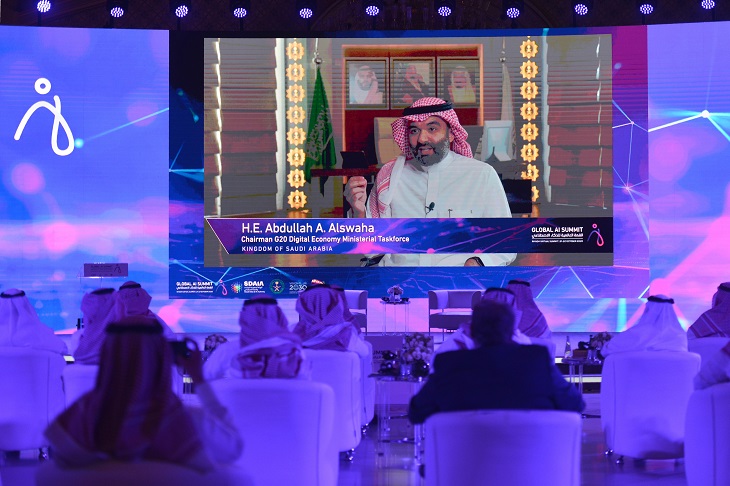
The Global AI Summit passed almost unnoticed last week, but as we swiftly approach a suffocating digital future, it is worth keeping an eye on what these industry leaders are up to.
At the moment, humanity’s digital technology is like a Ferrari taking the bends along the Amalfi coast at top speed. Sure, we’re making progress, but sooner or later there’ll be a sudden tourist bus – a screech of rubber – and a long drop into the Gulf of Salerno.
Where is biometric technology heading? The question is no longer ‘what can it do?’ it is ‘what does it want to do?’
Unfortunately, the answer is likely to unsettle free-spirited citizens, as collectivist ideology bleeds into the minds of political leaders and tech CEOs. The world is gearing up for a worst-case scenario where our digital frameworks are spearheaded by communist China and oppressive Islamic theocracies. One has a lot of people to control, and the other is keen to police citizen morality against Western influence.
In this case, the recent Global AI Summit boasted three main themes; ‘AI Now’, ‘AI Next’, and ‘AI Never’.
AI Never comes with the description:
‘How do we ensure that the future we design is one that we want to live in and not a dystopian sci-fi? AI Never challenges the audience and speakers to engage in debates about the ethics and responsible use of AI across a range of domains and topics.’
It sounds all nice and fluffy until you realise that there are people leading the digital ethics conversation who strain credulity when it comes to a safe AI future. After all, are we to believe politicians with severely tyrannical governments are serious about digital ethics? If they cannot practise human rights in real-world laws, why would the digital realm be any different?
This is a sentiment that should be repeated to Australian leaders who showed favouritism toward digital tyranny in the name of ‘safety’ and ‘sustainability’ when given the chance.
Westerners need to understand that entire branches of AI are being funded by countries with questionable motivations. Whatever technological advancements they make can easily be exported into our systems by leaders like Trudeau who side-eye collectivism with a fond look. If we are not careful to make a digital stand on AI ethics as a civilisation, we won’t have a say in what happens to our data as organisations like the United Nations collectivise international data on our behalf – almost certainly for ‘green’ initiatives.
Unfortunately, because Australia’s politicians have shown themselves keen to use the digital world to increase government power and surveillance, there needs to be a national conversation opened to contradict our assumed consent. There was no self control shown during Covid and there is unlikely to be any offered during the ‘climate apocalypse’.
The President of the Saudi Data and AI Authority, Dr Abdullah bin Sharaf Alghamdi, began his message to the Global AI Summit with:
‘In an effort to successfully address increasingly complex challenges, both local and global in nature, and to harness the accelerated pace of technological development, a revisited concept of smart cities has taken root, with leading countries now facilitating the development of smart city ecosystems in order to successfully meet the requirements of rapid population growth, to enhance resource efficiency, and to enable collective solutions for improving individual quality of life. This revised approach to smart cities is increasingly holistic and focuses on sustainable development principles, each addressing economic, social, environmental, and cultural dimensions.
‘…Since its establishment, the Saudi Data & AI Authority (warm and fluffy, no?) has been enabling this transformation by providing unprecedented levels of data across AI technologies for smart cities.’
Australian cities are involved in the Smart City project. It is a loosely collated mass digital stalking project that utilises things like advertising billboards and bus shelters to spy on citizens with facial recognition software – feeding data back into a central control centre. It is part-advertising and part-surveillance – one of many hybrid commercial and government projects that sees private citizen data turned into a valuable commodity wholly without our consent.
Former Prime Minister Malcolm Turnbull and then-Assistant Minister for Cities and Digital Transformation Angus Taylor signed us up for a version of this digital future under the ‘three pillars’ of; Smart Investment, Smart Policy, and Smart Technology.
While there is no problem utilising data in ‘smart cities’ to keep an eye on burst water pipes or smashed bus shelters – what governments are most interested in is biometric data from the people who live in these cities. That is, where they are going, how they get there, what they do, who they meet, and who they are. These are pieces of information that the government has no right to know. It is no different to issuing the Prime Minister with a detailed breakdown of your day-to-day movements.
Also keen to try out the slippery slope of smart cities are Auckland (New Zealand), Markham (Canada), Gothenburg (Sweden), Seoul (South Korea), Chattanooga (USA), and Huzhou (China).
No doubt the government will say, ‘this is for your safety’, or worse – convenience – but the dystopian digital hell that the AI summit warns about lies in the technology it endorses.
What do you think the government will use all this smart city infrastructure for the next time a ‘pandemic’ rolls around?
It is highly likely that facial recognition software will come in handy to monitor ‘close contacts’ or the unvaccinated and to alert authorities (or automatically dock your social credit score) if you’re caught with a foot outside your allowed area. Heaven help you if you refuse vaccination orders. This assumption is backed up by Covid being used as the repeated example for keeping ‘smart cities safe’.
Ask yourself, do the people living under communism’s eternal surveillance in Tibet and Xinjiang feel ‘safe’?
It’s no surprise to find security and policing on the smart city agenda, with AI-driven automatic ‘respond and act’ protocols topping the list which in turn trigger ‘drone responses’.
Urban transformation, sustainability, a ‘vibrant society’, and surveillance are being used interchangeably and whether you have a natural interest in technology or not, it has an interest in you.
But don’t worry, the trusted (?) World Economic Forum is leading the charge for smart city ethics.
‘World leaders announced the launch of the Global Smart Cities Alliance on Technology Governance at the 2019 G20 Summit in Osaka, Japan. As the International Organisation for Public-Private Cooperation, the World Economic Forum was selected to be the secretariat of the G20 Global Smart Cities Alliance.’
Human beings are not performance quotas. The idea that AI is being used to squeeze social targets out of the human fabric that binds a civilisation together is an unwanted and dangerous precedence wrapped up in the usual lie of ‘Utopia’.
There is no version of social control that ends with happy, free, and creative cities. Humanity needs the chaos and thrives off the quirk of error in order to excel.
The younger generations, who do not have a healthy fear of technology, are going to be the Trojan horse by which leaders bring in a prison-like data-driven future.
If we want to keep ourselves safe while advancing technology, then it is the government – not citizens – that must be caged off from Big Data. Without limitations on government visibility, there will be no limits on government control.