The Gruen Transfer, the ABC’s comedy show about advertising, has a segment in which host Wil Anderson asks, ‘What would Putin/Palmer/Trump do?’ It uses their bizarre public relations stunts as fodder for Anderson’s satire. With Prime Minister Albanese’s announcement of the draft words he proposes to put into the Constitution to enshrine the Voice, we can now play, ‘What would the Voice say?’ If, that is, Australians were foolish enough to put this new body based on ancestry into the Constitution.
The second sentence Albanese wants inserted into the Constitution says the Voice ‘may make representations to Parliament and the executive government on matters relating to Aboriginal and Torres Strait Islander peoples’. Paul Kelly in The Australian (Conviction not enough for the voice, August 3, 2022), points out:
‘[This is] open-ended, unqualified, and unlimited. It means the Voice can make representations to the Parliament on bills, to the executive government on ministerial decisions, but is not limited to matters before the government or Parliament. The Voice can make representations on virtually anything or even initiate its own agendas.’
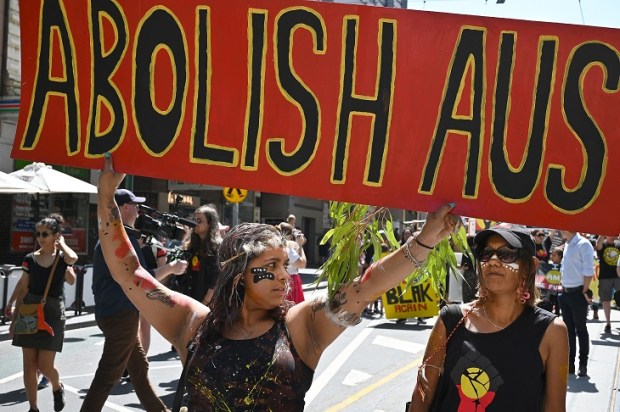
Albanese envisions a comfortable conversation between an ALP government and the Voice he described at the Garma Festival as ‘simple courtesy’, ‘common decency’, adding that ‘respect works’. But his faith is belied by some prominent Indigenous voices. Greens Senator Lidia Thorpe was the opposite of courteous, decent, and respectful during the swearing-in of senators. With her black power raised fist, she made an outburst about ‘sovereignty never ceded’, and showed contempt for the Constitutionally required affirmation of allegiance to the Queen Elizabeth II, whom she disparaged as ‘colonising’. Invasion Day rally organiser Tarneen Onus-Williams said she hoped Australia would ‘burn to the ground’ but later clarified this was a metaphor not to be taken literally.
The enthusiasm for the Voice from the ALP and the ABC shows the green-left assumption is that Indigenous people, or at least their representatives on the Voice, will be naturally inclined to support green-left-progressive views. Alternatively, they may assume the Voice will fall in behind the green-left’s general cultural dominance and won’t have the courage and intellectual depth to challenge it. They may assume that the Voice will mostly occupy itself with adding to the progressive advocacy on issues like Indigenous health and education services; policing, crime, and justice system reforms; welfare and public housing; Australia Day, flags, and various other symbols and rituals; and, of course, the Makarrata process to ‘to supervise a process of agreement-making between governments and First Nations and truth-telling about our history’. Many of these, it should be noted, are State and Territory government responsibilities.
But we need to think more broadly, and longer term, when we play ‘what would the Voice say’. The Voice could take an interest in virtually any development, but particularly in regional and remote Australia, especially any that involve land under native title.
Consider a proposed gas development in the Northern Territory’s Beetaloo Basin. The developer negotiates an agreement with native title holders including the Northern Land Council and substantial benefits from the project would flow to native title holders and local Aboriginal communities. The relevant approvals come forward to the Australian government, which might want to reject the project on, say, emissions reduction grounds. The Greens would certainly demand it. The Voice, however, might back the Northern Land Council and native title holders and press for approval. On the other hand, consider the 6,500-square-kilometre ‘Asian Renewable Energy Hub’ in the Pilbara intended to supply power to a green hydrogen export plant in Port Hedland. Again, agreements are negotiated, approvals are sought and this time the Australian government is keen to see it go ahead. The Voice, however, might find the vast array of wind turbines and solar panels diminishes the spiritual connection to the land and press for rejection, or modification, or for additional compensation. The list of projects the Voice might take a stand on is potentially endless.
The Voice may object to environmental legislation, particularly if it impinges on native title. For example, Noel Pearson objected to QLD’s Wild Rivers legislation, claiming it diminished the dignity of the Wik and other Aboriginal peoples by restricted the land rights he spent years fighting for. What might the Voice say about future restrictions on clearing, incentives for carbon sequestration, and other landscape measures demanded in the name of emissions reduction or endangered species preservation?
The Census reveals a dramatic increase in the number of Australians identifying as Indigenous. The sharp rise cannot be explained by a natural increase. Some of the increase may be due to people once ignorant of their Indigenous heritage, or once reluctant to acknowledge it, but much of it is likely to be self-identification that would not satisfy the other two elements of the conventional three-part test – descent and community acceptance. While the green-left progressives are all for self-identification, two NSW Aboriginal Land Councils recently lodged a formal complaint with the Independent Commission on Corruption to test whether the University of Sydney’s alleged failure to ensure that people who receive benefits for Aboriginal people are in fact Indigenous constitutes corruption. The Voice may want to make strong representations on this issue, for example, that there be a legislated definition of Aboriginal and Torres Strait Islander identity. This could quickly become an issue should those who do not meet the accepted definition of Indigenous put their names forward for the Voice.
Even in a prosaic area like business taxes, we now have differentiated business tax rates for large and small businesses. The Voice might make representations for a further differentiated, lower, tax rate for Indigenous enterprises. More generally, the Voice might be expected to make representations that Indigenous organisations, or Indigenous people, be exempted from various requirements, or receive more favourable treatment, such as carve-outs, discounts, concessions, top-ups, and procurement preferences, etc. It seems rather likely that the Voice will make representations that are inconsistent with the Racial Discrimination Act and could not be acted on by government.
The Langton-Calma report recommends a voice with 24 members, gender-balanced, with male and female co-chairs, supported by an independent Office of the National Voice (ONV). With its open-ended, unqualified, and unlimited remit, the ONV would, over time, become an Aboriginal bureaucracy that could involve itself in virtually every aspect of legislation and executive government. Members of the Voice itself could specialise in, and become selected based on, expertise in the range of topics the voice seeks to involve itself in. These would become de facto Indigenous Voice portfolio ‘ministers’. It’s easy to imagine that over time the voice would become an aboriginal shadow government. The Makarrata agreement-making process is likely to cement the voice and the ONV as, in effect, the representative body and bureaucracy for a self-governing, quasi-independent Indigenous pseudo-nation whose relations with Australia are spelled out in agreement otherwise known as a treaty.
The Voice will make Indigenous politics much more visible to the public – the various kinship and language groups and rivalries, the various urban and regional and remote interests, the various political viewpoints, the various campaigns for membership of the Voice and quarrels over what it says.
In the lead-up to the referendum, as the Parliament and ministers go about their business, we should all consider a critical question: ‘What would the Voice say?’ If the Voice does go into the Constitution, it will become a permanent feature of our public life.
Dr Michael Green has a PhD in Systems Engineering.