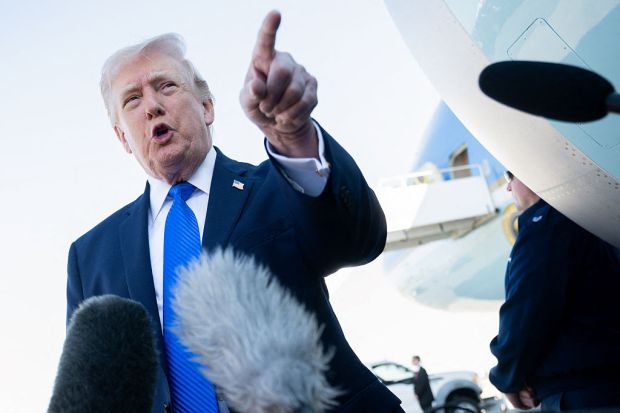
If Donald Trump keeps campaigning on immigration, he cannot lose. His Democrat rival for the US presidency, Hillary Clinton, has no plan to secure the US border with Mexico. And she promises amnesty within 100 days for an estimated 30 to 50 million mostly impoverished, heavily welfare-dependent illegal aliens, which will surely lure millions more across the Rio Grande.
Presidential elections are decided by a couple of million votes and America has since 1965 predominantly taken in Third World immigrants who bloc vote (eight out of ten) for the Democrats. A Clinton win would secure her party permanent, unbeatable Californian-style voting majorities, eliminating all conservative agendas and the Republican Party itself. Author Ann Coulter argues in her 2015 book, Adios, America! The Left’s Plan to Turn Our Country into a Third World Hellhole, that coupling mass migration and amnesty amounts to ‘America committing suicide’, given the much higher level of crime and welfare dependence in America’s immigrant population. Coulter documents a host of new crimes resulting from immigration policies, such as ‘child rape’, which is far more prevalent in Latin American cultures than hitherto in America.
Americans would still be wondering what was happening to their country if Coulter did not have Mark Steyn’s rare gift for making the unbearable extremely funny. As luck would have it, Donald Trump knew Coulter through Republican circles and read the book, which came out just two weeks before his presidential run. Journalists who had not thumbed through the 89 pages of Adios, America!’s footnotes reacted with outrage to Trump’s ‘Mexican rapist’ announcement speech, thus ending the media’s 50-year blackout on discussing America’s immigration policy!
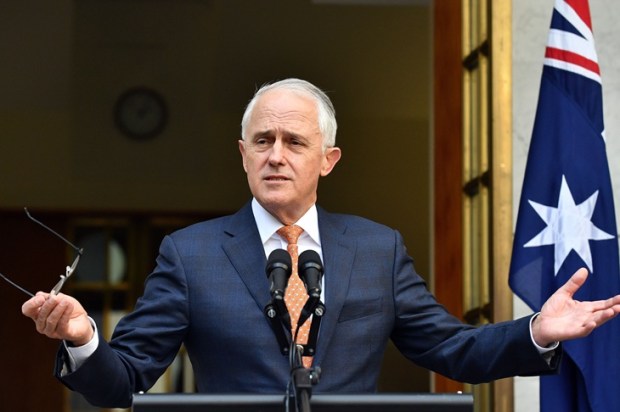
Former Spectator Australia editor and now Radio National presenter Tom Switzer is a foreign policy analyst covering the US election for an Australian audience. In September 2015, during the Republican Party’s presidential primaries, Switzer made a prediction when there were still 16 candidates in the GOP race, ‘I’ve been writing [Trump] off from the outset so I’ve got no real credibility on the Trump phenomenon. I still think he’ll get smashed by the negative attack ads and the establishment will get their act together and blow him out in the early part of [2016].’ By May 2016, Trump had flattened his remaining GOP rivals and won the most votes in the history of the US Republican primaries.
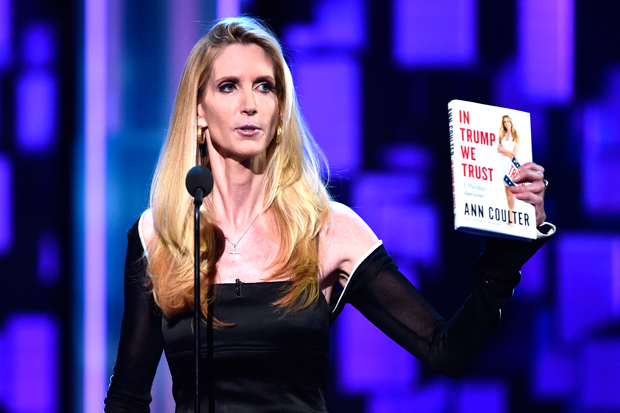
How Switzer and so many other journalists misread Trump is the subject of Coulter’s further ‘emergency’ election book published this August, In Trump We Trust: E Pluribus Awesome!
Coulter informs readers, ‘The media have twisted themselves in knots, trying to grasp how he won over millions of Republicans and what he’d be like as president… [Trump’s] announcement speech about Mexican rapists and building a wall may have appalled the media and the political class, but the voters were ecstatic.’
Throughout the presidential campaign Switzer had been highly critical of Trump’s personality, describing him as ‘crude and rude’, ‘unpredictable and dangerous’ and a ‘buffoon and xenophobe’. Trump supporters asked, ‘Does concern over torture and murder by a classmate, child rape or vehicular manslaughter at the hands of illegal aliens count as “xenophobia”? If so, then those traits are fine by us.’
Or as Coulter puts it, in In Trump We Trust, (Chapter 2: The Reality TV Star We’ve Been Waiting For!), ‘Everything that seems like a disability with Trump always turns out to be an advantage. If we were in the laboratory, designing the perfect presidential candidate, it’s unlikely we would have produced a tasteless, publicity-seeking, coarse, billionaire, reality TV star. Ha! … It turns out that is exactly what we needed.’ Millions of voters understood that only the self-funding, braggadocious billionaire Trump had the media savvy and construction skills (!) to battle the enemy media and build The Wall.
What about Trump’s oft-cited ‘lack of policy specifics’? Switzer wrote for a Canberra think-tank, The Strategist in March 2016, ‘[Trump’s] success is difficult for many journalists and intellectuals to stomach, but easy to explain: he taps into a widespread sense of anxiety and anger felt across many parts of Middle America… Trump’s supporters want someone whom they can vent their fury at the Beltway class of politicians and pundits. Policy details aren’t so important… [A]nyone who disagrees with The Donald on anything from deporting 11 million Mexican illegal immigrants to banning Muslims from entering America to ending trade deals is an “idiot” or “loser”.’
Coulter has a chapter on that too. In In Trump We Trust, (Chapter 7: No Policy Specifics!) she explains, ‘All those angry, uneducated Trump supporters seemed to understand what his policies were… Even after Trump began to release position papers loaded up with policy details, journalists and pundits agreed: No policy specifics! The public could not be allowed to imagine for one minute that Trump’s appeal had anything to do with his issues. … On 17 August 2015, Trump released his first policy paper. It was on immigration, and it was the most august political document since the Magna Carta. It explained Trump’s ideas on building a wall, making Mexico pay for it, ending sanctuary cities… and calling for a moratorium on all immigration.’
Millions of voters understand that America is ‘over’ unless they can get Trump into the White House to build The Wall, deport illegals and implement his plan to choose immigrants on the basis of merit, skill and proficiency, not by the criterior ‘lives within walking distance of the border’.
For Australia’s survival too, I have taken the pledge tweeted out by former Liberal MP and Sky News’s Ross Cameron, ‘If I am to be tried and convicted for the crime of supporting @realDonaldTrump, advise the gulag, I do not recant.’
The post Trumped up appeared first on The Spectator.
Got something to add? Join the discussion and comment below.
You might disagree with half of it, but you’ll enjoy reading all of it. Try your first month for free, then just $2 a week for the remainder of your first year.