Peru is a delight to the senses, from its fusion of ancient native and European, principally Spanish, cultures.
This is reflected in every facet of life, from its world-renowned cuisine, art, architecture, language and the sophisticated character of its people.
The capital Lima is located between the blue of the Pacific Ocean and spectacular Andes mountain range.
Regular earth tremors are a reminder that it rests on the Pacific ring of fire seismic zone where continental plates push against each other in an eternal grinding struggle. Early morning exercise is a popular activity as hundreds, if not thousands, of people run and walk along the cliff top avenue Malecón de la Reserva. I found it a perfect way to start each day before turning to the more serious matters to be debated and discussed.
The Conference of the Parties (COP) 20 to the United Nations Framework Convention on Climate Change is held in the grounds of an abandoned army barracks known as the Pentagon of Peru. A large temporary conference centre comprising several massive marquees has been constructed with delegates greeted each day by many smiling Peruvian faces always keen to provide support. Native dancers provide a colourful backdrop to the conference opening session. Opening speeches further remind delegates that the challenge of climate change is one that is a collective responsibility of all humanity. Australia’s announcement on my first day at the conference of a $200 million pledge to the Green Climate Fund elicits warm spontaneous applause. The timing, I am assured, was impeccable. Peru had been determined to mark its hosting of COP 20 with the Green Climate Fund topping the initial target of $10 billion. Australia’s pledge takes the fund beyond that initial milestone. The Peruvian President Ollanta Humala Tasso tells me it was a show-stopper.

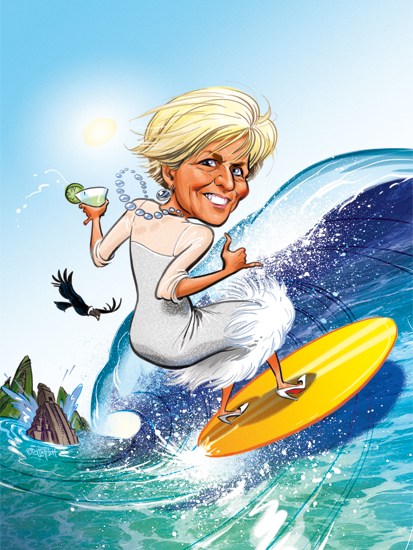
The Peruvian Government has a national scholarship programme for students, particularly from low socio-economic backgrounds, to study abroad. Australia was the first country selected to receive scholarship holders and more than 170 have made their way to Australian universities in the past 2 years. I assure the Minister of Education that Australia would welcome double that number within the next two years. Speaking of scholarships, Peruvians are mad keen on water sports, understandable given its almost 2500km Pacific Ocean coastline. At a business reception, the Council on Australian Latin American Relations (COALAR) invites me to announce two scholarships it has funded for talented but socially disadvantaged young Peruvians who will be given the opportunity to study surfing techniques at Surfing Australia’s High Performance Centre. Peru’s most famous surfer world champion Sofia Mulanovich is at the reception followed by a large and adoring media pack. She claims three Aussies were always her fiercest competitors for world titles.
Trade Minister Andrew Robb and I undertake a flurry of bilateral meetings; the highlight being a long and productive discussion at the Presidential Palace with the President, Foreign Minister Gonzalo Gutierrez and Trade Minister Magali Silva. We discussed our common trade and investment interests, and opportunities for increased tourism. Having flown from Sydney to Santiago to Lima on a 18 hour journey I was very enthusiastic about the prospect of direct Qantas/Lan Chile flights. The Foreign Minister revealed the secret of his popularity in Peru – he authored a book on the origins of pisco, the national alcoholic beverage of Peru. It is a hotly contested debate between Peru and Chile as to which nation invented the pisco sour. Foreign Minister Gutierrez concluded conclusively it was Peru! These seemingly innocent looking drinks, like fluffy lemonade, are served anywhere at anytime, and are a trap for the unwary. When I host a dinner for the Umbrella Group we toast to a productive few days in Lima – naturally over a pisco sour!
I find a moment to formally open our Embassy in Lima which was closed in 1986 apparently due to budget cuts under the Hawke Government, and then a decision to reopen it was made 22 years later during Peru’s hosting of APEC in 2008. We have now moved to new premises and I was delighted that Peru’s former Ambassador to Australia and now Vice Minister of Foreign Affairs, Claudio De La Puenta, was witness to our plaque unveiling. With Peru now one of the fastest growing economies in Latin America, a fully functional Embassy, energetically led by Nick McCaffrey, is a wise investment. Lima is yet another example of why we need more overseas missions to promote Australia’s interests, not less.
Our Embassy invites about half a dozen of Peru’s most high profile female leaders to a working breakfast. The line-up is impressive – a former Government Minister and now head researcher at the Bank Association of Peru, an accomplished chef, restauranteur and cook book author (Peru’s answer to Nigella Lawson without the personal dramas), the first female Prime Minister of Peru, the Director of Peruvian Museums, an award winning journalist and war correspondent in Iraq (a cross between Christine Amanpour and Dianne Sawyer) and a former principal ballerina who is now running dance and leadership academies for homeless teenagers across Peru. I was awed by their achievements and their determination to improve the lives of all Peruvians. We all smiled at the universality of our sisterhood as one claimed an ancient Peruvian proverb; ‘Man who say it cannot be done, should not interrupt woman who is doing it.’
Got something to add? Join the discussion and comment below.
You might disagree with half of it, but you’ll enjoy reading all of it. Try your first month for free, then just $2 a week for the remainder of your first year.