The first ever Test match that Australia played against Pakistan was a classic. It was October 1956 and the Baggy Greens were on their way home after losing to a Jim Laker-inspired England. They stopped off in the Indian subcontinent to play three Tests against India and one against Pakistan. The Australian team was brimming with talent with the likes of Neil Harvey, Richie Benaud, Ray Lindwall and Keith Miller in the line-up, and they must have been hopeful that having failed to regain the Ashes, they would at least chalk up a comfortable victory against a side that only played its first Test match four years earlier.
However, they were skittled out for just 80 in the first innings with fast bowler Fazal Mahmood, who had earlier boasted about dismissing the visitors for under 100, taking six wickets. Pakistan had a first innings lead of 118, but although Australia rallied in their second innings, they only left the home side 69 to win.
Today, a team would rattle off that target in little more than an hour, but cricket was a much more leisurely affair in the Fifties. Pakistan took all of 45.5 overs to make it to 63, just six short of their total, by the close of play on the third day. Then politics intervened. Play was suspended for 24 hours to mark the anniversary of the assassination of Liaquat Ali Khan, Pakistan’s first Prime Minister.
When the Test resumed, 6,000 spectators turned up to watch the home side score the six runs they required. ‘The victory against Australia marked the end of the first chapter of Pakistan’s cricket history. It was the end of its childhood. After beating the two giants of the cricket world — England and Australia — Pakistan successfully ended the so-called teething stage of a precocious child,’ noted Fazal.
The match was significant in other ways too. It was Keith Miller’s final Test, it was the game in which Ray Lindwall took his 200th Test wicket and it was also the match in which the Queensland’s superbly gifted all-rounder Ron Archer, who surely would have become one of the game’s all-time greats, incurred the injury which ended his Test career. It also remains the only occasion when there have been two scheduled rest days in a Test match. The story of that compelling first Pakistan v. Australia clash is told in journalist’s Peter Oborne’s masterly new book, Wounded Tiger: A History of Cricket in Pakistan.
While Australia’s greatest cricket rivals have been England and Pakistan’s India, what is striking is that the most important moments in the history of Pakistani cricket have tended to come not against its neighbour, but against Australia. Pakistani cricket ended its childhood with that famous victory in Karachi.
In 1977 Pakistan announced itself as a top cricketing power by winning its first Test match in Australia. Pakistan’s first ever ‘whitewash’ of a Test series opponent came against Australia in 1982-3, and then in 1992 it was in Melbourne that Pakistan, having beaten Australia in the group match, won its first and to date only World Cup.
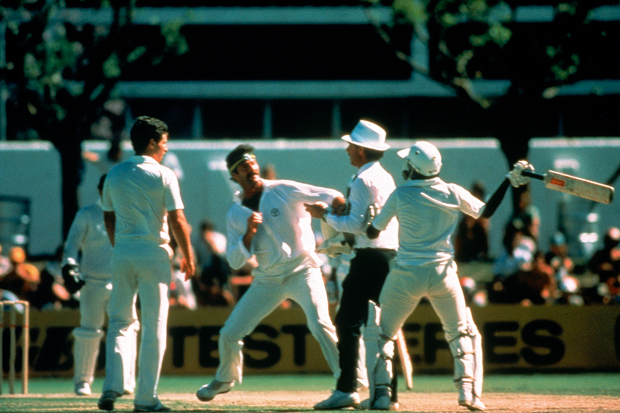
Test series between Pakistan and Australia have always been memorable. At Perth in 1981, Pakistan slumped to 26-8, their worst ever start. In the second innings the ‘infamous confrontation’ occurred between Pakistan captain Javed Miandad and Dennis Lillee, two of the feistiest characters in the history of the game. Oborne traces the bad blood back to Pakistan’s 1972-3 tour of Australia. ‘Intikhab Alam had declared on 574 for eight in protest against a volley of bouncers from Dennis Lillee, who hurled the ball away in indignation, and set up a lasting personal feud against Pakistan players.’ As Javed ran for a single at Perth, Lillee kicked him.
‘It was a gentle kick, but still a kick and Javed then raised his bat at Lillee, as if in threat.’ Australia fined Lillee $200 but also asked Javed to apologise. He refused. ‘Had I been captain of England, I wonder if the idea of retaliating with a kick on the pads would even have entered Dennis’s mind’, Javed later wrote.
In Karachi in 1994, Pakistan enjoyed what Oborne calls their ‘most dramatic win’ — and guess what — it was against Australia. Pakistan needed 314 to win. They struggled to 184-7 — and then to 258-9. With last man Mushtaq Ahmed performing heroically, Inzaman steered his side to within two runs of a highly improbable victory. He then had a rush of blood to the head and ‘decided to charge Warne’. He missed the ball completely, but then something truly extraordinary happened: wicketkeeper Ian Healy, the man who never missed an easy stumping, did just that. Pakistan got four byes and celebrated a remarkable result.
Soon though, Pakistani cricket found itself under a very large cloud. Rumours about match-fixing under Salim Malik’s captaincy had begun to circulate. Australian newspapers reported that ‘a prominent Pakistan cricket personality’ had tried to bribe Shane Warne and Tim May to bowl badly in Karachi. Salim Malik was suspended and Pakistan, under Wasim Akram, lost the subsequent Test series in Australia 2-1.
Even off the field, Australians have made their impact on Pakistani cricket. Kerry Packer caused major ructions when he launched his own World Series competition in 1977. The first Pakistan player approached was Asif Iqbal. ‘If money was being made, why should we not be part of it’? he argued. General Zia-ul-Haq, who had just come to power in a military coup, thought differently. ‘What Packer is doing is prostituting cricket,’ he declared. But Packerless Pakistan struggled. ‘General Zia had learnt his lesson… restore a strong national team even if that meant bringing back the Packer players’, writes Oborne.
You could say that that first meeting between Pakistan and Australia set the tone for what followed. Encounters between the two nations have been exhilarating, engrossing and at times wonderfully bad-tempered. Here’s to the next 60 years of rivalry; if it’s anything like the last 60, we’re in for quite a ride.
Got something to add? Join the discussion and comment below.
You might disagree with half of it, but you’ll enjoy reading all of it. Try your first month for free, then just $2 a week for the remainder of your first year.