The Ukip treasurer Stuart Wheeler’s recent comments about women being less good than men at bridge (and chess, and poker) were met with predictable outrage. But I’m afraid he was right: at the very top, women do trail behind men.
Of course, there are exceptions (Sabine Auken, for instance, recently won the European open pairs); but in a list of the world’s top 500 players, you’d be hard-pressed to find more than a handful of women.
None of this makes me feel remotely threatened or annoyed. But I do find it fascinating, and have discussed it with numerous world-class players over the years. Sabine herself has suggested that men have a greater talent for concentration; the great Polish player Jacek Pszczola thinks it’s down to women being more emotional; others claim that women are less ruthless, less competitive, less confident, less one-track-minded. Some think our brains just work differently.
Whatever the reason, it’s a fascinating subject — one that should be aired, not stifled in a flurry of outrage.
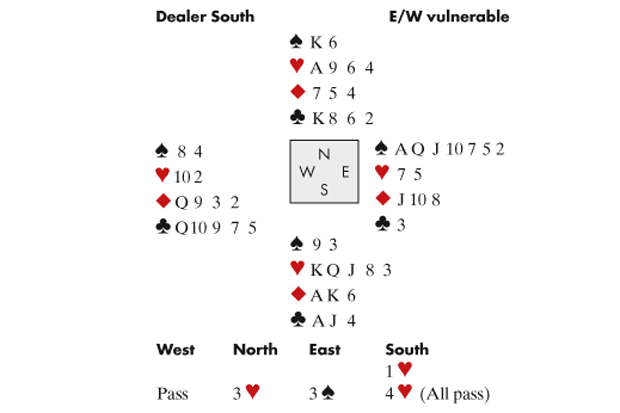
Anyway, sermon over. This hand recently came up at a mixed event — and surprisingly few players, male or female, got it right (see picture).
West led the ♠8. East took two tricks and exited with the ♦J. Declarer won, drew trumps and cashed a second diamond. You can place East with seven spades from the bidding and lead, and two hearts. If East has four diamonds he is void in clubs and a diamond exit will endplay him: he will have to concede a ruff-and-discard. If West has four diamonds (or three to the ♦Q), then a diamond exit will force him to concede a ruff-and-discard or play a club into declarer’s tenace. So the crucial case is when East has three diamonds and one club. You cater for this by cashing the ♣K before playing a diamond: then, whoever wins, is endplayed!
Got something to add? Join the discussion and comment below.
You might disagree with half of it, but you’ll enjoy reading all of it. Try your first month for free, then just $2 a week for the remainder of your first year.