Sometimes writers grow tired of their most popular creations, though few get so bored that they actually kill them off. Even Arthur Conan Doyle, having despatched Sherlock Holmes at the Reichenbach Falls, recanted in the face of a rebellious readership and brought his hero back.
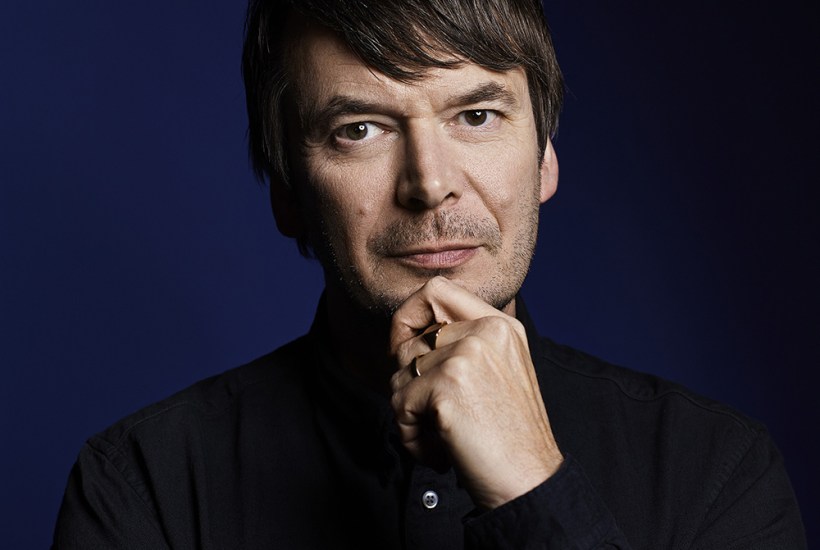
Now Ian Rankin has taken leave of Inspector Rebus, and in The Heights (Orion, £25) has left Edinburgh as well, moving to London with a new protagonist, Gillian Gish. She is a policewoman of nine years’ standing with the Met and gets called in when a night security man is found murdered in a Knightsbridge glass tower of ritzy apartments.
An array of CCTV cameras and a missing fob help narrow the search for the killer. Among the suspects are several residents living in the ‘18-storey bank vault’, where even the smaller flats go for a cool £15 million. They include an actress turned influencer, the wife of a notorious gangster, a pop star known as Zafk, and the by now statutory oligarch. Accompanied by the gruff veteran cop Jack Milton, Gish conducts a series of interviews in the apartments, which are described in all their monied finery, though moving from suite to suite seems rather like a progress through the rooms of Cluedo.
The pen-portraits of the suspects are well drawn – Rankin has always excelled at these characters. But less persuasive is his new protagonist. We don’t learn much about Gish until we are well into the book, and her depiction remains frustratingly thin, with hints about an eventful past. We know she lives in Tottenham Hale with her ageing mother, who is suffering from dementia; and that at work Gish has a reputation for recklessness, which her defenders call intuition. A potential admirer, a journalist named Simmons, pops up from time to time, but his interest is unreciprocated, perhaps because Rankin is laying the seeds for romance in a subsequent volume. On the whole, however, I would rather see a return to old stamping grounds and the perennially appealing Rebus.
Jonathan Ames, the author of a trio of thrillers featuring Happy Doll, an LA-based private investigator, has also changed protagonist and (for the most part) setting, in his latest novel, A Past Without Pictures (Pushkin Press, £9.99). Instead of Doll, we have Maria Cole, a homicide detective, whom we initially meet in LA, shooting a burglar who has pulled a knife on her. He is the first person Cole has killed – but we sense there will be more, since she lives on the cusp of relentless violence. She ‘often appraised men this way: how to take them out as quickly as possible… Maria revisualised the stomp kick… Then an elbow to his busted nose, flattening it completely, would finish the job.’
Learning that her father, an ex-con from whom she’s been estranged, has been murdered in Alabama, Cole travels there to try to make sense of his death. Switching from LA to a small town in the southernmost reaches of Alabama is not an upmarket move; it’s the land of ‘poor white trash’ and, because of its coastline on the Gulf of Mexico, is known as the Grits Riviera.
At first the murder seems an open-and-shut case, and a 22-year-old burglar is charged. But viewing things with a professional eye, Cole finds that the pat explanation proposed by the local police chief is a front for a more complicated conspiracy, and soon uncovers a web of local corruption that includes the crooked sheriff. Cole is more richly drawn than Rankin’s Gish, but the book ends in such a crescendo of violence that is hard to see a steadier future for her in the heat-soaked climes of Alabama.
Equally violent, The Boy by Mark Gyves (No Exit Press, £14.99), is nonetheless gripping debut by a new Irish crime writer. The eponymous boy lives in Cork and has lost his mother at the story’s beginning. His father is a chronic alcoholic who has squandered a remarkable intelligence that briefly won him fame as a student.
When the Mr Big of the local drugs trade is murdered, it creates a vicious competition to find a successor. The boy is accidentally drawn into this conflict when he and a friend uncover a hidden stash of drug-related cash. We share his excitement at this windfall, but sense too that nothing good comes without a concomitant cost. One of the dealers, Clifford Cromby, is a paedophile who befriends homeless teenage boys and then imprisons them in the basement of an abandoned manor house he owns.
The Boy is a rough read – shocking in its violence – but a cleverly constructed one, and a noteworthy debut. It does, however, end somewhat unsatisfyingly, with the lad’s fate left in the balance. Hopefully, a sequel will provide an answer to the closing ambiguity.
When writing a psychological thriller it might seem obvious to make a psychotherapist your protagonist. In fact the interchanges between client and shrink are rarely very exciting. What makes The Bestseller by Jenny Knightsby (Mountain Leopard Press, £10.99) unusual is the psychotherapist’s indiscretion, which violates a strict professional taboo and has far-reaching personal consequences.
Helena Salve is the therapist in question, happily married – unlike most of the couples she specialises in seeing – but trying unsuccessfully to start a family. One of her clients, who comes to sessions alone, is Belle Averelle, and is clearly seeing Helen without her husband’s knowledge, simply because her big problem is her marriage. A diagnosis of coercive control is an easy one for Helena to make, but she struggles to build Belle’s confidence to the point where she will leave her husband. Frustrated by Belle’s passivity, Helena tells her closest friend Tala all about the case.
Tala is a minor novelist, reduced to taking boring office jobs to get by. Her interest is piqued by Helena’s account of Belle’s travails, and quickly writes it up in a lightly fictionalised form – only to find, to her astonishment, that it becomes a bestseller. Belle’s violent husband cannot fail to recognise it as a savage depiction of his marriage.
Unsurprisingly, Helena feels betrayed by Tala, and the tension between the two grows when Belle finally leaves home and stays temporarily with Helena. The narrative see-saws between threats and actual danger, with twists continuing to the very last pages. The writing is clear, if unnuanced, and though there are aspects of the plot which seem mildly improbable, we do grow to care about the characters.
Got something to add? Join the discussion and comment below.
You might disagree with half of it, but you’ll enjoy reading all of it. Try your first month for free, then just $2 a week for the remainder of your first year.