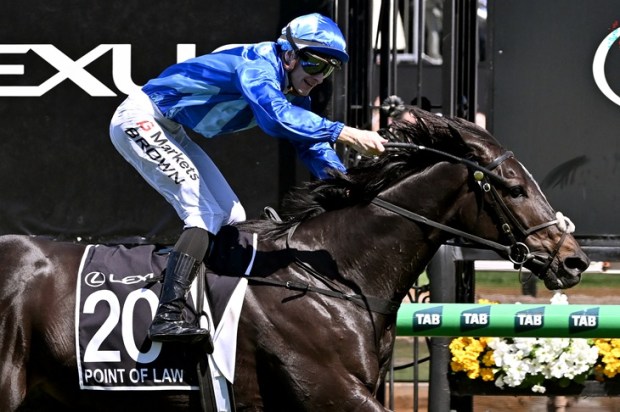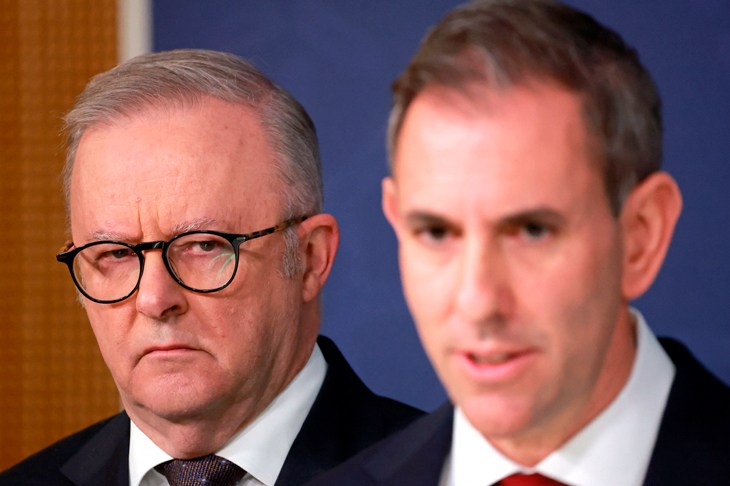
On this year’s Melbourne Cup Day, it wasn’t the race, but the rate rise that stopped the nation. It was the 17th interest rate rise since Labor was elected in May 2022 and the fifth this year. You might think the nation would be used to it and that the Treasurer and the Prime Minister would be adept at responding.
But it wasn’t, and they weren’t.
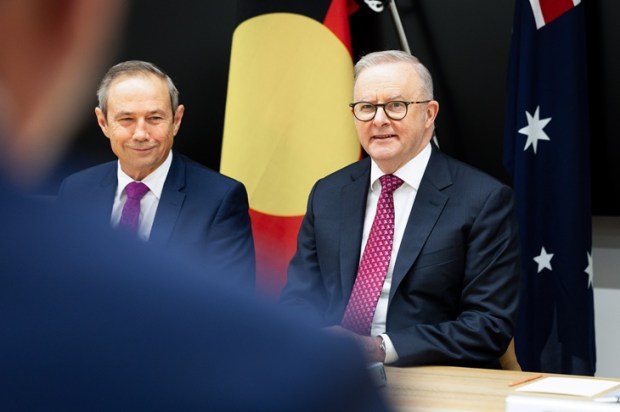
The Prime Minister tried his favourite trick of heading off overseas – they don’t call him Airbus Albo for nothing – but the travelling press pack insisted on asking him why he was swanning around the Caribbean instead of staying home to face the irate voters.
Albanese was incensed, telling the King that reporters had badgered him about the trip and he had told them he was there because His Majesty had invited him.
It was a bit rich coming from a lifelong republican elected on a platform of abolishing the monarchy.
His Majesty was not amused at being blamed, but graciously groaned, ‘Oh God, it’s all my fault, oh no.’
Back home, the Reserve Bank Governor Michele Bullock was no doubt feeling the heat. Having prematurely cut interest rates three times in 2025, one conveniently before the May election, she is now in the embarrassing position of having to reverse those cuts and raise rates further.
She was probably in no mood to cover for the government, stressing that oil prices were not the reason the board had raised the cash rate five times this year.
‘I know there is confusion in the community, so I want to be very clear: monetary policy cannot impact global oil prices. Rather, the tightening in monetary policy is to address domestic capacity pressures,’ she said, explaining that those pressures existed before the conflict and prompted the RBA to start raising rates before it started.
This didn’t deter the Treasurer, who again claimed the war in the Middle East was ‘the primary driver’ of the ‘uptick in inflation’ while conceding it was ‘not the only driver’.
Indeed. The RBA forecasts that public demand (broadly, spending on goods, services and investment by all levels of government) will balloon by 3.8 per cent in the year to June 2027, more than double the anaemic 1.6 per cent rate of economic growth it predicts for the same period. Worse, it forecasts that economic growth will slow further to 1.3 per cent by December next year.
That public spending is supremely unproductive. The Productivity Commission’s September 2026 report found that labour productivity in the non-market sector was below its March 2007 level. Indeed, since June 2014, non-market-sector productivity has declined by 2.5 per cent while market-sector productivity has risen by 7.5 per cent. Yet it is in the unionised public sector that pay is outpacing inflation, while in the private sector, wages have gone backwards.
Bullock explained that the rate rise would make people feel poorer because we are poorer: incomes are not growing quickly, productivity growth is weak and a massive supply shock has been imposed upon us.
And that’s the point. Higher fuel prices during the Iran war have made us poorer, just as higher coal and gas prices during the war in Ukraine made us richer.
It highlights how foolish the PM was to claim in a Caribbean speech that ‘returning our nations and our world to the path of prosperity and rising living standards requires an end to those wars’.
Albanese then denied suggesting that prosperity could not return until the wars ended. Meanwhile, he found time for a day aboard a ‘low-carbon’ ship owned by billionaire ‘Twiggy’ Forrest, whose green hydrogen adventures have benefited from precisely the sort of government largesse that is driving inflation.
An exporter of mining and agricultural commodities like Australia is always exposed to volatile global prices. That is why a prudent treasurer would have used the coal and gas boom to pay down debt.
We could also have protected ourselves better from fuel-price shocks by building and maintaining adequate reserves. Our international obligation is to hold oil stocks equivalent to 90 days of net imports; our domestic fuel cover is far lower.
More fundamentally, governments’ addiction to productivity-strangling greenhouse policies has kept alternatives to imported fuel expensive. Instead of subsidising renewables, we could have continued to use coal-fired power, keeping electricity cheap for drivers of unsubsidised electric vehicles. We have also deterred investment in turning coal waste into liquid fuel. And we could have kept gas cheaper by avoiding state fracking bans and interminable investment approvals.
Higher fuel prices have certainly increased costs throughout the economy. But the main source of inflationary pressure is the toxic combination of out-of-control government spending and the whole gamut of productivity-killing policies – taxes on investment, labour-market rigidities, corruption in construction and mining delays over blue-banded bees.
And here’s another way this rate rise was different: it was the first to coincide with opposition leader Angus Taylor leading Albanese as preferred prime minister in the News24/YouGov Pulse poll.
That can’t be pleasant for Albanese, who mocked Taylor shortly after his election as opposition leader, paraphrasing former Labor treasurer and prime minister Paul Keating: ‘Can a soufflé rise once?’
Keating also inspired the Treasurer’s foolhardy tax grab in this year’s budget. The changes to negative gearing and capital gains tax have crashed the housing market, just as those of us who lived through the 1980s – yours truly included – predicted.
There’s an echo of Keating in mortgage rates, too. The latest hike is expected to take average variable mortgage rates to about 6.75 per cent. On one estimate, repayments on a median-priced home would absorb 37.4 per cent of a typical household’s income – a smidgen below the record 37.5 per cent in December 1989, when Keating was treasurer.
Back then Labor had Peter Walsh, arguably its greatest finance minister. Keating dubbed him the Sid Vicious of Australian politics. Walsh imposed cuts severe enough to help Labor deliver three consecutive budget surpluses between 1987 and 1990. In those days Labor understood that government spending had to be restrained if the private economy was to have room to grow. Commonwealth expenditure fell to 23.7 per cent of GDP, its lowest level since the early 1970s.
Today, it is forecast to be 26.8 per cent, and instead of Sid Vicious and the Sex Pistols singing ‘God Save the Queen’, Katy Gallagher is singing ‘Hey, Big Spender’, while Albanese is blaming the King.
God help us all.
Got something to add? Join the discussion and comment below.
You might disagree with half of it, but you’ll enjoy reading all of it. Try your first month for free, then just $2 a week for the remainder of your first year.