A white grandmother, Gloria, opens the door to her daughter’s family. From the outset, it is clear that Freddie and Maggie, her mixed-race grandchildren, are two of the worst brought-up children ever to grace a Christmas advert.
But here is the unfortunate irony. For years, some of John Lewis’s most beloved Christmas adverts have featured white children demonstrating extraordinary kindness. Now the retailer has chosen to feature a mixed-race family, and the children are incapable of expressing affection for their grandmother without being bribed.
Freddie and Maggie, her mixed-race grandchildren, are two of the worst brought-up children ever to grace a Christmas advert
Freddie and Maggie sprint past their grandmother, refusing the offer of a hug, shoes on, scattering their rucksacks across the hall. Upon arrival, the children’s black father promptly disappears while their exasperated mother looks on as they destroy Gloria’s perfectly fluffed velvet cushions and ransack her study.
In an attempt to bond with her grandchildren, Gloria fetches Pickles, a wheeled wooden dog, down from the attic. Unfortunately, this is a toy several years too junior for the offspring she is hoping to entertain. They stare at her blankly before abandoning her for lunch. Defeated, Gloria stuffs £30 into each of their Christmas cards. Apparently, they’ve made it very clear that cash is ‘what they want.’
At this point, the only creature interested in Gloria’s company is Pickles. Eventually Gloria gives up all together on bonding and heads out on a ‘montage’ him. Her estranged daughter and son-in-law don’t even notice she’s missing.
After a fateful shopping trip the two are picked up by a rickshaw, still haunting London’s streets after the last government failed to ban them. In the real world, this would be a particularly dangerous decision for a vulnerable elderly woman on Christmas Eve. Not pictured is the £300 bill that the driver would no doubt present her with at the end of the journey.
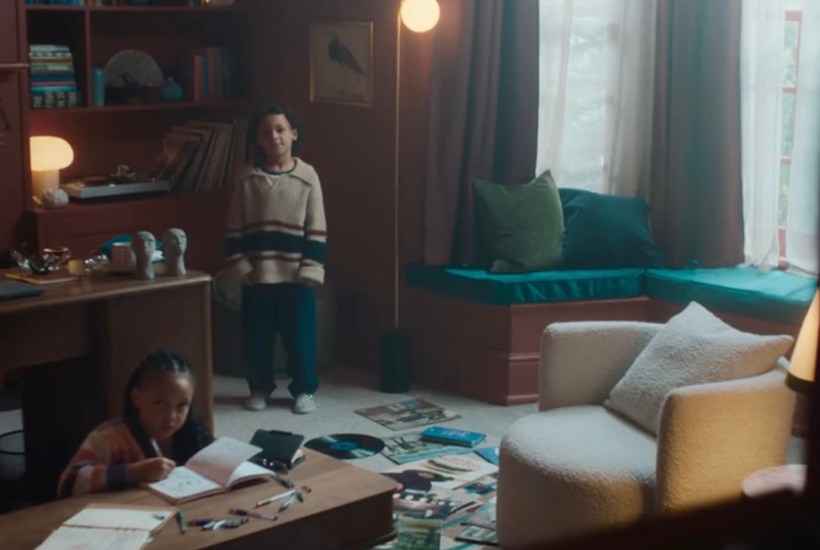
It is at John Lewis that Gloria has a revelation. If she cannot persuade her grandchildren to enjoy her company, perhaps she can persuade them to enjoy her house. She resolves to sacrifice her home office, secretly transforming it overnight into a playroom complete with disco balls, decorations and a record player.
On Christmas morning, Freddie and Maggie are back, faces like slapped arses, shaking their cards for cash. There is none. Instead, Gloria presents them with a key to the new playroom. They are, at least for a few moments, placated. Gloria has finally done enough to buy their love, at least for a moment, and presumably for a lot more than £30.
The decision to feature a mixed-race family looks like an attempt by John Lewis’ marketing executives to prove their diversity credentials. But there is a certain irony at play.
For years, John Lewis has marked the changing of the seasons with adverts which celebrate children’s generosity and selflessness. This year, it has produced two thoroughly unappealing mixed race little brats.
Compare them with their predecessors.
Last year, we had the slightly nervous teenage boy who had agonised over how to express his love for his father, eventually settling on a record that would remind him of his youth. Or consider the child who spent the Christmas season consumed by the fear that his toy penguin, Monty, was lonely. Disinterested in his own Christmas, all he wanted in the world was to find his penguin a companion.
Then there was the little girl who spotted a lonely old man on the moon and set about finding him the perfect present so that he would know he wasn’t alone – a telescope.
Back in 2011, John Lewis broadcast The Long Wait. A small boy is desperately impatient for Christmas to arrive. He attempts to cast a spell on the clock to speed up time, counts down the days through December and even resorts to going to bed early to make the hours pass faster.
Like Freddie and Maggie, is he eagerly anticipating a fistful of cash from an elderly relative? No. When Christmas morning finally comes, he runs straight past his own pile of presents. He has bought and wrapped a gift for his parents and cannot wait to hand it over.
Presumably, the intention was to produce a heartwarming story about bridging the generational divide in a modern British family. But the contrast is rather unfortunate. Gone are the angelic white children of Christmas adverts past; in their place are two mixed-race grandchildren with all the charm of demanding hotel guests.
I’m left wondering: is the John Lewis Christmas advert racist?