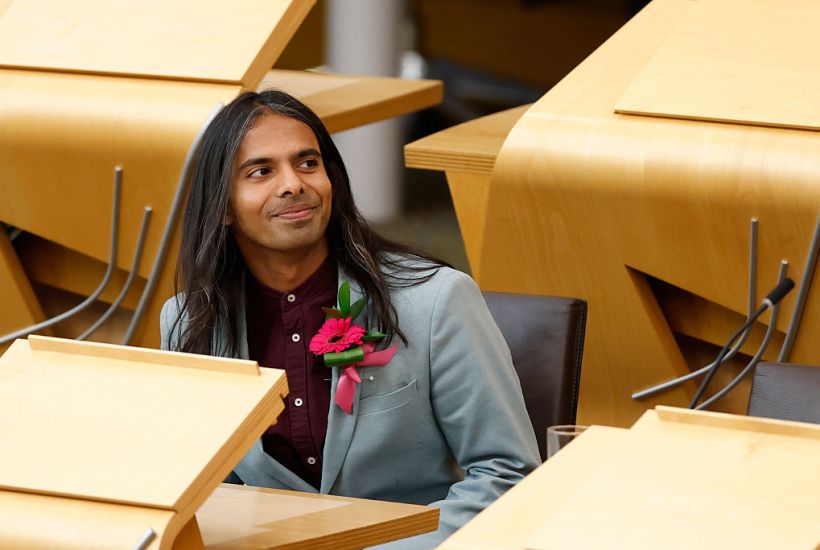
Members of the Scottish Parliament seemed genuinely surprised when this year’s Holyrood elections returned a new MSP who, it turned out, had only temporary immigration status in the UK. Q Manivannan only had a student visa on being elected as a Green MSP, but has now managed to secure a three-year graduate visa, which will cover the full parliamentary term.
There appeared to be huge surprise when Manivannan was elected, almost as though those who voted unanimously on the legislation hadn’t actually realised its consequences at the time
Now, a committee of MSPs has published a report on the legislation that allowed this to happen, concluding that it was passed in a way that made Scotland ‘atypical’ and ‘ahead of what the public want’. The Scottish Parliament’s Standards, Procedures and Public Appointments Committee examined how the government had introduced the law change that enabled foreign nationals with limited leave to remain in the UK to stand for election in Scotland.
That law – in case, like many MSPs, you hadn’t been paying close attention – came in the 2025 Scottish Elections (Representation and Reform) Act. The argument for it from the SNP and the Greens was that widening the criteria for who could stand in elections would allow MSPs to better represent their diverse communities. In this report, the Committee is also scrutinising a new bill introduced in September which seeks to amend that Act, and which would ensure that Commonwealth and non-Commonwealth nationals would have the same rights. But the Committee also took evidence on whether the overall change allowing foreign nationals with limited leave to remain was the right one. It concluded that it was not.
The report says that:
‘The 2025 reform, which allowed non-UK nationals with limited leave to remain to stand as MSPs and councillors on a non-reciprocal basis appear to have run ahead of public opinion, made Scotland a relative outlier in this area, and were not clearly evidenced as needs-based. At a time when confidence in politicians and state institutions is fragile, especial care is required in relation to any electoral reforms that may risk undermining trust in the democratic process.’
The committee asks the Scottish government to reconsider the whole reform, which First Minister John Swinney has now refused to do. He cites the fact that the Scottish Parliament voted ‘unanimously’ on the legislation in 2024 as a reason for not changing it now, while the Greens have said that it would be a backwards step to change it.
And yet there appeared to be huge surprise when Manivannan was elected, almost as though those who voted unanimously on the legislation hadn’t actually realised its consequences at the time. The committee rather drily points out that the Scottish Parliament hadn’t noticed the deficiency in the Act that this new bill is trying to correct when it comes to the status of Commonwealth and non-Commonwealth citizens. But it is also the case that Parliament didn’t think through the legislation more generally, assuming that the argument for ‘more diverse representation’ automatically meant that this was a good law.
This is one of the problems with legislation that is sold as embodying good and progressive intentions: anyone who questions its design is considered opposed to good things, rather than simply wondering whether someone whose visa would run out before their term as an MSP should really be eligible to stand in an election. Scotland may be an outlier in the UK in its eligibility criteria, but it certainly isn’t an outlier when it comes to the poor quality of legislative scrutiny. It is entirely possible to imagine Westminster MPs passing a bill without understanding its full consequences, and then being told that their support means it doesn’t need to be revisited. If only those legislators realised the seriousness of what they were reading and voting on at the time.