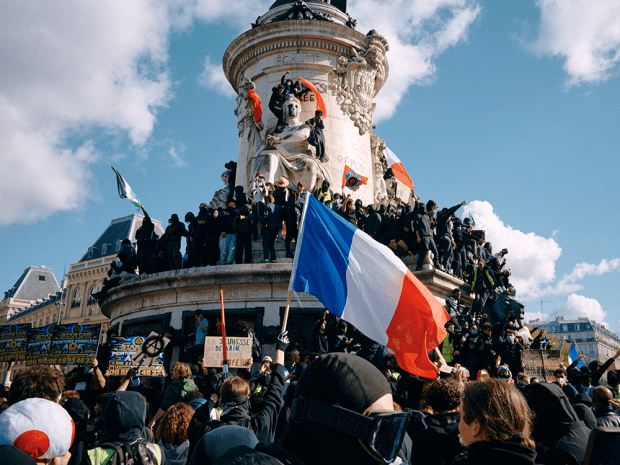
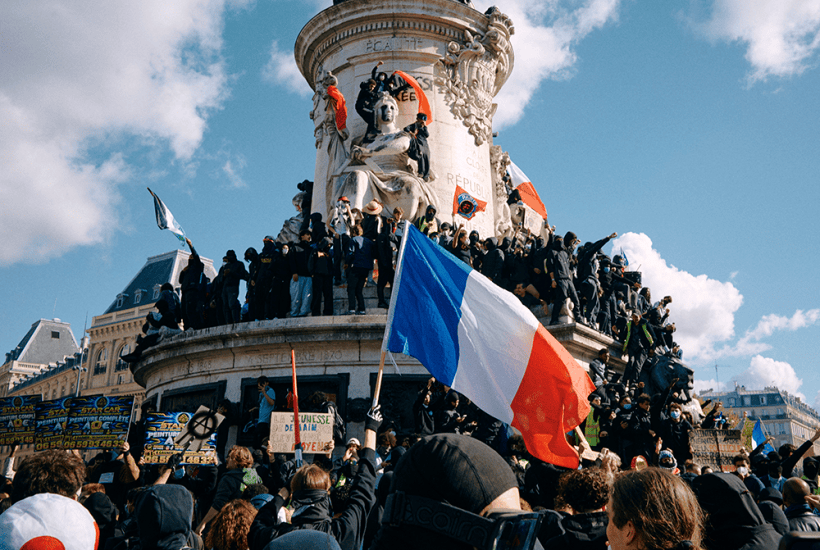
Two worlds met in Paris last week. Thanks to the presence of Art Basel, some of the world’s most valuable art that wasn’t already in the city was shipped there. It arrived just in time for Paris to go up in flames. Most of the art fair went ahead as planned at the Grand Palais, but the final weekend was cancelled.
Parisian friends and those who were visiting the city described scenes of Dada-esque absurdity. They navigated streets filled with burning bins and rioting ‘youths’ in balaclavas, before slipping into champagne receptions. Some who attempted to get out of the city spoke of Mogadishu-like scenes at Gare du Nord, where the country’s newest net-contributors were busily assaulting any available police and stealing the luggage of any tourist they could find.
You have to have thought and read an awful lot to be as wicked as some of France’s philosophers and writers
Unfortunately reports from the front line all confirm a pre-existing prejudice of my own – which is that almost no group is more detached from society than those who call themselves ‘artists’. A particularly fine example came courtesy of a woman called Louisa Buck, who writes for the Art Newspaper. Reviewing the carnage in the city, as well as the contents of Art Basel, Buck (the daughter of the late Conservative MP Sir Antony Buck) twittered admiration not for the art but for the vandalism.
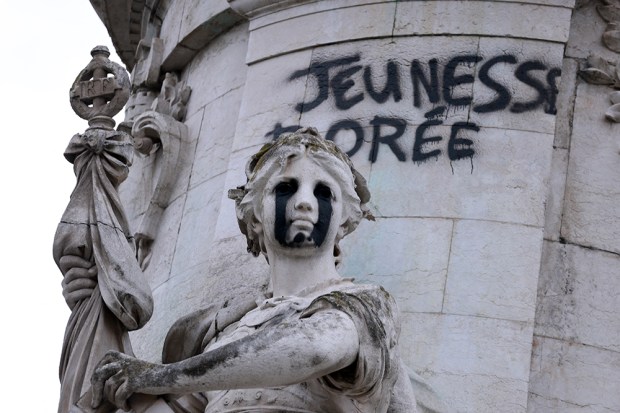
Taking to Instagram, she wrote: ‘For me the most powerful artwork encountered in the last 48 hours was the defaced sculpture under lowering skies in Place de La République passed on my way off to Gare du Nord that speaks volumes of the fury and disappointment felt at uncaring governments and savage policing – and it’s not just restricted to France.’ She continued to trill about the beauty of the black graffiti that made it look almost as though the figure of Égalité was ‘weeping black tears… (or maybe her eyes put out altogether)’.
Of course to voice such sentiments, any person – especially an art critic – must have had their brains fall out altogether. The monument in question is one of Paris’s landmarks, with the 19th-century sculpture centring around a statue of Marianne, the symbol of France. But the art world has long been dominated by an elite of ‘anti-elitists’. So much so that the daughter of a Tory MP and knight of the realm thinks nothing of celebrating the despoiling of France’s national monuments because of the need for justice, progress or some such.
Naturally, France is still able to produce home-grown idiots too. I like to keep up with French writers because France is still a country in which philosophy and thought matter, though there is a perfectly good argument that this is part of the problem. You have to have thought and read an awful lot to be as wicked as some of France’s philosophers and writers can be.
Édouard Louis is one writer I always read. Louis, a disciple and friend of the memoirist and cast-iron shit Didier Eribon, has, like Eribon, made a career of writing in unsparing detail about the left-behind French working class and specifically the horrific lives of his immediate family. I can’t say his books are fun reading, but they are honest – and honesty is one of the things I like most in a writer.
Being the sort of person who is the toast of the French, and to some degree international, literary world, Louis is also a political ignoramus. Whenever he veers away from writing about what he knows and tries to talk about politics, he pours out the recycled pabulum you would expect from any other Saint-Germain-des-Prés philosophe who has read more about life than he has seen.
Interviewed on the radio recently, he came out with a full-throated defence of the rioting in the city which has made him rich and famous. Indeed, he declared that he was in favour of setting the streets of Paris alight and of going out and breaking things. According to him, the business of politics is a matter of deciding whether to have or not to have blood on your hands. He even came up with that predictable and banal phrase ‘there is no great revolution without excesses’.
Whenever I hear a writer, artist or philosopher speaking in these terms I think deeply un-Christian thoughts. They include the hope that this time one of the excesses might involve a precious young novelist being punched in the face and his own doubtless perfectly ordered apartment set on fire. All so the rest of us can sigh sympathetically and say that sadly this time it is his turn to feel the excesses of the revolution.
Knowingly, I suppose, Louis enters a distinguished line of foul French intellectuals, the most obvious being Jean-Paul Sartre, whose writings have to be read if you want to understand one way in which extreme violence can be normalised. In his introduction to Frantz Fanon’s execrable The Wretched of the Earth (a classic of ‘post-colonial literature’) you can read Sartre positively salivating about the prospect of blood being spilt. He does not abhor violent revolution; he desires it. He doesn’t mind the spilling of blood on the streets; he wants it. The close reader might notice, however, that it’s not Sartre’s blood that is on the menu for spilling – it’s always the blood of other people that will magically rejuvenate society.
In other words, it isn’t just France’s new culturally enriching population who believe burning things down can be good. Some of its home-grown best are up for it too. One French woman, Bettina Zourli, a sociology lecturer, was caught on camera last week arguing with a beautiful young Parisienne who had been threatened with rape by the rioters. Zourli appeared to have no sympathy for the victim, and explained to the younger woman that she was simply ‘collateral damage’. She has since apologised for her ‘clumsy’ words.
Like so many other French activists and thinkers, Zourli spoke her truth. France’s best include people who believe – to use the old cliché – that you cannot make an omelette without breaking eggs. But they never do make their omelette. They just leave every-one else with a bloody, burned-out mess.
Got something to add? Join the discussion and comment below.
You might disagree with half of it, but you’ll enjoy reading all of it. Try your first month for free, then just $2 a week for the remainder of your first year.