Few in the mainstream media spotted the irony of the BBC’s Paris correspondent describing the recent anarchy across France as ‘mostly peaceful’. Just as in 2020 a similar claim was made by CNN as we watched Kenosha, Wisconsin, go up in flames, the BBC reassured viewers to a background of burning cars, looting and assaults on police. The ‘world’s most trusted news provider’ has also echoed President Macron’s denials of any involvement by immigrants or Islamists in the violence. It’s decided not to notice the large presence among the looters and rioters of African faces, keffiyehs, Palestinian flags, and shouts of ‘Allahu Akbar!’.
France’s unrest was indeed sparked by largely peaceful student protests about school conditions. These were joined by ‘gilets jaunes’ activists angry about cost of living, then hijacked by hard-left militants intent on attacking the police and destroying symbols of the state (e.g. the 1883 Hôtel de Ville in Limoges) and ‘capitalism’ (McDonalds stores are a perennial favourite). The final part of the cocktail has been the looters, largely from deprived immigrant backgrounds.
Riots have often featured in French politics. But the scale of the violence that erupted on Saturday 17 October was, as the Paris deputy mayor observed, ‘never seen before’. Across France, half a million protestors and rioters were on the streets. Over 3,000 businesses – including Paris’s famous Galéries Lafayette department store – were damaged and/or looted, 997 police were injured, seven seriously, and, in addition to the destruction in Limoges, government buildings and schools in many other cities were destroyed or vandalised.
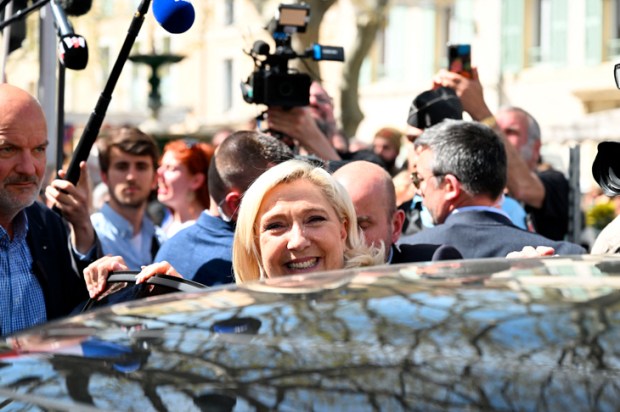
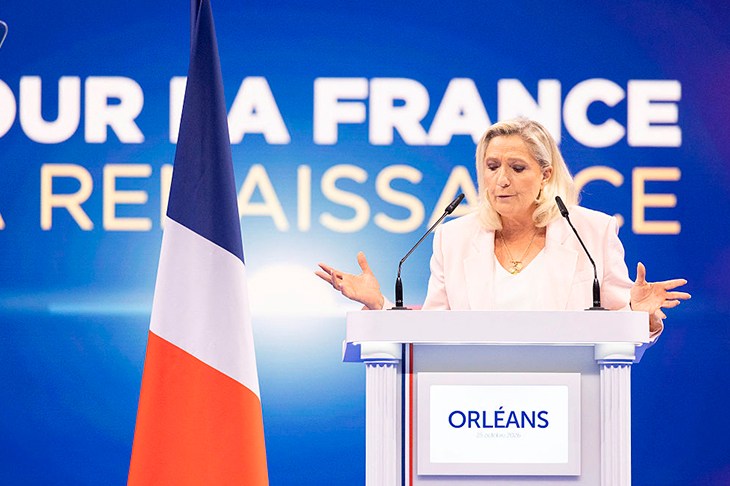
National Rally (Rassemblement National) (RN) parliamentary leader and presidential candidate Marine Le Pen and party leader Jordan Bardella unsurprisingly haven’t held back. While not criticising peaceful protesters, they’ve attacked Macron for the weak police response. Bardella has also flatly contradicted Macron’s ludicrous claims that there’s no immigrant element in the unrest, saying most of the looters are of ‘immigrant background’. Polling shows 55 per cent of voters agree with him. Even Macron’s allies admit the protests have boosted Le Pen.
RN has also linked the anarchy to the Islamo-hard-left Jean-Luc Mélenchon, head of the France Unbowed (La France Insoumise) party, Le Pen’s closest rival for the presidency. In Australian terms, France’s presidential elections next April (and May if there’s a second round) will be like a choice between One Nation and an even harder-left version of the Greens. Mélenchon’s aim is ‘a New France’, involving the revolutionary destruction of what he sees as the old white, Catholic France.
It’s a mystery why Mélenchon thinks most French voters would choose such extremism. Since the riots, polls show support for Le Pen has increased by one to two points to around 36 per cent, way ahead of Mélenchon on around 16 per cent. Le Pen would almost certainly win a second-round run-off against him in a landslide and also comfortably against any of the other candidates. More than half of French voters (51 per cent) now believe she would make a good president. Her victory could however be soured by France’s grim economic outlook: French government debt is now 120 per cent of GDP and the bond markets fear a default, which would probably mean austerity-dictating officials of the European Central Bank in charge, as was the case with Greece fifteen years ago.
As Macron enters the final months of his presidency, his judgment seems seriously awry. He’s been widely mocked for trying to exploit the shooting attack by a white Frenchman on five people of African origin. He claimed it was the ‘first time’ France had seen a terrorist act motivated by a plan to kill based on colour or religion. This bizarrely overlooked France’s long recent history of jihadist attacks against Jews and Christians. Macron’s dismissal of claims that France has been ‘invaded by hordes of migrants and Islamists’ also doesn’t stand up to scrutiny. On his watch, close to three million have been added to Europe’s biggest population of African and Middle Eastern immigrant origin, now totalling about nine million, around 13 per cent of France’s population.
In other unhinged signs of desperation, Macron has claimed that images of the rioting were AI-generated (only a few were, with none seriously distorting the picture of what happened) and that the riots are because of high oil prices caused by Trump’s war with Iran.
His Prime Minister is trying to stop X and other social media from posting footage of the anarchy. He’s also pathetically tried to exploit hatred of Trump and Israel by suggesting that, internationally, only Trump and Netanyahu have linked France’s anarchy with immigration. Oddly, he forgot to mention that most of France’s critics on immigration issues are its EU partners. Recently, most of them pushed at a summit meeting for agreement on the need for mandatory detention of illegal arrivals and the elimination of ‘pull factors’. This was aimed at the ‘regularisation’ by Spain’s socialist government of up to a million illegal immigrants and its failure to deport many of the tens of thousands who broke into its Ceuta enclave in North Africa during the summer. Macron sided with Spanish Prime Minister Pedro Sánchez and vetoed the wish of the EU majority.
Spain’s French-backed hopelessness on illegal immigration continues to generate deep internal EU tensions. Polish Prime Minister Tusk was so angry with Sánchez at the summit that he walked out. And pointedly after the eruption of the French anarchy, Tusk and his Hungarian counterpart echoed Trump in tweeting about the importance of strong borders. Tusk also posted on X that ‘Spain must follow our example if Schengen (the EU’s internal passport-free zone) is to survive’. Hungarian Prime Minister Magyar – who’s maintained the strong border policies of his predecessor Viktor Orbán – noted that ‘in the face of this senseless destruction… perhaps it is now clear to everyone why Hungary advocates the strictest possible approach to migration’.
The good news for Europe is that Sánchez could soon join Macron among Europe’s ex-leaders. In what looks like an ill-judged roll of the dice, he’s called an early election for 29 November.
Opinion polling suggests Spain’s two big right-wing parties are on course to win a comfortable majority and form a new government.
Got something to add? Join the discussion and comment below.
@markhiggie2
You might disagree with half of it, but you’ll enjoy reading all of it. Try your first month for free, then just $2 a week for the remainder of your first year.