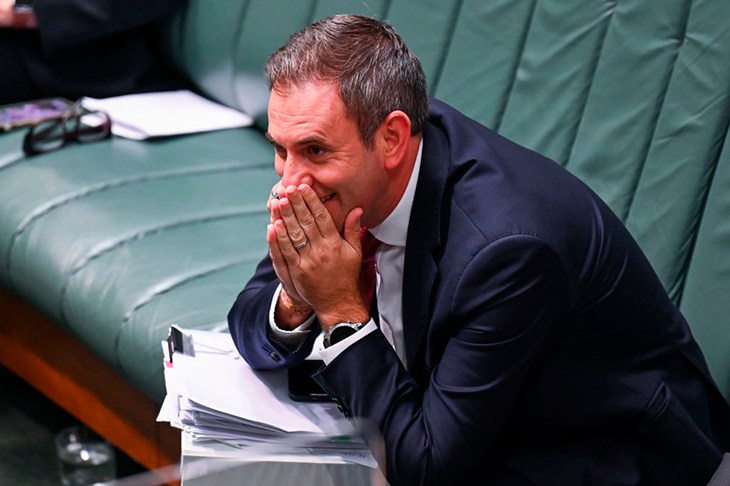
Jimbo is toast: it’s the scientific consensus. His term as Treasurer of this country must end as soon as possible. He should never have been awarded the job as top money man. He has made a complete hash of the position, and he now needs to seek out greener pastures.
Recently Jimbo has been off travelling the world, assuring the players in the global investment community that Australia is a great place to park their moolah. Yeah, right: it’s probably better than North Korea and Uzbekistan, but investors need to watch out for those surprise tax and regulation changes – they are always a great way of attracting capital to a country, not.
2026 has been Jimbo’s annus horribilis. It’s almost entirely his fault although he would beg to differ. It’s hard to think of any adult in any senior role who is more inclined to refuse to accept any blame for outcomes for which they are clearly responsible.
It’s the war in the Middle East, global uncertainty, Trump’s tariffs, the weather – one of Jimbo’s ‘strengths’ is dreaming up excuses for his poor performance and the alarming deterioration in Australia’s economic conditions.
Mind you, Jimbo was never a good choice to be our Treasurer. He wrote that ridiculous piece in the Monthly arguing for a values-based economy, whatever that means. His intention was to reinvent capitalism, with the state playing a major role as co-investor. The mind boggles.
Fiscal rules were not needed, according to Jimbo. He wasn’t going to be held back by guardrails limiting the growth of government spending and restricting government debt. To his way of thinking, those rules are just so yesterday and undermine the potential for the government to do good. To be sure, his old boss, Swanny, had rules, but he couldn’t stick to them. Best do without pesky fiscal rules.
The end result has been that Jimbo has basically pissed $400 billion in unexpected revenue up against the wall, and the good folk of Australia have very little to show for it. This financial year, the underlying cash deficit is expected to come in at $32 billion, with the more accurate headline deficit (this includes off budget spending) coming in at double that figure – around 2 per cent of GDP. Every sensible economist knows that Jimbo should be running a budget surplus at this stage.
Having pilloried the former Coalition treasurer, Josh Frydenberg, for the possibility that government debt would exceed one trillion dollars, Jimbo can now wear that dubious medal – government debt has gone over the trillion-dollar mark under his watch.
A central role of all good treasurers is to control the spending ministers. ‘No’ is the most important response that should simply roll from the tongues of competent treasurers. Jimbo, by contrast, doesn’t have that word in his vocabulary; he has simply gone along for the ride during one of the most profligate periods of government outside a war or pandemic.
In the past, some treasurers have taken a while to warm up. In fact, Paul Keating was a lousy treasurer in his first years in office; he really got going after 1986. Jimbo has been the reverse: he started off badly, but his performance has since deteriorated.
Just think of the mistakes that Jimbo has made this year. Of course, the biggie was the budget in May, with the repercussions still playing out loudly six months after its delivery. Having emphatically ruled out any changes to capital gains tax or negative gearing, a series of massive changes were announced and quickly legislated.
While Jimbo likes to bang on about young people getting a ‘fair crack’ at housing – one of his most annoying habits is his repeated use of supposedly humble phrases, often in alliterative form – the changes to the capital gains regime were extended to all assets. It’s hard to fathom the rationale for this other than pulling in more revenue.
Given the surprise nature of the changes – OK, the clear breaking of election promises – it was entirely predictable that various faults would quickly emerge. Extensive consultation with those who understand the world of investment and taxation could have prevented this, but alas it was not to be. Treasury officials have emerged this year as a pack of naive ideologues without the technical skills and knowledge to do their jobs properly.
An early clanger became apparent with the so-called ‘widow’s tax’. Upon death or divorce, the surviving partner would be denied the benefit of negative gearing for an asset held by the couple. This could not survive and the Prime Minister had to intervene to get this changed.
Then there were the proposed provisions related to trusts and the application to discretionary testamentary trusts that are commonly written into wills. It looked like a death tax, it smelt like a death tax, it even talked like a death tax. Again, the Prime Minister intervened, and testamentary trusts were suddenly exempted.
In the meantime, the start-up crowd were arcing up, pointing out the punitive rate of capital gains tax that would apply to those few ventures that really take off from a close to zero base. Did Labor want to encourage entrepreneurship and risk-taking? Isn’t this part of their productivity agenda? (Let me pause here, while I have a quiet chuckle.)
The ‘solution’ is an incredibly bureaucratic set of guidelines that allows some business founders in certain circumstances to use the old capital gains tax rules, but with limits. It’s just so Canberran – wordy and unworkable. But Jimbo wouldn’t have a clue and it showed.
A recent catastrophe has been the ban on credit/debit card surcharges. (A tip here: when it comes to best-practice public policy, bans and compulsion are actions that should be used as sparingly as possible. The justification must be unquestionable and substantial. Just because people, some people, don’t like surcharges is not a good reason to ban them.) Jimbo could have stepped in and ruled against the ban. He simply didn’t understand the full consequences.
When the Australian Tax Office announced that it would discontinue the use of credit cards to pay tax bills, the glaring faults in the ban were plain to see. The ATO claimed they couldn’t afford to continue the practice, with all attempts to negotiate lower merchant fees with the financial institutions unsuccessful. For struggling small businesses, the message was clear: Jimbo, as well as Albo, thought that they should simply suck it up by bearing the cost of the ban. But if the ATO couldn’t get a better deal on merchant fees, what chance would a small suburban business have?
As the clouds gather over our economy and we wait to see whether the Reserve Bank decides to lift the cash rate for a fifth time this year, it’s obvious that Jimbo’s time is up. He has no solutions, only incoherent chatter.
There is no room in the budget to hand out any more favours to struggling folk and businesses. In the meantime, the housing market continues to tank across the country – what happened to that slightly slower growth in housing prices announced in the budget? – and unemployment is rising.
It’s time for someone else to have a go. And that someone needs to understand how the economy works and to have a grip on the rules that must govern the use of taxpayer funds.
Got something to add? Join the discussion and comment below.
You might disagree with half of it, but you’ll enjoy reading all of it. Try your first month for free, then just $2 a week for the remainder of your first year.