So refreshing for a Melbourne dweller, to alight from a direct flight and find myself in a city free of graffiti, of troubled or threatening folk on the streets, of arrays of empty stores, free even of traffic jams.
I’m in Taipei, a very walkable tree-lined capital, with mostly medium-rise buildings with welcoming street-level retail, most journeys via the extensive, clean and frequent mass rapid transit subway system. Friendly people familiar with helping foreign visitors. A bit of Chinese helps, but far from essential.
A vibrant and enthusiastically democratic place – international in disposition, and in the range of folk on the streets, but also comfortable in its own skin. In the most recent Pew survey, 67 per cent of the 23 million people living here see themselves as Taiwanese, and a further 28 per cent as both Taiwanese and Chinese.
Taiwan has been proven by DNA, linguistics and archaeology, to have been the original source for most Pacific Islands populations. That connection is palpable to me, having lived a decade in Papua New Guinea – including by visiting the terrific Museum of Formosan Aborigines, and also wandering through a vast, popular fair of indigenous-run stalls selling unique goods from clothes to cosmetics, of course delicious cooked food, and with lively music and dance performers.
Taiwan’s proportion of indigenous people is similar to Australia’s. But oddly, our own Ambassador for First Nations People, Justin Mohamed, does not appear to have considered it worth visiting Taiwan during his three-and-a-half expensive years in the job, including about 50 other overseas visits.
I’ve been here in Taipei for the 39th annual conference of the Australia-Taiwan Business Council – of which I’m honorary vice-chairman – with our Taiwan counterparts. This has attracted the biggest-ever Australian contingent, of 71 people, all paying their own way.
The conference themes have been Artificial Intelligence and data centres, critical minerals, health and biotech, and education and tourism – areas of rapid growth between Australia and Taiwan.
The core context is Taiwan’s soaring economy – set to increase by 11 per cent in 2026, easily the fastest rate of all advanced economies. Its tech-driven stock market is the world’s fifth-biggest, having this year overtaken India and London, and is worth double the Australian exchange, five times Singapore’s.
Fortunately, Australian firms are now starting to seize the resulting opportunities, including creating a new supply chain for the vast amounts of critical minerals needed by Taiwan’s high-tech industry, with Taiwan Semiconductor Machinery Company worth $A3 trillion, spending $A11 billion a year on research and development, and with Delta Electronics, a $A200bn company, a global leader in the hardware required by data centres.
Our Business Council has been running, with financial support from the National Foundation for Australia China Relations, a program for young entrepreneurs from Australia and Taiwan to work, learn, and play together. Noah from Ballarat, now based in Taipei, a typically energetic pioneer in the program, has co-built within a few years an online marketing firm that employs 100 people and operates in a couple of dozen countries.
The 24 million Taiwanese people get on with their lives without crippling concern about ‘the China threat’ from 150km to their west, despite foreigners’ obsession with it.
In past decades, many Taiwan families were involved in business in the People’s Republic of China. But that engagement has shrunk rapidly as investment has shifted to South East Asia and back to Taiwan itself, and as Taiwan’s growth has begun to eclipse China’s. Taiwanese people are not hiding from ‘reality’. They have been hearing threats from Beijing for 77 years.
And they have long, bitter experience of colonisation and invasion, having been governed by the Japanese – albeit surprisingly, for the most part, benignly – for 50 years to 1945. Then the Nationalist government in China took over Taiwan, imposing harsh rule that fostered protests cruelly cracked down on in 1947, the authorities killing about 25,000 people. When the remnants of the Nationalist army sailed to Taiwan in 1949, under Chiang Kai-shek, martial law – and thus the ‘white terror’ – was imposed, lasting 38 years, with full democracy finally attained in 1996.
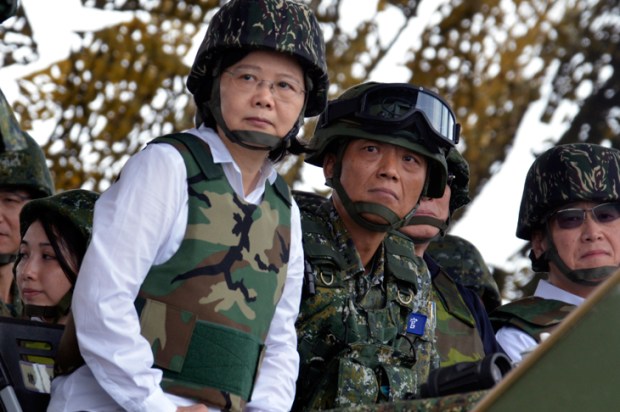
Civil defence has become a regular feature of life. Signs point to air raid shelters on most streets, and all young men must serve in the military for at least a year. Taiwan spends about 3.8 per cent of its GDP on defence, almost double the Australian proportion. And there’s growing awareness of the risks in buying Chinese-made electronic goods that might become ‘operationable’.
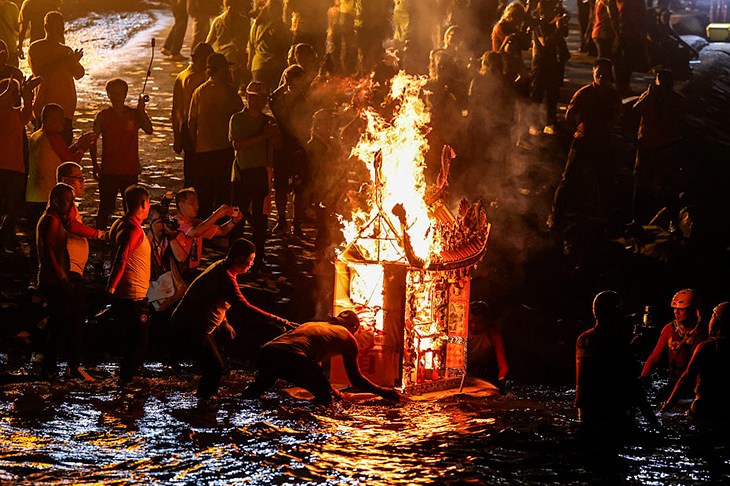
Many of the office buildings on Taipei streets have set up tables outside, at ground level, with fruit, rice, cakes and other goodies to feed the spirits who are wandering freely during Hungry Ghosts festival, when the gates of the underworld are opened. Office by office, staff – many working for tech firms – take their turn to burn incense and paper money and paper replicas of cars, clothes and electronic devices, and offer food for their ancestors’ after-life needs. At Chinese opera venues this month, the front row is left empty for spirit guests.
Such lively, persisting traditions complement the weight of historical wonders in the finest museum in Asia, the National Palace Museum on a hillside on the edge of Taipei. This hosts the special collections of Chinese emperors formerly held in the Forbidden City in Beijing, which their curators brought over in 1949. Today, the museum encapsulates Taiwan’s contemporary charm, with tech panache projecting scrolls that depict every aspect of life in ancient China but with the figures now walking, dancing and playing.
Got something to add? Join the discussion and comment below.
You might disagree with half of it, but you’ll enjoy reading all of it. Try your first month for free, then just $2 a week for the remainder of your first year.