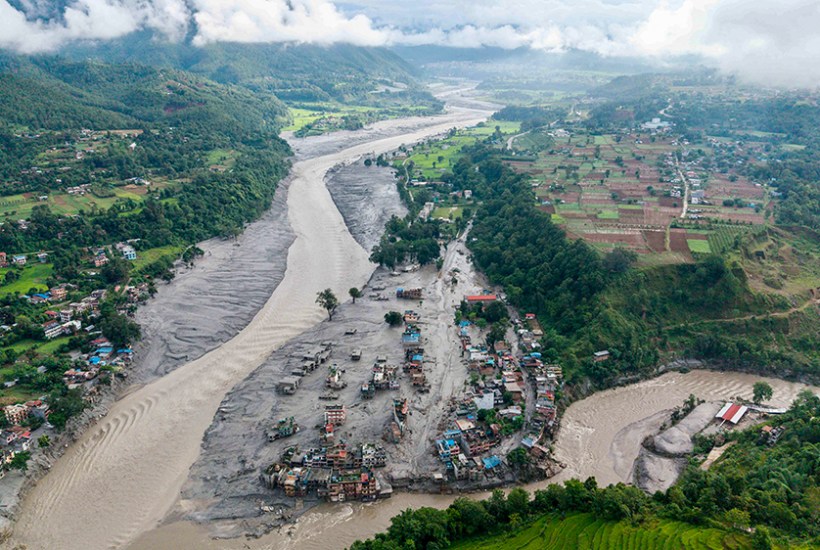
The tragic and terrifying Himalayan flash flood was caused by a chunk of mountain collapsing into a narrow gorge, sending a tsunami of mud and rock that gathered mass as it shot down the steep Trisuli river valley. More than that is not yet clear. Did a breakaway hanging glacier take a rock face with it or was it the other way round? Was there time for the debris to dam the valley and form a lake that burst or did the 60-metre flood of mud come from ice, river water, rock and soil that accumulated in the valley as the tsunami descended?
Some people are already certain they know what caused this. Either climate change did it or China did it. Assorted greens rushed to blame global warming with confidence bordering on certainty. The New York Times wrote: ‘The processes leading to these cascading failures are complex but the hidden hand behind them is human-caused climate change. Our fossil fuel burning is pulling down the world’s highest peaks.’
Meanwhile on social media, lots of Indian nationalists are equally sure China is to blame. The maverick journalist Lara Logan wrote: ‘The Chinese aren’t going to admit they’ve built massive server farms under these glaciers. Nor do they want anyone asking about that hydroelectric dam in Nepal – where exactly was all that power going?’
It is strange how humans rush to blame human actions in some cases but rush to excuse them in others
Both theories are clutching at straws to advance political agendas. This catastrophe was far more likely to have had an entirely natural cause. Mountain landslides and glacial lake outburst floods have caused catastrophic events in the Himalayas, the Andes and the Alps before and will do again with or without global warming. Collapsing under gravity after being thrust into the air by tectonic forces is what mountains do, mostly gradually but sometimes suddenly.
Just last year, at least 11 people died in a flash flood caused by a glacial dam bursting in the very same valley in Nepal. A similar event killed at least 18,000 in Peru in 1970 in a time of climate cooling and a long way from China: a chunk of a mountain broke off in an earthquake and buried the town of Yungay under millions of tons of debris. As in the Trisuli valley event, the debris plunged nearly 4,000 metres at high speed, giving people no warning.
Does the New York Times seriously think that if we had given up using hydrocarbons half a century ago (massively increasing global hunger and poverty as a result) we might have saved the people of the Trisuli valley? In any case, as a coincidental drone film taken at the time seems to suggest, it may be that the rock face collapsed first, bringing down the glacier, rather than the other way around. ‘It appears this was not so much a glacier collapse but the mountain itself falling apart,’ writes reporter Kunda Dixit in the Nepali Times. Climate change might conceivably have helped unglue the rock but such collapses have been happening for millions of years naturally.
As for Chinese infrastructure, data centres hidden under Himalayan glaciers are a myth. At most, the construction of hydroelectric dams and border posts in that valley might have been unwise and put more people in harm’s way. China’s occupation of Tibet is a tragic cultural tyranny. But it could not have started the landslide thousands of metres up the slope – on the Nepal side of the border – or worsened it significantly. The mud-flood was probably unstoppable anyway: just look at the way it rolled boulders the size of large houses down the valley like marbles.
The Chinese government is not helping itself by being typically secretive. And it is true that Chinese hydroelectric schemes can sometimes be risky. A new dam did probably cause (or bring forward) a bad earthquake in Sichuan in 2008 by loading a fault with extra weight of water. But in this case, unlike Wuhan in 2019, there is no reason to suspect Chinese culpability.
It is strange how human beings rush to blame things on human action in some cases but rush to excuse human beings in others. In the 1990s, I was amazed to watch most of the media and even science journals dismiss the theory that crop circles were first made by two blokes called Doug and Dave who had been to the pub: the circles were far too complex, left no footprints, must be messages from alien spacecraft. A few years ago the BBC was still giving airtime to the absurd idea that crop circles were made by ‘extraterrestrial intelligence attempting to warn humanity about climate change’.
The New York Times is quick to assert that the Trisuli disaster and any modern wildfire, storm, drought or flood are man-made, while those of a century ago were natural. Where does it get such certainty? Yet in the Covid-origin debate, that newspaper and most of the media insisted that any attempt to blame human beings for releasing the virus could be ruled out and a natural cause was certain. They stuck to this line even after it emerged that risky experiments were going on in the years before the outbreak in the same city with the same type of virus. At best this was inconsistent; at worst, it was kowtowing to Chinese propaganda.
The Covid argument turned partly on which explanation deserved the benefit of the doubt. Previous pandemics began naturally so the default explanation should be that this one did too, went the argument, and any other explanation had to prove itself against this null hypothesis. The Revd Thomas Bayes, author of ‘An Essay Towards Solving a Problem in the Doctrine of Chances’ (1763), would have explained that this logic is faulty because other pandemics happened before virology laboratories became widespread.
The natural explanation for the Nepali disaster deserves the benefit of the doubt far more than the natural-zoonosis explanation for Covid ever did.
Got something to add? Join the discussion and comment below.
You might disagree with half of it, but you’ll enjoy reading all of it. Try your first month for free, then just $2 a week for the remainder of your first year.