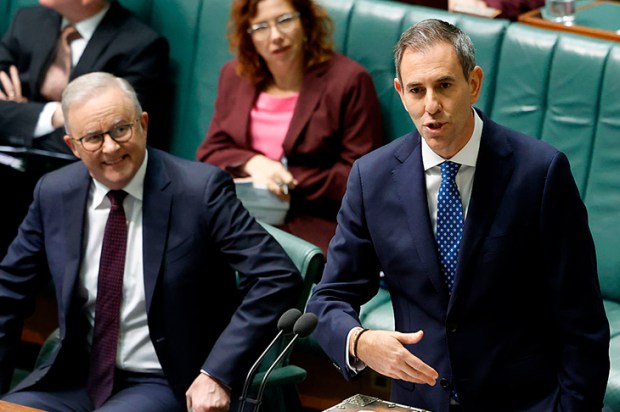
Last week, the federal government’s debt dial clicked over one trillion dollars. It’s a figure we should have avoided. But given that our gormless Treasurer, Jim Chalmers, is not predicting a return to budget surplus until the middle of next decade, this debt figure will continue to climb.
On Jimbo’s figures – OK, Treasury did the counting – government debt will reach $1.25 trillion by the end of the decade. This will amount to nearly 36 per cent of GDP. To put that in context, when the Howard-Costello government lost office in 2007, government debt was only $55 million or 4.7 per cent of GDP.
The point is that the deterioration in the federal government’s debt position has been catastrophic. Jimbo likes to pat himself on the back for our relatively low level of government debt by international standards, not that he can take any credit for this outcome. What he doesn’t want to emphasise is the speed of the deterioration in our debt position.
We all know that Jimbo’s strongest suit is his ‘don’t blame me’ routine. He’s like the little boy in the orchard holding the apples behind his back. ‘Not me,’ he tells the farmer who is wondering who stole the fruit.
According to Jimbo, a great deal of the debt was accumulated between 2013 and 2022. It’s certainly true that the Coalition government could have done a better job at restricting government spending and slowing the growth of debt during that time. Mind you, a great deal of fiscal repair was needed after the Rudd-Swan spend-a-thon in response to the Global Financial Crisis and this takes time.
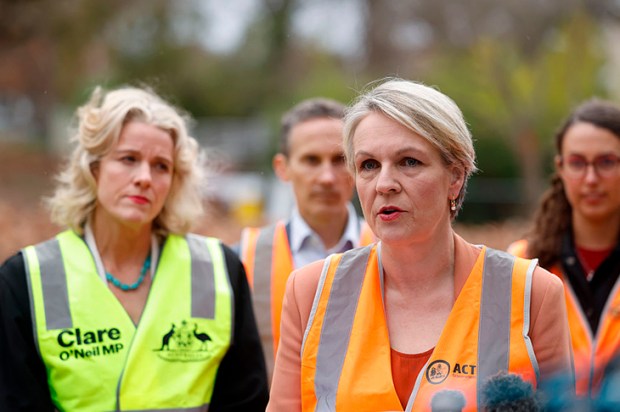
Let’s not forget here that Labor is always urging Coalition governments to spend more. It was during the Abbott-Turnbull-Morrison period that Tanya Plibersek – ‘Plibbers’ to Speccie readers – reinvented a rule of arithmetic by claiming that spending more amounts to a spending cut. If Labor says it’s going to increase spending by 20 per cent and the Coalition increases it by only 15 per cent, then that’s a cut, according to the Plibbers’ playbook.
(I’ve made this point before but let me make it again. What the hell was Joe Hockey, then Australia’s treasurer, thinking when he got rid of the legislated debt ceiling in 2013? Recall that he was having trouble negotiating with Labor to lift the ceiling. The Greens came on the scene and suggested that they would agree to remove the ceiling altogether.
Now having a debt ceiling doesn’t prevent government debt from increasing – see the US as an example of this. But it throws sand in the gears. It requires thought and action when a higher debt ceiling is required because of proposed higher net spending. Joe threw away that measure of restraint.)
And then came the dark Covid period. Any hesitation about cranking up unfunded government spending completely evaporated. But where was Labor in all of this? Spend more came the clear request, including on the poorly designed and vastly expensive JobKeeper program.
We must give Jimbo points for his brazen chutzpah claiming that, under his watch as Australia’s top money man, government debt is now lower than it would have been under a Coalition government. He even puts a figure on it – $200 billion.
Give me a break. Jimbo quotes a completely irrelevant figure from a forecast made in 2022 when the fog of Covid was just beginning to lift. He also fails to mention the fact that revenue has exceeded the forecast in that document by $400 billion – the combination of much higher-than-expected commodity prices and rampant bracket creep driving higher income tax revenue.
So, on this calculation, Jimbo has pissed at least $200 billion up against the wall. And we know this because we can look at the ratio of government payments to GDP to illustrate his profligacy.
In 2022-23, government payments as a percentage of GDP were 24.3 per cent; this financial year, the ratio will come in at 26.8 per cent. Believe me, that gap involves very serious dough and doesn’t even include the mass of off-budget spending that has been ramped up under the Albanese government.
One of the real troubles with much of the public discussion of rising government debt is the failure to acknowledge the need to pay it back as well as the cost of servicing the debt in the meantime. This is where the figures become very scary.
In 2010-11, net interest payments on federal government debt amounted to just under $5 billion or 0.3 per cent of GDP. This financial year, the figure is $20 billion or 0.6 per cent. By 2029-30, net interest payments are estimated to reach nearly $32 billion or 0.9 per cent.
Bear in mind here that there is a swag of government bonds issued during Covid at low interest rates that will need to be rolled over in the 2030s. This will substantially lift net interest payments again. The same phenomenon applies at the state level.
But my main reason for writing this column is not about the economics of rising government debt; it’s about the immorality of politicians doing so. Rising debt means foisting the burden of repayment on future generations who have had no say in its build-up in the first place.
It’s also about failing to keep a lid on the size of government. Higher debt leads to higher spending leads to higher debt. It’s the courageous, explicit political decision to reduce debt by cutting government spending – both Keating and Costello were able to do this, although in Keating’s case, only for a while – that is the only effective means of limiting the size of government.
Sure, flogging off government assets can help, but that avenue is relatively quickly exhausted. And at least in Costello’s case, he managed to quarantine some of the proceeds of the sale of Telstra and establish the Future Fund. It is now the biggest single asset the federal government has and is the key reason why there is a gap between gross and net debt.
The morality point is completely lost on Jimbo. He wants to expand the role of government in his quest to reinvent capitalism. The gap between the underlying and the headline budget position is growing. This is indicative of more off-budget spending saving bankrupt refineries, smelters and steelworks that are in trouble because of the federal government’s crazy energy policies. But Jimbo doesn’t see a problem.
He isn’t expecting a budget surplus until the mid-2030s, and even here, this is probably wishful thinking, a point noted by the head of the Parliamentary Budget Office. He calls it ‘optimism bias’. I could think of another word and it rhymes with pies.
A trillion dollars here and a trillion dollars there – the states are building up their indebtedness at a frightening rate – and, yes, we are talking real money. But it may take a complete rupture in the bond market for Albo and Jimbo to get a fright and reconsider their approach.
It might help if voters began to see the problem of debt and deficits, but that would require truthful communication from the Albanese government. It’s hard to see that happening any time soon.
Got something to add? Join the discussion and comment below.
You might disagree with half of it, but you’ll enjoy reading all of it. Try your first month for free, then just $2 a week for the remainder of your first year.