It is a tragedy that Jason Arday cut short his life after a slew of his impossible claims were exposed. He said he appeared in a Seven Up documentary 20 years before he was born, ran 1,000 miles in 12 days, and personally raised 5.5 million pounds for 80 charities, to name just three.
When Arday’s claims were challenged, he simply amended them. When it was pointed out that running 600 miles in six days was a near world record, he added in six rest days; the money for charities was raised not by him but by a syndicate; and he wasn’t in the Seven Up documentary but a community initiative.
Such dexterity with the truth suggests that after building his own ivory tower out of invented visiting professorships, unwritten books and research that he borrowed without attribution, the obvious next step should have been a career in politics.
After all, there are numerous ‘progressive’ politicians who have no problem believing six impossible things before breakfast, making six impossible promises based on them, and never admitting to making a mistake.
Our own Prime Minister is a shining example. He not only promised to cut power bills by $275 in 2025 and then raised them by $26 billion, when he was asked last year how much his commitment to cut emissions by up to 70 per cent by 2035 would cut power bills, he chuckled and said to the journalist, ‘You yourself laughed when you asked that question, so, it should be treated in the (same) way’.
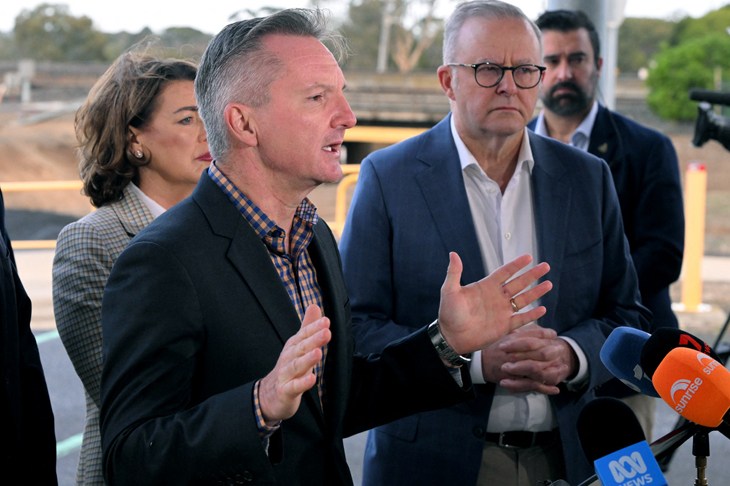
Oh, how we laughed. Our power bills are so cheap that Albanese and Labor Premier Chris Minns have gifted Rio Tinto $2.5 billion to keep the Tomago aluminium smelter operating for the next decade.
As Climate Change and Energy Minister Chris Bowen explained, ‘To remain competitive and secure its future, the smelter needs a reliable and affordable supply of renewable energy, with ageing coal-fired power options being prohibitively expensive’.
And he’s right. With Bowen’s policies in place, coal-fired power is indeed prohibitively expensive, whereas an affordable supply of renewable energy will only cost taxpayers $2.5 billion. And as Albanese pointed out, this $2.5 billion will save 1,000 jobs at a mere $2.5 million per job, not to mention saving the jobs of Albanese and Minns, they hope.
Such concern for workers makes the Coalition appear positively parsimonious in comparison. Egged on by Labor, it spent $112,000 per worker, protecting them from the killer Covid virus, most of whose victims were aged over 80 and a third over 90.
It would be unjust, however, not to mention the sterling efforts of Treasurer Chalmers, who, with the PM, promised more than 50 times before the last election not to touch negative gearing and capital gains tax. ‘How hard is it?’ Albanese asked a pesky journalist.
Too hard, we found out.
As Chalmers explained, ‘hand on heart’, he meant to keep his promise. He thought his efforts to boost housing supply and abolish the means test on government-guaranteed five per cent deposits for first home buyers would shoehorn every Australian who wanted one into their first home. Sadly, as he admitted, his efforts were ‘not quite sufficient’.
So, he had ‘chosen the hard road of reform rather than the easy path of least resistance’ and taken an axe to ‘landlord’s welfare’, aka negative gearing and capital gains tax.
He didn’t think the road would be that hard; however, as he confidently predicted, based on Treasury modelling, rents would rise by a trifling $2 per week, and house prices would also continue to rise by just some 2 per cent less.
As it happens, getting rid of landlord welfare forced the bludgers to raise rents by $7-$8 a week even in Chalmers’ suburb. Let’s hope it doesn’t hurt his job prospects.
Indeed, the National Australia Bank estimates that rents need to rise 25 to 30 per cent to cover the cost of Chalmers’ tax grab.
And since rent accounts for a third of housing costs, which are the largest factor in calculating inflation, Chalmers is keeping interest rates high.
Indeed, the Albanese government holds the record for keeping underlying inflation higher for longer than any government since records started more than 30 years ago.
As for house prices, instead of rising a bit more slowly, they are falling rather quickly, more than 5.5 per cent since March in Sydney and Melbourne and 2 per cent nationally and are expected to keep falling in 2026 and 2027 by 6 to 7 per cent nationally, driven by falls of more than 12 per cent in Melbourne and more than 14 per cent in Sydney.
Does this worry Chalmers? Not a bit. According to him, any criticism is ‘misinformation and disinformation and clickbait and B-grade partisan campaigns being run against the government’s sensible tax reforms’, as opposed to the A-grade partisan campaigns the government runs, claiming its opponents are going to axe superannuation and Medicare.
According to Chalmers, business is booming with ‘many more businesses being created’ thanks to his ‘big agenda to boost productivity and investment and drive growth’, with ‘more than 1.3 million new companies registered under the Labor Government’.
Certainly, the NDIS is growing like topsy with 25,000 registered providers. It is also true that a record number of fraudsters have been found amongst them, and an estimated $6 billion of the $45 billion scheme is misused annually. Apparently, criminal cartels across the world are targeting it.
Of course, the surge in new businesses is not just driven by the NDIS. There has been a rush to register companies as people move from trusts, soon to be taxed at 30 per cent, to companies, taxed at 25 per cent, and create companies to purchase shares rather than pay almost double the tax paid by individuals.
Chalmers claims there is a much smaller proportion of insolvencies than under the Coalition, undaunted by Asic’s annual insolvency data showing business failures rose to an historic peak of 14,722 in 2024-25 compared with the post-pandemic low of 4,912 in 2021-22, almost 80 per cent above Australia’s long-term pre-Covid average of around 8,200 company collapses per year. As for ‘boosting productivity’, there has been zero growth in it since Labor came to power.
Alas, Arday gave up too soon. In Australia, impossible claims come with Treasury modelling; their failure is merely misinformation, and the taxpayer foots the bill.
Got something to add? Join the discussion and comment below.
You might disagree with half of it, but you’ll enjoy reading all of it. Try your first month for free, then just $2 a week for the remainder of your first year.