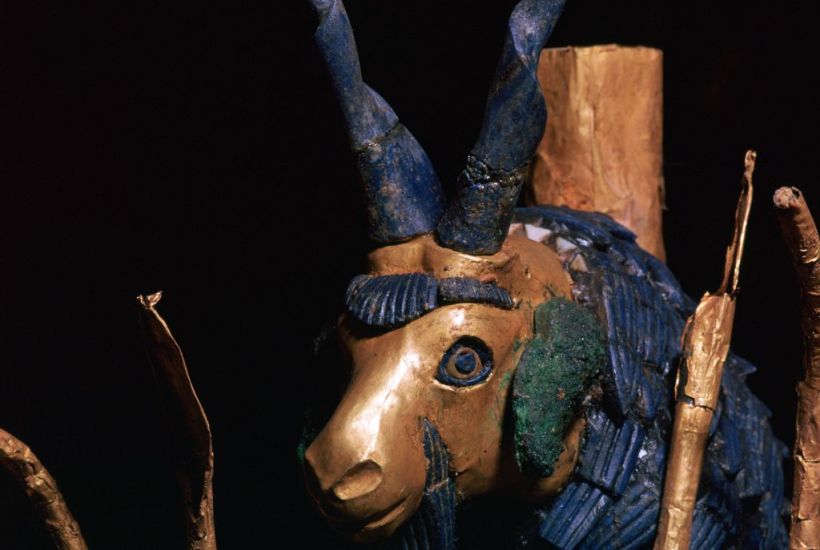
Like Abraham, I set out from Ur of the Chaldees to the hill country of Canaan, a journey of about thirty metres. Unlike Abraham, I was not allowed in. If you have been to the British Museum, chances are you have marvelled at the four-thousand-year-old treasures from the royal tombs of Ur in modern Iraq – especially the fabulous ‘ram in a thicket’ statuette, evoking (anachronistically) the fearful story of the near-sacrifice of Abraham’s only son. Without the timely appearance of that sacrificial ram, there would have been no son Isaac and no grandson Jacob (aka Israel, whose twelve lads fathered a nation). And nobody for the Islamo-Marxist alliance to focus its hatred upon.
Chances are you were able to move from Ur to the adjoining room, which displayed ‘The Iron Age kingdoms: Israel and Judah’. I was not, since it was roped off, and nor was the Jewish family next to me, who stood puzzled and peering at the one display in that vast museum which, the attendant told me, was ‘closed for maintenance’. Maintenance of peace, perhaps, since it was February 2025 and anti-Israel activists were clogging the streets of London with calls to erase the three-thousand-year-old Jewish homeland and replace it with a curious entity called Palestine. This craven peace prevailed as late as May this year, with the British Museum citing ‘intimidation’ as the reason to defer its presentation on ‘the histories of the kingdoms of Israel and Judah’ during Jewish Culture Month.
There was indeed a tiny piece of land called Palestine three millennia ago. The word Palestine comes from the word Philistine. Goliath, for example, was a Philistine, but his people were guilty of more than bogan bad taste: they were the Vikings of the Bronze Age, marauding Sea People terrorising the eastern Mediterranean. As historian Paul Johnson writes, ‘Around 1050 BC, having exterminated the coastal Canaanites, they began a large-scale movement against the interior hill-lands, now mainly occupied by Israelites.’
The twelve tribes of Israel, fresh out of Egypt, had likewise deprived the hill-country Canaanites of life and lodging, reclaiming the land once promised to Abraham. Let the London protestors march in the cause of ‘Land rights for Canaanites’! Let the ICC exhume the Jewish general Joshua from his 3,200-year-old tomb and try him for war crimes (along with every general of every nation of that era), but chanting about giving Israel to the Philistines, a long-extinct group of seafaring invaders who only ever colonised the coastline, is fatuous.
Look at a map of the Jewish Kingdom of David around 1000 BC with its capital in Jerusalem. You see a strip of coastal land called Philistia surrounding the township of Gaza. That was the full extent of the land of the Philistines (i.e. Palestine). From this sliver on the sea, Philistines were free to make forays against the Jews – albeit in a more manly fashion than their baby-killing gang-raping granny-slaying heirs in Hamas.
As the British Museum info-board suggests – captured on my iPhone from behind the barrier – ‘It might well have been the pressure of Philistine expansion that served as a catalyst to unify the scattered communities of Israelites’. Once unified, what a community and kingdom they became! Any of us who visit Israel have seen the richly excavated layers of that promised land and marvelled at the survival of David’s people in the most hostile neighbourhood on earth.
From the 8th century BC we peer down into the massive granary of the Israelite King Jeroboam at the walled city of Megiddo; from the 7th century we slosh along the tunnel in Jerusalem built by Hezekiah, thirteenth king of the Jews, diverting spring water in expectation of an Assyrian siege; movingly, we see part of Nehemiah’s wall from the 5th century BC after the Jewish survivors from Babylon sought to re-fortify their beloved city, and we watch today’s Jews weeping at the western wall of their temple, destroyed by Romans in the 1st century AD and usurped by Muslims in the 7th.
Israel is real like no other nation is real, not only with millennia of vividly documented history, but with a sacred national story that went global and has lost none of its symbolic power (just ask Jordan Peterson): slavery in Egypt, the Passover and the Exodus, Moses and the commandments, Babylon and back again – a spiritual epic unrivalled in the annals of humanity which continues to shape the human soul. For in the words of the second Joshua (as in Yeshua, as in Jesus – the one you can’t exhume), ‘Salvation is from the Jews’.
Palestine is the least real nation on the planet, a notion wrapped in an anachronism inside an ideology: a name and a place that perished with its Philistine namesakes 2,600 years ago when the Assyrians obliterated the towns around Gaza. Since then, the name of Israel’s foe has been wielded by enemies of the Jews, from Imperial Rome to Islamist Ramallah.
First in 135 AD, when Emperor Hadrian crushed a Jewish revolt and culturally cleansed the province of Judea by renaming it for their ancient enemy, Palestine. After Rome fell, the contemptuous place name largely faded from history; for example, there is no mention of Palestine in the entire Koran, dating to the 7th century – an awkward fact for Palestinian erasers of Israel. Hadrian’s anti-Semitic descriptor lay in the dust for seventeen centuries until Arab nationalists picked it up in the 1890s for the purpose of resisting Zionism.
Their newly fashionable label persisted under the 1920 ‘British Mandate for Palestine’ and so did the resistance: five Arab states waged war on Israel in 1948 after the United Nation’s partition of Palestine into a Jewish homeland to the west and an Arab homeland to the east.
Had the earlier British Mandate partition been embraced, there would have been a two-state solution in place for a century now, since Jordan was to be the new Arab Palestine.
Instead, the world’s oldest hatred rages, the world’s one indispensable nation resists, and the notion of Palestine remains little more than an Islamo-Marxist plot. A plot where our Prime Minster and his western Sydney MPs feel right at home.
Got something to add? Join the discussion and comment below.
You might disagree with half of it, but you’ll enjoy reading all of it. Try your first month for free, then just $2 a week for the remainder of your first year.