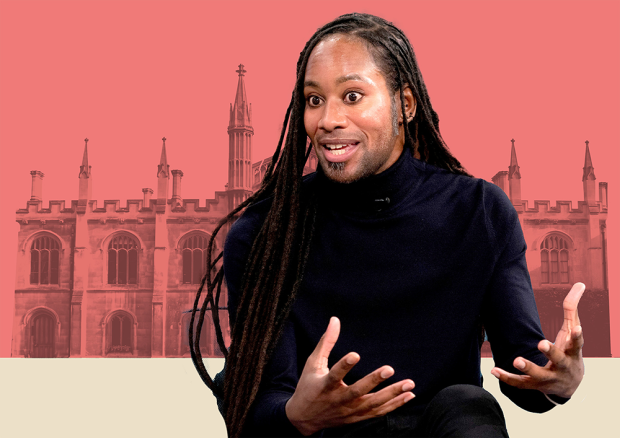
Poor old Gary Stevenson. Not that poor is an adjective usually attributed to the man who calls himself the ‘best fucking trader in the fucking world’. Despite writing a number one Sunday Times bestseller and with more than 1.6 million subscribers to his YouTube channel, Garys Economics (yes he does miss out the apostrophe), the self-styled ‘inequality economist’ has decided to pack it in. A nation weeps.
Everything about Stevenson feels forced
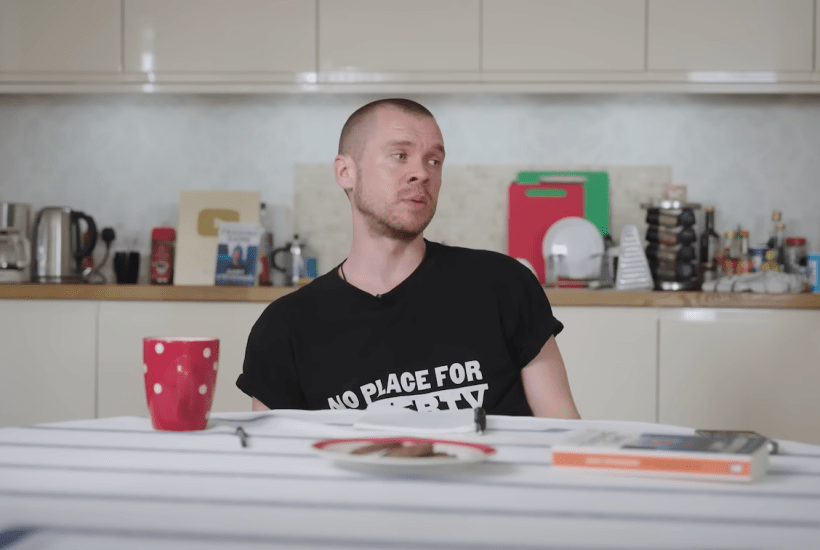
In a 48-minute address to camera while wearing a T-shirt emblazoned with ‘no place for poverty’, Stevenson delivers a stream of consciousness so self-absorbed that even Meghan Markle would consider it a bit much. After around 40 minutes of grievance-laced rambling, he eventually gets to the point: he’s quitting YouTube, citing ‘burnout’. Who knew that life on the professional self-aggrandising circuit was so exhausting?
The subtext throughout Stevenson’s diatribe is that he’s furious with the response to his recent Channel 4 documentary How to Get Filthy Rich. In it, Stevenson argues that Britain should introduce an annual 2 per cent tax on wealth above £10 million. Given this is his singular obsession, you’d assume he’d have thought about his proposal deeply enough to respond to the inevitable points of contention. And yet, time and again, when presented with an opposing view on his programme, Stevenson shuts down.
The telecoms mogul Bassim Haidar points out the obvious: that such a punitive wealth tax would simply cause investors like him to pull their money out of the UK. Andrew Henderson, founder of Nomad Capitalist, challenges the self-righteousness at the heart of Stevenson’s agenda, by saying ‘I don’t think life is fair and I think that fundamentally upsets people who talk about inequality because you feel entitled to rich people’s money’. But it’s the tax lawyer Dan Neidle who delivers the most incisive blow when he calls Stevenson’s proposal ‘absolute populist claptrap’.
Labour member Neidle is hardly the reincarnation of Milton Friedman, yet he dismantles the visibly shaken Stevenson when he calmly lays out the irrationality of his idea. When challenged on the risk of capital flight, Neidle labels Stevenson’s histrionic response as ‘totally unserious’. Then, when an increasingly agitated Stevenson asks Neidle whether he even cares about poverty, his reply is pitch-perfect: ‘you are unable to separate your emotional reaction to inequality from a rational assessment of the best tools for it.’
If Stevenson was hoping his documentary would serve as a clarion call for an eat-the-rich uprising, he’s been left bitterly disappointed. In a two-star review, even the Guardian called the film a ‘faintly embarrassing waste of time’, criticising his ‘adolescent bullishness’ and asking ‘has he simply spent too much time preaching to the choir and forgotten what it’s like to be challenged?’
There is something rather tragic about Gary Stevenson. A 39-year-old man-child, he seems to genuinely see himself as an expert, as if his A-level politics worldview is a universal truth and any challenge to it must come only from the devious or the deceived. His messiah complex means he simply doesn’t realise he’s just a left-wing activist with a social media presence. Hence why, when people push back against his increasingly outlandish claims, he behaves like an X Factor contestant who’s been told they can’t sing for the first time.
In truth, Stevenson is the Toni Basil of economic punditry – he has a single trite tune that he plays ad nauseam. His asinine agenda is perfect clickbait for the children of Corbyn, but like his fellow traveller Zack Polanski, there is always something implicitly narcissistic about the way Stevenson chooses to present himself. While the Green party leader behaves like an overgrown theatre-kid, Stevenson’s brooding public persona is unnecessarily performative in its own way.
From his videos filmed from his kitchen, while his gold YouTube plaque sits casually on the counter behind him, to his uniform of T-shirts and hoodies, everything about Stevenson feels forced. His constant need to reassert his supposed credentials, such as his MPhil in economics or his widely debunked claim to have been the world’s best trader, makes his need for validation as transparent as it is pathetic. Watching his content it is impossible to escape his self-aggrandisement, such as his claim to have ‘the biggest political show in the country’, which is demonstrably false.
Deep down, I suspect there is a sharp mind struggling to escape the constraints of Stevenson’s self-conceit. To have gone from a low-income household to being a millionaire aged 25 takes talent and industry. But through an astonishing lack of intellectual humility, Stevenson has burdened himself with the inability to reflect and grow, which in turn makes him incapable of becoming the effective anti-poverty campaigner he purportedly aspires to be.
So if this really is the end of Gary Stevenson’s brief intrusion into public life, and I somehow suspect it isn’t, then it’s to be welcomed. For those of us who believe in free-market economics we should accept good-faith challenges from the left. But Stevenson never acted in good faith. His fatal flaw was to see those who opposed him as the mouthpieces of a corrupt elite. It always seemed beyond his comprehension that there are those who, when presented with the same set of facts, arrive at a different conclusion. Perhaps his next degree should be in self-reflection.