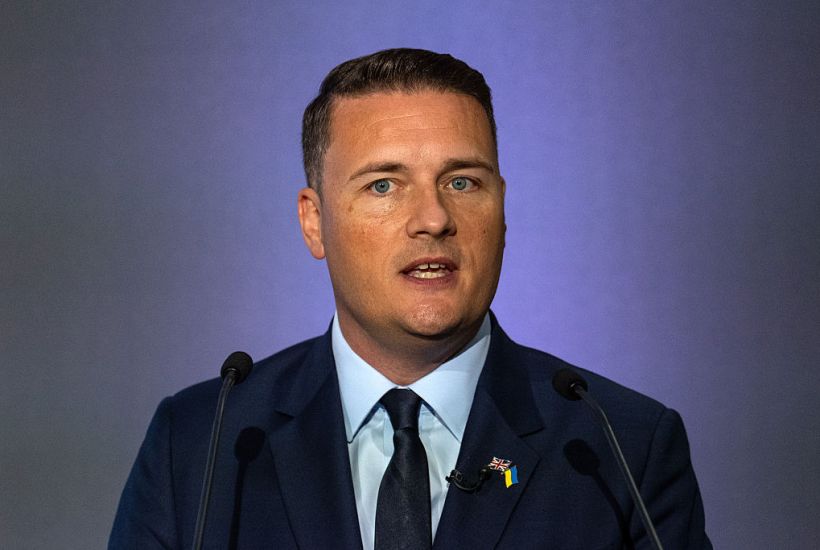
As Hamas leader Khalil al-Hayya, in his first speech as head of the terrorist group’s political bureau, promised to ‘continue on the same path and footsteps as before, carrying the banner high, until it flies over Al-Aqsa (Jerusalem) and the lands of a free and proud Palestine,’ Britain’s new Defence Secretary was also making his own promises to diminish Israel.
Labour’s strange fixation on Israel appears increasingly driven by the need to satisfy a political constituency that treats each concession as the starting point for another demand
Just two days into his new job, Wesley Streeting declared that he ‘fear[s] Israel has fallen short’ of British military standards in Gaza. It is an extraordinary claim from a man who has been in the job barely long enough to set up his computer login, but long enough to have attracted the criticism of former army chief Richard Dannatt, who said Streeting ‘knows pretty much the square root of nothing about defence’.
As Britain adjusts to its new Prime Minister and his new choice for Defence Secretary, Hamas is also under new leadership, with al-Hayya promising the terrorist group will ‘continue to act across all fronts for Gaza, the West Bank, Jerusalem.’ When it comes to their policy on Israel, Messers Streeting and Burnham seem determined to do the same, following on from Keir Starmer’s decision to ‘recognise’ a Palestinian state which has no defined borders, population or just about any other required feature of statehood. No matter: it is Israel which has ‘fallen short’ and must be punished. The invaders of October 7th shall reap the rewards of British recognition and a tsunami of British taxpayer money in aid.
Streeting had already decided Israel was guilty of war crimes when he texted his pal Peter Mandelson months ago. But what has he seen during his first two days at the Ministry of Defence that has enabled him to assess the conduct of one of the most complex urban wars in modern history? Which operational briefings, legal assessments or intelligence reports have led him to conclude that Israel has failed to meet British standards? What exactly confirmed to him that he was right to judge a state defending itself against both the gathered proxy forces of the Islamic Republic of Iran, its own formidable arsenal of ballistic missiles, and also a worldwide campaign of disinformation and condemnation?
Streeting acknowledges his own lack of military experience or knowledge – ‘that’s precisely why the Prime Minister hasn’t asked me to be chief of the defence staff’, he said on Wednesday. But there have been many who do have experience in the military who have been brave enough to speak out against the populist trend to trash Israel just as it is fighting its toughest war of survival.
General Sir John McColl, the former Deputy Supreme Allied Commander Europe at Nato, said after visiting Israel that the IDF’s procedures under the law of armed conflict ‘are as strong as ours’. He said Israeli forces were doing ‘their absolute level best’ to minimise civilian casualties. He compared it to ‘dealing with Falluja in 2004 where British troops dealt with suicide bombers hiding behind civilian shields, booby traps everywhere, but the difference in Gaza is the extraordinary tunnel mechanism that they have there.’ It seems, then, that British military standards never had the same level of stress testing as the harsh reality in the Gaza strip has provided for the IDF.
Colonel Richard Kemp, who commanded British forces in Afghanistan, has called the war-crimes framing erroneous and has long argued that the IDF operates to an exceptionally high standard. General Martin Dempsey, the former Chairman of the US Joint Chiefs of Staff, said Israel went to ‘extraordinary lengths’ to limit collateral damage and civilian casualties.
The High-Level Military Group, whose members included senior officers from Britain, Germany, America, Australia, Spain and France, concluded that Israel’s conduct met, and in some respects exceeded, the standards Western militaries set for themselves. John Spencer, a leading scholar of urban warfare, has described Israel’s civilian-harm mitigation measures as the ‘gold standard’.
Wes Streeting may disagree with all of them. But he should explain why. A serious accusation requires more than self-assured bluster.
The government’s wider position is equally difficult to defend. Before taking office, Andrew Burnham praised restrictions intended to ensure that ‘no British bombs or bullets can be used by the IDF in Gaza or in the West Bank’. Streeting hinted at more to come. It is a pleasing slogan for Labour activists. Strategically, it is almost comically detached from reality.
Britain supplies less than 1 per cent of Israel’s defence imports. Israel, meanwhile, has overtaken Britain as the world’s seventh-largest arms exporter and accounts for 8.2 per cent of British arms purchases, second only to the United States.
The dependence runs through Britain’s armed forces. The British Army’s Watchkeeper drone is heavily based on Elbit’s Hermes 450 platform. The Ministry of Defence has acquired IAI-designed Jaguar remote patrol vehicles. Elbit Systems UK supplies thermal sights, radar components and synthetic training systems used to train tens of thousands of British soldiers.
This week, Yuval Steinitz, chairman of the state-owned Rafael Advanced Defense Systems, spoke to me exclusively for my podcast. He described how British Typhoon aircraft use Rafael’s Litening targeting pods for long-range detection and intelligence, and said the Royal Air Force was the first in the world, even ahead of the IDF, to adapt the system for intercepting drones and cruise missiles.
He also explained that Israeli air-defence systems are already used across Europe, including David’s Sling in Finland and other Rafael systems in numerous European countries. Britain is debating how to prevent marginal British components from reaching Israel while depending upon Israeli technology to see, target, train, patrol and defend.
Steinitz’s most important point was moral as well as strategic. Russia and China will continue supporting and even arming Iran. Iran will continue arming and directing forces committed to Israel’s destruction. Withholding weapons from Israel under those conditions creates no balance. It weakens one side while leaving the other side’s supply lines intact. As Prof. Steinitz told me, those seeking to deprive Israel of the means to defend itself ‘pave the way for the destruction of Israel’. That is the unavoidable implication of an embargo imposed upon Israel while Iran and its proxies remain armed.
Labour’s strange fixation on Israel appears increasingly driven by the need to satisfy a political constituency that treats each concession as the starting point for another demand. Partial restrictions produce calls for a complete embargo. Sanctions produce demands for isolation. Criticism becomes accusation, accusation becomes punishment, and punishment becomes policy.
It is entirely understandable why a weak and scared Labour government would start to tiptoe down this slippery slope, gradually building up a momentum until they are hurtling towards a constantly moving finish-line of ever harsher condemnations and the eventual ostracism of Israel. For them, it is the path of least resistance. It is also morally wrong, because Israel is a state fighting for its survival after an unprecedented invasion of 6,000 Palestinians set off a regional war aimed at its destruction. To try to disarm the Jewish state in this precarious moment is to risk what Steinitz called a potential second Holocaust. To do so out of political expediency rather than moral or evidential certainty is both unforgivable and self-defeating. It signals weakness, foolishness, and strategic blindness.
Israel this week raised its alert level to its highest since Operation Roaring Lion, as the United States looks to be preparing a major escalation of its military campaign against the Islamic Republic of Iran in the coming days. Britain should be preparing to support Israel in this decisive moment, not throwing it under the bus.