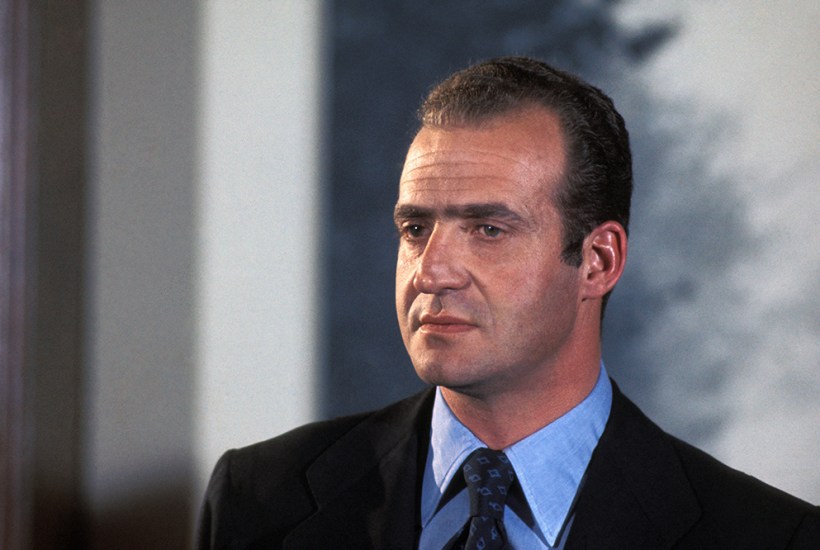
The life of Juan Carlos I, Spain’s 88-year-old former king, who reigned from 1975 until his abdication in 2014, falls into two parts: richly deserved triumph followed by richly deserved disgrace. Building on his 2004 biography, Juan Carlos: A People’s King, Paul Preston’s account of this extraordinary life is magisterial.
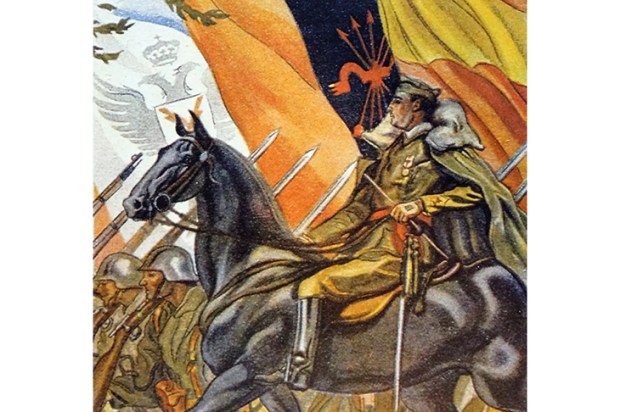
The son of Don Juan de Borbon, the exiled heir to the Spanish throne, Juan Carlos was born in Rome in 1938. With a view to the eventual restoration of an authoritarian monarchy, he was sent to Spain, aged ten, to be indoctrinated in General Franco’s political tenets. He also had to endure the dictator’s long lectures on the mistakes made by previous Spanish monarchs. Preston may exaggerate slightly in saying that the boy had effectively been ‘sold into slavery’, but he was certainly very lonely. ‘This child radiated affection, though they only ever spoke to him about duties and responsibilities,’ one of his teachers later recalled. ‘I am watched always,’ the young prince told his father.
Among several rivals, he eventually emerged as the favourite to be named successor upon Franco’s death, a position that heightened the acute tension of his daily life. Though he believed that the monarchy would manage to survive in a democratic Spain, he nevertheless had to manifest commitment at all times to the continuation of the dictatorship. His telephone was tapped and his servants were paid to report on his every move to Franco. For 20 years, he later remarked, he had to pretend to be an idiot.
The scrutiny intensified further when he was officially nominated Franco’s successor in 1969. Many remained deeply suspicious of his political inclinations and the dictator’s family wanted him replaced by a rival Borbon who had married Franco’s granddaughter. The jostling for power grew more urgent as ‘the biological fact’ (the euphemism for Franco’s death) became imminent. The collapse of the neighbouring Portuguese dictatorship in 1974 confirmed the Francoists’ worst fears. Franco himself reportedly started taking a machine gun to bed with him, and died the following year.
When Juan Carlos was proclaimed king on 22 November 1975, he was nicknamed Juan Carlos el Breve – suggesting a short reign. The Francoist establishment was determined to prevent change at all costs. Astonishingly, the prime minister regularly visited Franco’s tomb to commune with his spirit and request his political revival to thwart the king. Meanwhile, among the opposition there was a massive pent-up demand to dismantle the dictatorship as quickly as possible.
As Harold Wilson observed, the new king certainly had ‘a very hard row to hoe’. He longed to give away the immense powers that Franco had bequeathed and become a constitutional monarch, but for several years he had no option but to play a dangerously active role in the political arena. In the face of terrorism – right-wing, left-wing and Basque – he proved himself shrewd, ruthless and audacious. With tireless energy, courage and consummate skill he and a new prime minister, Adolfo Suarez, used the authoritarian system against itself to initiate democratic reform.
His supreme test came in 1981 when, facing down an attempted coup, ‘only he stood between Spanish democracy and its destruction’. Grateful Spaniards poured out onto the streets: ‘We thought we deserved better than a king, but it turns out that we got a king better than we deserve.’ Nevertheless, after decades of sacrifice, a weary Juan Carlos was beginning to feel that it was now time to attend to his personal wishes: ‘In that shift from sacrifice to indulgence,’ Preston suggests, ‘his downfall began.’
While Franco left Spain only three times during his almost four decades in power – to see Hitler, Mussolini and the Portuguese dictator Salazar – Juan Carlos made 242 visits to 102 countries, projecting Spain’s image abroad, promoting business and fostering international links. But he was also giving free rein to his ‘financial acquisitiveness… and unbridled sexual appetite’.
The final 100 pages of this excellent book make for sad reading. With increasing media scrutiny, Juan Carlos’s reputation is trashed and the moral capital he had earned squandered. One implausibly high and precise estimate is that he had sexual encounters with 4,786 women. Preston notes that Andrew Morton has ‘put the figure at a more modest 1,500’. Rumours of illegitimate children, public sympathy for his long-suffering wife Sofia, munificent gifts of dubious origin, suitcases full of cash, corruption charges against his close family and 17 major operations resulting from sporting accidents and a licentious lifestyle all contributed tohis abdication.
Still, as Juan Carlos enjoys his luxurious, self-imposed exile in Abu Dhabi, he can reflect that his sober, hard-working son Felipe VI is successfully securing the dynasty – while also agreeing with Preston on ‘the immense utility of the monarchy in providing a neutral headship of state in a highly conflict-ridden country’.
Got something to add? Join the discussion and comment below.
You might disagree with half of it, but you’ll enjoy reading all of it. Try your first month for free, then just $2 a week for the remainder of your first year.