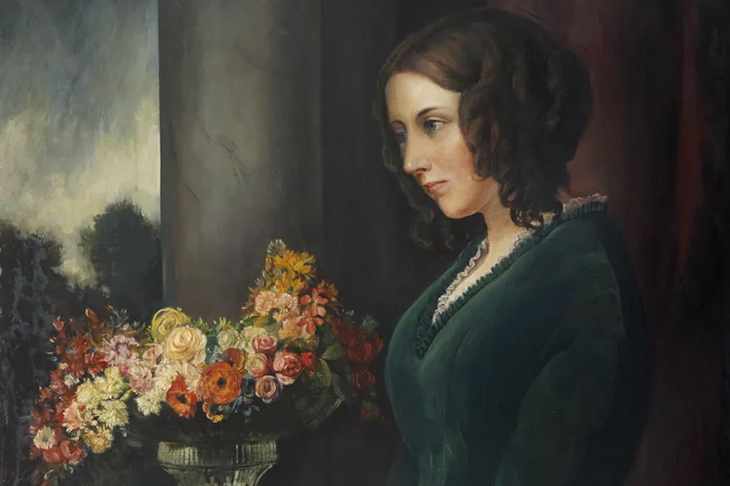
For every smog-spitting chimney in Victorian London there was a woman tasked with keeping the hearth clean, both physically and morally. This ‘angel in the house’, as Coventry Patmore dubbed her, lived entirely for her family, but above all for her husband. With her organs tightly compressed beneath a whalebone corset, she ministered to his every need and forgave him all his worldly sins. She was, in short, not a real woman but an ideal.
In Mrs Dickens, Emily Howes exercises the novelist’s prerogative to flesh out an ideal, to show how the real woman beneath her halo of thorns suffered. We meet Catherine Hogarth on the cusp of her engagement to the novelist Charles Dickens, whose veneration of women as ‘the better sex’, ‘the tenderer, the purer of heart’, stirs in her a desire ‘always to be kind’, to be his ‘balm’ – the Little Dorrit to his inimitable Boz. As if writing her into being like one of his heroines, Charles moulds Kate into a doting wife, whose hair is styled according to his preference and whose feelings are always secondary to his own.
Charles moulds Kate into a doting wife whose feelings are always secondary to his own
A psychotherapist by training, Howes casts Dickens as a coercive controller. Everything, from the arrangement of the furniture to the choice of headstone for Kate’s dead sister, comes under his exacting jurisdiction. Even Kate’s shrewd maid, Anne Brown, whose below-stairs view of the marriage is given to us in alternating chapters, is eventually brought to heel. But, ultimately, it is Kate who suffers the most: Kate the ‘indolent woman’, who is ‘as near to being a donkey as one of her sex can be’, as Charles cruelly describes her; Kate, the woman who bore him ten children, only to be pushed aside for a younger woman with a slimmer waist.
It was George Bernard Shaw’s view that posterity would sympathise more with Kate than with Charles. How right he was. But our sympathy is not inexhaustible. If Howes’s novel is like a mangle, designed to wring out every last drop of compassion for poor Mrs Dickens, then the reader is wrung dry. By the end, for all his cruelty, it is with longing that we wait for the charismatic Charles in his yellow waistcoat to re-enter the room. There is a reason why millions of people still read David Copperfield while Kate’s cookbook languishes in obscurity – and no amount of artistic licence can change that.
Got something to add? Join the discussion and comment below.
You might disagree with half of it, but you’ll enjoy reading all of it. Try your first month for free, then just $2 a week for the remainder of your first year.