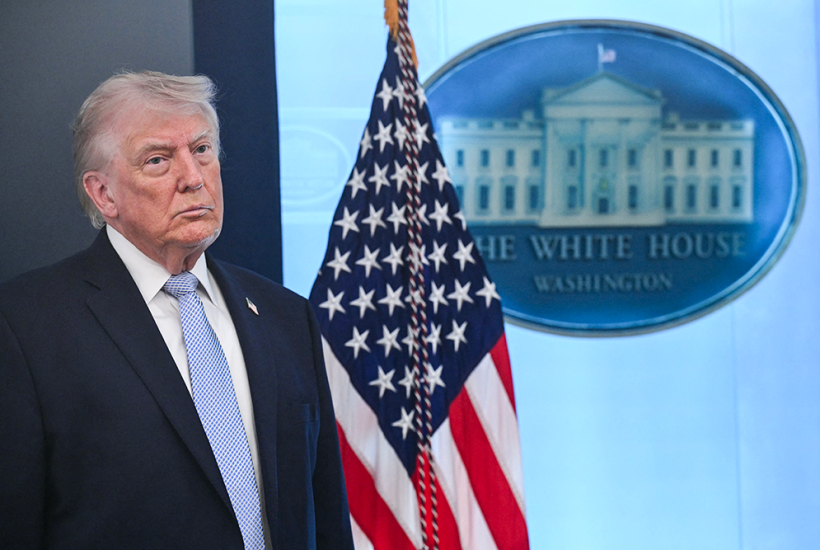
If, as Donald Trump had threatened, ‘a whole civilisation’ had died on Tuesday night, the whole civilisation concerned would have been that of the United States, not of Iran. If an American president had deliberately ordered the death of a civilisation – whether or not such a thing is achievable – America’s claim to world leadership would have collapsed. Like, I suspect, many, however, I did not go to bed that night thinking that Trump would carry out his threat. I remember my parents telling me that, during the Cuban missile crisis, people truly believed there might be nuclear conflagration at any moment. It did not feel like that this time. It felt as if Trump had said something frightening and horrible in order to be able to claim mastery over whatever was going to happen next. In one sense, this tactic sort of works: the enemy is kept guessing. In another sense, it does not work at all: no ally can follow or assist Trump without being degraded or humiliated in the process.
In Shia Islam, the 40th day after death (arba’in) marks the end of mourning. It is now more than 40 days since the announced death of the Supreme Leader Ali Khamenei but still no known or reported funeral ceremony. Islamic law is strict about the need to bury the deceased within 24 hours. Did this happen to Khamenei? Has his funeral taken place? If he is buried, where? I have been checking the careful and elaborate rules which govern all stages of a believer’s death and burial. There are various ‘detestable acts’ (makruhat), such as inserting camphor into the nose of or leaving women alone with the deceased, which must be avoided. There is no stated provision for long-term emergency refrigeration, so we must assume that the funeral has happened. If so, its secrecy has deprived Iranian people (or rather, Iranian men – it is a ‘detestable act’ to let women attend) of the chance to join the funeral procession and thus attain the ‘virtue’ which, they are taught, will serve them well with the angel on the day of resurrection. I have noticed a widespread belief in the Muslim world – based on the alleged fact that his body was never produced by the Americans – that Osama bin Laden is not dead. Will a similar belief take root about Ali Khamenei? If his father is thought to be alive but occulted, his son and declared successor, Mojtaba, will, if he is conscious, be in a peculiar position.
One could almost hear the sigh of western media disappointment at the weekend when the American navigator and weapons systems operator whose plane was shot down over Iran was successfully rescued by US special forces (with Israeli help). So many pieces to camera or for other media were champing in the starting gates. This was Donald Trump’s Jimmy Carter moment, they would have said, another US president broken by Iran. The hostage crisis was exposing Trump’s weakness and making him politically vulnerable. Plucky little Iran could fell the American Goliath. It was not to be. Just as superior communications had enabled Israeli and US forces to kill 40 or so named, targeted leaders of the Iranian regime, so they could keep track of their wounded man in enemy territory long enough to rescue him in daylight. The same media carefully downplayed this astonishing recovery. Imagine how excitedly and positively it would have been presented if the president had been Barack Obama.
Last year’s Strategic Defence Review, commissioned by Sir Keir Starmer on coming into office, said: ‘The government must have… the means to prepare and respond as threats to the UK or its allies escalate and – crucially – before crisis becomes war. Existing legislative frameworks lack the flexibility to facilitate this. New home defence legislation, in the form of a Defence Readiness Bill, should give the government additional powers in reserve to support the mobilisation of industry and Reserves.’ (The bold type is in the original.) This week, it was revealed that the Defence Readiness Bill has been delayed for a further year. Not only do we lack defence readiness: even a bill to help enable defence readiness is itself not ready. It is beyond satire.
A junior doctor explains to me why colleagues have an incentive to strike, even if they don’t really want to. Suppose it is your roster, as it often is, for four 12-and-a-half-hour sessions of night duty. Due to an arcane court judgment, the pay you lose for striking is calculated at only 1/365th of your annual pay, the equivalent of five hours per day worked. Your night-roster enhancement is baked into your contract for each month, so you will be paid it whether you are on strike or not. If you strike on a night shift, therefore, you will still be paid for seven and a half hours. That is pretty attractive, especially if you have a family. You would have to be very dedicated to go in and break the strike for the exhausting and unpleasant 12-and-a-half-hour shift, rather than avoid all the argy-bargy, play on the beach (or whatever) and still get seven and a half hours’ pay.
Since I founded the Rectory Society more than 20 years ago, we have had only two lay Patrons. The first was Deborah, Duchess of Devonshire (‘Debo’). The second was Sir Tom Stoppard, who died in November last year. I am delighted to announce our new Patron. He is Vice Admiral Sir Timothy Laurence, husband of the Princess Royal and current chairman of the Science Museum. His more directly rectorial qualifications are that he spent much of his childhood in his grandfather’s Lincolnshire rectory and is a former chairman of English Heritage. I like the spread our three distinguished Patrons represent – aristocrat, playwright, sailor. Collectively, they embody the society’s founding text: ‘In my Father’s house are many mansions’ (John 14:2). Our Ecclesiastical Patron, unchanging as the eternal rock, is Lord Chartres, former Bishop of London.
Got something to add? Join the discussion and comment below.
You might disagree with half of it, but you’ll enjoy reading all of it. Try your first month for free, then just $2 a week for the remainder of your first year.