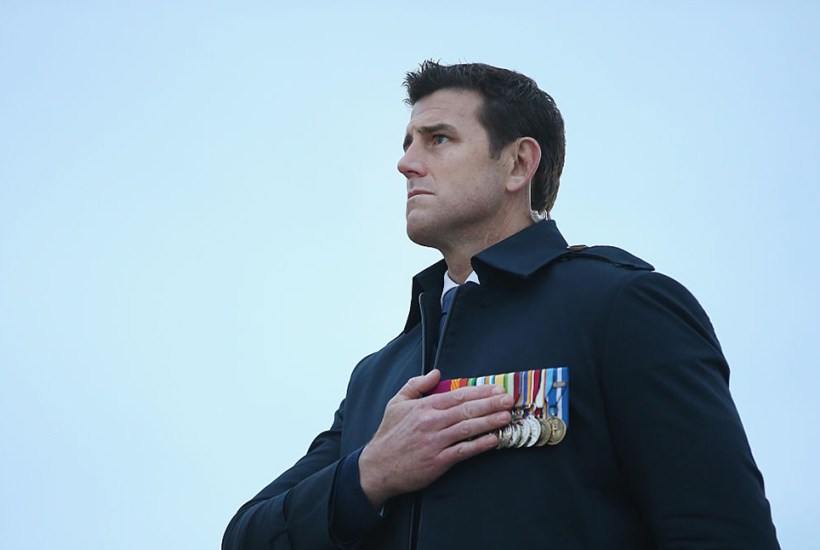
So Ben Roberts-Smith has been arrested, and his life will never be the same again. Over the next few years as the trial process unfolds it will be well to remember that battlefields are extremely confused places, and some are much worse than others.
Warfare against regular uniformed combatants, such as that seen between the Allies and the Axis powers in World War II can be bad enough. The fighters on both sides wore uniforms, and although battle is rarely straightforward it had some quite clear expectations. You could expect an enemy soldier to be identifiable through his uniform and helmet. He would attack you, and you would respond. But wars without clear groups of combatants and clear free-fire zones are the stuff of nightmares. Even the first and second world wars had this sort of confusion – with lethal and tragic results.
Henry Metelmann, fighting in the German Army, saw several of the Panzer tanks in his unit blown up by mines concealed in the roads. Eventually the soldiers found out who had been planting these at night: a Russian civilian woman of around 60. She was summarily condemned to death, and the sentence carried out by the Germans the next morning. There was no mercy for such part-time disguised soldiers.
Guy Sajer, fighting on the same front in the Wehrmacht, had his first experience of combat in a small action which saw one guerilla wounded, and another killed. When he tried to get the wounded man onto a passing train full of casualties being taken to the rear, the lieutenant in charge was incredulous. ‘Do you really think I’m going to saddle myself with one of those bastards who’ll shoot you in the back any time…?’ and he ordered two soldiers to execute the partisan immediately.
Spies are routinely despatched without trial. Australian soldier Albert Jones noted five days after the Gallipoli landings that some German and Turkish officers had been caught ‘wearing our uniforms: they were quickly dealt with’.
Robert Graves describes the execution of two spies in the early days of the Western Front: one a civilian sending information to the enemy, and the other a German in a British corporal’s uniform interfering with telephone wires.
Suspicion could be enough to warrant the quick execution of a civilian even suspected of being a spy: Brigadier-General F.P. Crozier related such an incident in his account of the Great War. A farm labourer was thought by a British officer to be passing on information on troop strengths and locations, for after he left the farm for the day the British positions would be shelled. The officer mentioned it to a French interpreter, and the labourer was quickly shot. Is this a war crime?
Back in World War II, Cam Bennett, an officer in the Australian Army, was too dazed and confused in the retreat in Greece by Allied forces to wonder why a supposed naval officer in civilian clothes was wandering around asking the soldiers who they were. His sergeant was more suspicious, and arrested the man at pistol-point. He asked Bennett to accompany him behind a building where the would-be spy was given the opportunity to say any final words; he gave the Nazi salute and a ‘Heil Hitler’ and was shot.
The sort of fighting Australian troops saw recently in Afghanistan was more grey than that. It relates very much to the Vietnam War. There one of the old sayings was that a local man could be ‘a farmer by day, and a Vietcong by night’. Then he would be out with a fighting group, mounting an attack on an Australian base.
So if you were defending that base, could you shoot at a black-clad figure? Most nations’ rules of engagement would say you had the right of self-defence, but what if you made a mistake, and that shadowy figure turned out to be a local wandering home late?
Marine John Daube recalled, ‘One day a Vietnamese boy about eight years old approached our group wearing a knapsack. It looked like the bookbags kids use today. It was in the middle of the summer, so we were pretty certain there was no school. A reflection of the sun highlighted a wire that ran over the kid’s shoulder and down his arm. One of the Marines shot him. As the child fell, he pulled the wire and blew himself up.’
Private John O’Halloran was on patrol on his second day in Vietnam, and recalls, ‘We were walking down a road, and coming from the opposite direction was a woman and a little baby in her arms. The Sergeant told us to watch out for a trap, because the VC use women all the time. We were maybe 15 feet from her and she started crying like a baby. I didn’t know what was going on, and the next thing I know the Sergeant shot the hell out of the both of them. She had a grenade under the baby’s blanket….’
Most soldiers probably reflect on the possibility of killing civilians by mistake, but until the time comes, when one has to make that decision, it is probably not easily understood. In any war against an enemy who can become a combatant simply by taking up arms, there will be inevitable confusion, mistakes, mayhem and death. If one side breaks the rules, the other side soon follows. For civilians seeing conflict on their TV screens, they will inevitably rail against the seemingly savage and morally wrong dimensions of the war. Yet, not being there, and seeing only a fragment of the picture, leads to distortion of the reality of what is often self-defence.
Anger and revenge often play a part. It is the same in all battles: the rules of surrender must be adhered to or dire consequences follow. In World War I a Turkish sniper ‘…put up his hands but still held his rifle and fired point blank. Instantly, the Australian swung his rifle and struck the head of the Turk. There was no need for a second blow….’
Australian troops at Passchendaele stormed a two-storey pillbox and the survivors in the lower section had begun surrendering when a shot from the upper storey was fired, killing one of the Australians. They immediately shot all of the Germans.
Captain Ambrose Cull tells of a similar incident in the early days of the European campaign, when three Germans surrendered in a dugout, and then as they came out with their hands up two of them suddenly reached for revolvers and opened fire, hitting one of the Australians; their sergeant responded with three shots of his own, killing the two Germans. Then the Australians opened up on every other one of the enemy in the trench, killing around 60 of them.
So are these war crimes, or this just the bitter cruel reality of war?
Got something to add? Join the discussion and comment below.
Dr Tom Lewis OAM is a military historian. This analysis is drawn from his book ‘The Truth of War’, published by Big Sky.
You might disagree with half of it, but you’ll enjoy reading all of it. Try your first month for free, then just $2 a week for the remainder of your first year.