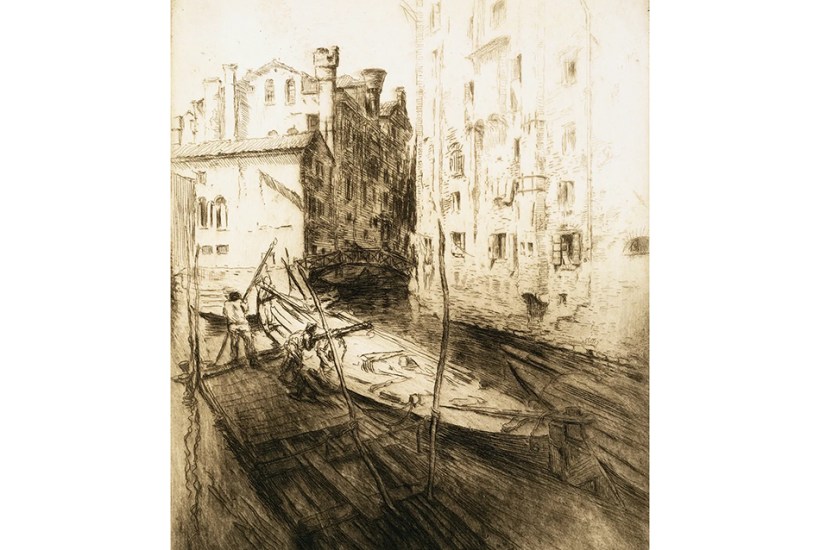
The word ‘ghetto’ is said to derive from the Venetian dialect term for ‘foundry’: ghèto. In the early 16th century, on the orders of the Doge, Jews were herded en masse from the centre of Venice to the Ghetto Nuovo, or New Foundry district, where metal workers had long cast cannon for the Venetian fleet. The Ghetto – the first of its kind on the Italian peninsula and anywhere in the world – became a model for segregated Jewish quarters throughout Europe. It was soon blighted by poverty, malnutrition and disease. The Ghetto Nuovo was a landmark in the history of Jewish persecution.
In this fascinating history of the New Foundry and its inhabitants, Alexander Lee conjures the Adriatic seaport in all its strange glory. Beyond the scenery of gondolas and tulip-shaped chimneys was a hidden, gated world of sorrow and derision. The Holy Inquisition, which operated in Venice with papal blessing from the 1560s onwards, gleefully indicted the Jews as slayers of Christ and Christian children. Worse, the ‘infidel Israelite’ was a moneylender. The charge of usury had the usual anti-Judaic connotation in Inquisition-era Venice, yet, as Lee points out, the city was reliant on the Ghetto merchants for its glittering prosperity. At best, Jews were grudgingly tolerated.
In densely researched pages, Lee chronicles the Ghetto’s polyglot intermingling of communities from Germany, Spain, Portugal and the Ottoman empire. Expelled from anti-Semitic Castile and Aragon in the 1490s, Iberian migrants or Sephardim (after Sefarad, Hebrew for Spain) found a welcoming refuge in Venice. By the mid-17th century the Ghetto had become the most thriving outpost of diaspora Jewry in the Adriatic, with infusions also of Ashkenazi Jews from northern Europe. At different times, Sephardim and Ashkenazim alike were vulnerable to the rack and burning tongs of the Inquisition.
In a stirring chapter, ‘The Burning of the Gates’, Lee chronicles the Ghetto’s liberation by Napoleon Bonaparte when the armies of the new French Republic invaded from across the Alps and extended the Rights of Man to Italian Jews. After the gates of the Ghetto Nuovo were torn down in 1797 by Napoleon, a tree of liberty was planted in the main square and a number of the 1,600-odd inhabitants chose to name their newborn sons Bonaparte in honour of the emancipator.
As it turned out, Jewish civil liberty lasted scarcely two decades until the end of the revolutionary era when, in 1815, the Austrian empire in Italy revoked many of the equalities granted by Napoleon. Venetian Jewry was reconsigned to a bureaucratic segregation, if not physically to the Ghetto, which had been dismantled for good.
In 1848, while much of Italy was convulsed by revolution, Venice rose up against the Austrian occupier and declared an independent Venetian republic. Venetian Jews joined forces with the thousands of volunteers who supported the anti-Austrian revolt led by the patriotic lawyer Daniel Manin, who was himself of Jewish descent. Morale collapsed in the besieged city after food and water shortages combined with outbreaks of cholera. The unequal combat lasted more than a year while Venice was pulverised by Austrian howitzer. Venice capitulated on 24 August, to become once again a fiefdom of the abhorred Austro-Habsburgs. Manin fled into exile in Paris, where he taught Italian to, among others, Charles Dickens.
A surprising number of Venetian Jews supported Mussolini in the early days of fascism. Among them was the journalist Margherita Sarfatti, one of the Duce’s many mistresses, who exerted a stronger influence on fascist Italy than is generally realised. She was one of the masterminds behind the regime’s pompous celebration of classical Rome. Her bestselling 1926 biography, Dux, exalted Mussolini as a godlike manifestation of romanità (‘Romanness’). Yet Sarfatti’s name was dirt once Mussolini had committed Italy to Nazi Germany’s anti-Semitic cause. As Lee reminds us, a latent tension had always existed between fascism and Italian Jews. Zionists in particular were seen by Mussolini as a self-regarding, supranational ‘sect’ inimical to the Blackshirt bond of blood and belonging. (‘They are carrion,’ he said of Jews in private.) Sarfatti managed to escape German-occupied Lombardy, but her sister Nella died on a transport bound for Auschwitz from the Italian transfer camp of Fossoli near Modena.
Life for the Jews of Venice deteriorated under Hitler when they were subjected to constant surveillance and humiliated in their homes; between November 1943 and August 1944, with fascist police collusion, up to 289 Venetian Jews were deported to the German death camps. Few if any lived to tell the tale. Today, the ‘most woe-begotten corner of Venice’ (as Lee calls the Ghetto district) has a wealth of tourist bars and kosher restaurants; its five ancient synagogues are still standing. This admirable book offers a poignant testimony to a people who have approached annihilation many times. Venetian Jewry has come a long way from its days in the foundry.
Got something to add? Join the discussion and comment below.
You might disagree with half of it, but you’ll enjoy reading all of it. Try your first month for free, then just $2 a week for the remainder of your first year.