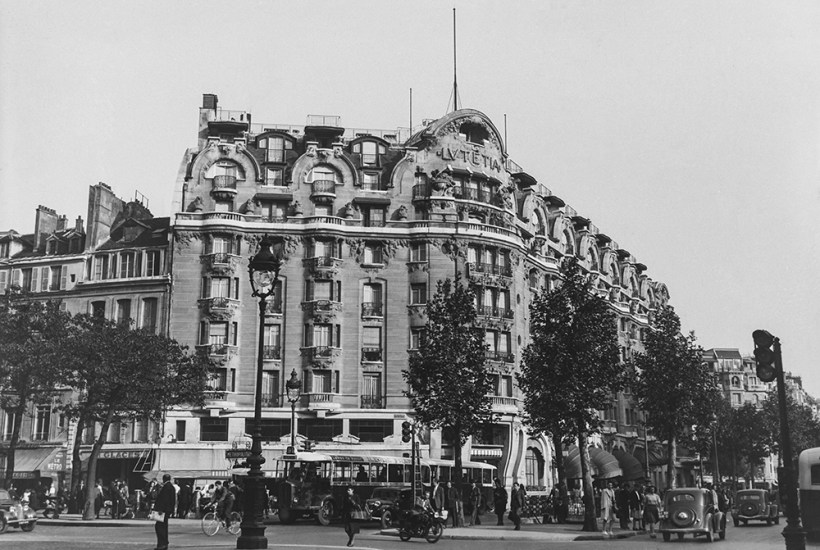
The saga of the rise and fall of the Third Reich could be traced by following events in any one of the countries occupied by the Nazis. Jane Rogoyska has refined this approach by focusing on what happened in a single building, a fashionable ‘grand hotel’ in central Paris, between 1933 and 1945.
The Lutetia is the only luxury hotel in Paris on the Left Bank, where it has always looked out of place – its bulbous, domed grandeur dominating less pretentious neighbours in a district that is still better known for its cultural and academic traditions. Rogoyska tells the story of the building’s wartime adventures in three parts – before, during and after the German occupation of France. The lives recounted fall into three groups, only one of which is French.
Part One describes the destruction of German and Austrian culture that took place after the Nazis seized power in 1933. The writers forced into exile in France included many of the literary stars of Habsburg Vienna and the Weimar Republic: Berthold Brecht, Heinrich Mann and his brother Thomas, Walter Benjamin, Alfred Kerr, Hannah Arendt, Joseph Roth, Franz Werfel and Stefan Zweig.
They escaped with their lives but in many cases lost their livelihoods. In Paris they were ‘condemned to live each day in growing solitude, anonymity and humiliation’, lining up at ‘counters to obtain food coupons, cash handouts and advice’, living in penury in cheap hotels. They also had to face the hostility of French bureaucracy and of the population in general towards anything ‘German’, and were often reluctant to be heard speaking German in public. Arthur Koestler, who was both Jewish and a communist, took the extreme step of joining the Foreign Legion to escape the attention of the bureaucrats bent on interning him.
The Lutetia, briefly the home of James Joyce, plays an incidental role in the prewar story, being well beyond the means of the impoverished refugees. But eventually some of the exiles, inspired by Heinrich Mann, decided to fight back by forming a provisional committee to launch a ‘German Popular Front against Fascism’. They chose to meet in the elegant salons of the Lutetia, the only venue on the Left Bank whose splendour would be appropriate for their ambitions. (The fee for hiring the hotel’s largest meeting room was paid by the Comintern.)
In 1935, the committee acquired a new name, the Lutetia Committee, and a powerful recruit, Willi Münzenberg, the ‘Red Millionaire’ and organising genius of international communism. But despite his leadership (and the initial support of E.M. Forster and Aldous Huxley), no German Popular Front emerged, and the tentative alliance between communists and social democrats died on 23 August 1939 with news of the Nazi-Soviet pact. The leader of the French communists, Maurice Thorez, with his customary lucidity, welcomed Der Pakt as ‘a stroke of genius’ on Stalin’s part that would avert another European war. The second world war broke out two weeks later. By then many of the exiles had managed to escape for a second time, to Switzerland, England or the United States. Joseph Roth did not make it, having drunk himself to a solitary death in the gloomy bars of the Latin Quarter. And in due course Ernst Toller, Walter Benjamin, Stefan Zweig and Alfred Kerr all committed suicide.
The German army occupied Paris ten months after the outbreak of war, and the Lutetia was requisitioned and allotted to the Abwehr, roughly the German equivalent of MI6. The story of the hotel’s use as a reception centre for deportees is quite well known, so Part Two, where Rogoyska draws on less familiar German sources to reconstruct the life of the Lutetia during the Abwehr’s occupation, is the most impressive and original section in the book.
The military intelligence service was, she writes, ‘an organisation that stood uncomfortably on the fringes of the Nazi regime’. The senior officer, a rather civilised gourmet named Colonel Friedrich Rudolph, decided to requisition the French staff as well as the hotel. The concierge remained at his post, the cooks and waiters and chambermaids continued to serve their new guests with their habitual courtesy, and the manager, Marcel Chappaz, ensured that everyone was comfortable, having first removed the most valuable bottles from his wine cellar and hidden them. The commanders of the Abwehr remained in these quarters until the very last minute, enjoying a final bottle of champagne a few hours before the arrival in Paris of Allied forces. They regrouped in Berlin, where Colonel Rudolph was promptly imprisoned as a suspect in the July plot to assassinate Hitler.
Meanwhile, back at the Lutetia, the political deportees were being registered, squirted with DDT and helped into reception, where the staff were assisted by boy scouts. Many of their patients were the true heroes of France’s war, all that remained of that small minority who had found the courage to fight back after the military debacle of 1940. The survivors returned in a terrible state, here described in vivid detail. They were wasted, in rags, crawling with lice and often contagious with typhus or tuberculosis. Two of the Lutetia’s staff died following contact with the first postwar guests. The deportees gave no sense of happiness. Their expressions were vacant, in the words of one 14-year-old boy scout volunteer, Michel Rocard, later prime minister of France: ‘The landscape of the faces of these men had been destroyed by other men. It was frightening.’ And they said nothing; their silence imposed silence on everybody else in return.
Rogoyska’s vivid and thoroughly researched account, a masterclass in the creative use of secondary sources, is a little less convincing when she generalises about events beyond the hotel’s revolving doors. The Abwehr’s effectiveness in Occupied France was not notably hindered by the dominant role given to the rival SS-SD. In fact fear of being handed over to the Gestapo gave the interrogators of the Abwehr a very persuasive argument. Nor, oddly enough, did the Gestapo’s brutality lead to an increase in volunteering for the French Resistance. Abwehr incompetence was self-generated. All the agents it sent to England were either executed or ‘turned’ by MI5, and the misinformation they passed to Rudolph’s colleagues in Berlin played an important part in the success of D-Day.
Rogoyska suggests that the care given to the deportees in some way ‘absolved’ the Lutetia from guilt over its wartime role. I am not convinced. In 1955, Rudolph paid a return visit to Paris, a place of happy memories, and hesitantly entered the Lutetia, where Monsieur Chappaz happened to be on duty in the hall. The manager greeted ‘the Colonel’ warmly and offered him lunch at his favourite table, as a guest of the hotel.
Got something to add? Join the discussion and comment below.
You might disagree with half of it, but you’ll enjoy reading all of it. Try your first month for free, then just $2 a week for the remainder of your first year.