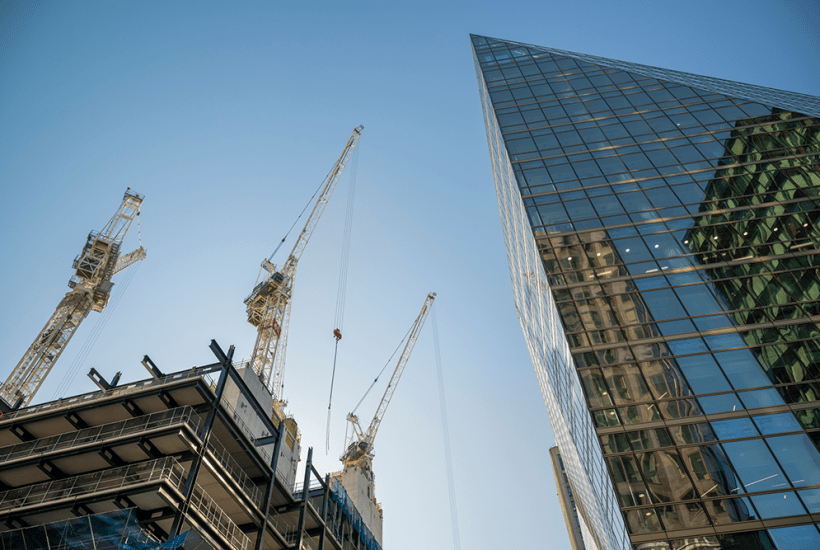
There are elements of economic life, such as the impact of President Donald Trump’s ever-changing tariffs, that are far beyond national control; others, including the supply of most consumer goods, that are best left to free markets; and others which naturally benefit from state intervention. New housing, wholly dependent on planning and building regulations, clearly falls into the last category.
So we might well ask how the Labour government plans to solve a homebuilding crisis so extreme that its target of 1.5 million new homes within this parliament is likely to be undershot by 50 per cent or worse. As for London, the locomotive of national prosperity that needs a constant supply of new homes for its workforce, there are barely any active sites these days: construction starts in 2025, at fewer than 6,000, were a tiny fraction of the target and the lowest for any major city in the developed world.
Of course there are market factors, including higher mortgage rates depressing sale prices. But the core problem is the Building Safety Regulator (BSR), created as a response to the Grenfell fire, which imposes such conditions and decision delays on any block of flats of seven storeys or more as to have suppressed that part of the sector, both private and social, almost entirely.
Housing Secretary Steve Reed last month made the BSR ‘a standalone organisation, paving the way for the creation of a single construction regulator… putting residents at the heart of everything it does’. But not, we might observe, allowing safe new homes to be built for them at anything like the pace required. Run by former London Fire Brigade chiefs, the BSR has the look of a smug quango in urgent need of a rationalising axe.
Voice of business?
Who speaks for British business in these difficult days? Who bends ministerial ears and commandeers public airwaves to make a positive case for private enterprise?
The veteran industrialist Rupert Soames made some media impact as president of the Confederation of British Industry, partially restoring the lobby group’s standing after a misconduct scandal in 2023 that almost closed it down. But his tenure ended last month and we have yet to hear from his successor, BAE Systems chair Cressida Hogg, who is perhaps more likely to find common ground with Chancellor Rachel Reeves than the gravelly patrician Soames. Still, to quote Sky News, ‘many doubt that [the CBI] will ever be able credibly to reclaim its former status as “the voice of business”’.
Likewise, the Institute of Directors has never recovered from a bout of inner turmoil involving allegations of racism, sexism and bullying back in 2018; it produces useful survey data but its leadership is anonymous.
A brighter prospect is the British Chambers of Commerce, speaking for smaller firms across the country: its new president, the former Bank of England economist Andy Haldane, is a compelling commentator whose light has been hidden for the past five years in his post-Bank role as head of the Royal Society of Arts.
The optimistic tone of Haldane’s first interview in the new job – ‘There’s a fighting chance that this year we will see growth exceeding expectations’ – reflects a BCC survey in which 46 per cent of member businesses said they expect to grow this year, compared with 35 per cent last year. Haldane’s pressing task must be to persuade Rachel Reeves to say nothing in next week’s Spring Statement that might reverse the trend.
Rural monstrosities
This week’s value eating-out tip is the Baxter Arms at Fenwick, near Doncaster. I haven’t had the pleasure yet, but I’m keen to try its £12 ‘large Sunday dinner’ as an excuse to vox-pop local drinkers on the subject of the 1,300-acre solar farm that’s about to engulf their quiet village.
This tract of flat south Yorkshire bounded by motorways and the north-east mainline is hardly the Cotswolds, but nor is it rough pasture where sheep may safely graze under a vast solar array. My man on a big crop-sprayer tells me it is viable arable land ‘on the heavy side of ideal’, well suited to wheat, barley and oilseed rape, and capable of an annual yield of around 4,000 tons of staple foodstuffs that will otherwise have to be imported. How do we compare that with the promoter Boom Power’s claim that the solar farm will light up 75,000 homes?
Some will argue that the UK has already so comprehensively abandoned any ambition for food security that we might as well sacrifice every last drab landscape to the more achievable goal of clean energy: the greenlighting of this site in net-zero zealot Ed Miliband’s own constituency (though rubber-stamped by his junior minister to avoid perceived bias) is clearly a flag-planting for that cause.
My own view is that monstrosities like the Fenwick project will one day be condemned as a temporary aberration: a hideous detriment to rural life that profited canny developers and Chinese exporters far more than it did any good for the nation or the planet. If the lads in the Baxter Arms think different, I’ll report back.
A queue of spivs
Sarah Ferguson is reported to be ‘sofa-surfing on a global scale’, with no obvious means of financial support. Might it all have been different if she had been better advised? A decade or so ago, a wise and reputable banker of my acquaintance received a call from her office inviting him to present himself to discuss her requirements.
He duly visited her grand rented home in Eaton Square, where he navigated ‘a queue of spivs in the hallway’ vying for her attention, and could barely find a seat in the drawing room among piles of endorsed merchandise and unsold Budgie books. He politely declined the assignment, inadvertently leaving the then Duchess of York to her downward spiral of fate as a supplicant of the devil Epstein.
Got something to add? Join the discussion and comment below.
You might disagree with half of it, but you’ll enjoy reading all of it. Try your first month for free, then just $2 a week for the remainder of your first year.