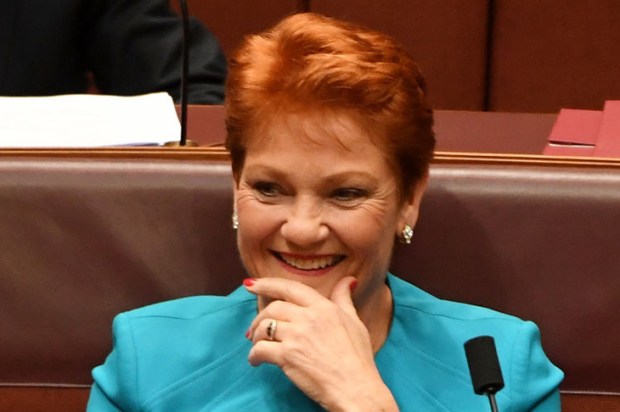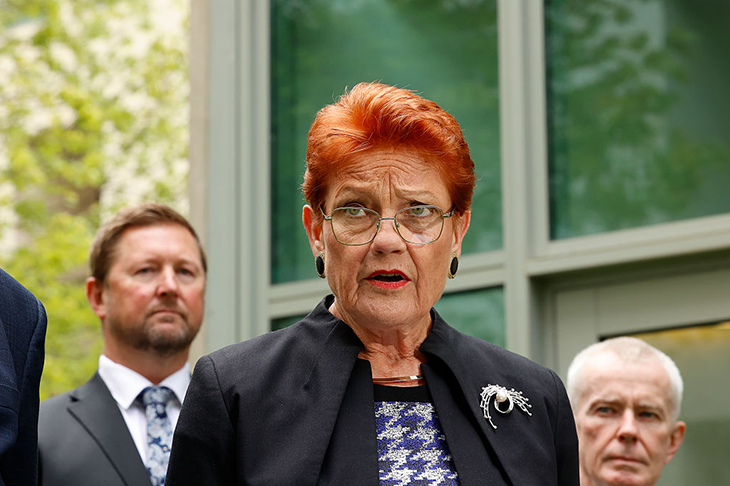
In response to the rise of One Nation in the polls, a consensus among the elites emerged last week: Pauline Hanson had to be stopped. The first reaction was to repeat the tired trope that One Nation is a party of complaint without policies. Yet, One Nation has clear, common-sense policies. Opponents may disagree with them, but instead of debating them, they pretend they do not exist.
An interview on Sky with Sharri Markson offered the coup de grâce. This relates to Pauline’s concern regarding radical Islamism, which leads to outrages like the Bondi Beach attack. A corollary is the problem of ‘good Muslims’ – those who want to assimilate. Why aren’t they in the forefront of defeating radicals, as Ahmed al-Ahmed heroically was at Bondi?
The reason ‘good Muslims’ are normally quiet is obvious: if they dare speak out, they know they will be dealt with. Instead of examining these fundamental issues, Pauline was misreported. Despite claims she said, ‘There are no good Muslims,’ she actually asked a far more piercing question: ‘How can you tell me there are good Muslims?’
This is an indictment of our failed integration models. In a society where we have imported the reactionary clerics of failed republics, but lack the ‘bulwark’ of traditional authority, the moderate Muslim is forced into a defensive invisibility. He cannot speak, and we cannot ‘tell’ who he is, because he lives in the shadow of the radicals. As a Tribune of the Disillusioned, Pauline is simply pointing out that the ‘good’ are being left at the mercy of the ‘bloodthirsty’.
To the establishment, her legitimate unease about Islamofascism and the treatment of women – as in Iran and Afghanistan – is a form of pathology. Yet it is universally observed that in ghettoes in the West, attractive, well-dressed women can be made to feel uncomfortable. I am reminded of an attractive young lady in a smart suit who once preceded me up the stairs of a suburban train. She reached the top, paused, and immediately turned back in pure instinctive retreat. A large group of young Muslim men had claimed the space as their own, creating an atmosphere of unspoken but absolute intimidation.
For an attractive Western woman – dressed as women once did in the Tehran of the Shah or the Cairo of King Farouk – to feel ‘unwanted’ in such a setting is a rational response to the fact that the rules of our civilised Commonwealth are being superseded by the primitive law of the street.
Crucially, Senator Hanson is identifying the tragic paradox of multiculturalism. The ‘good Muslim’ – the individual who seeks to live according to the standards of the Anglosphere – lives in a state of constant fear. To the reactionary mullahs, such a person is a munafiq (a hypocrite) or a traitor. They are their first targets. By allowing ‘out-of-control’ clerics to dominate our suburbs, our governments have abandoned the assimilated Muslim to the mercy of the bully.
The irony is that this reactionary form of Islam is precisely what the traditional kings of the Muslim world ensured against. For three years I lived in Morocco, a country that works because its King is also Amir al-Mu’minin – the Commander of the Faithful. His constitutional authority is sacred. His spiritual blessing (baraka) allows him to out-manoeuvre reactionary clerics.
The French learned the hard way that the Moroccan Crown was the only viable centre of gravity. When the French exiled Sultan Mohammed V in 1953, they ignited a revolution of the spirit. They were forced to bring him back in 1955, realising that without the ‘sacred’ authority of the Sultan, the country would descend into chaos. It is telling that Morocco remains one of the very few Muslim countries which, upon Israel’s declaration of independence, did not expel its Jews and steal their property; the King acted as their protector.
Contrast this with the ‘republican’ experiment. In the Arab world, a republic usually means an army coup or the takeover by medieval, bloodthirsty clerics, or both. This is unlike Australia, where a republic means handing even more power to a delinquent political class.
Take the horror of the Egyptian Sunset. Under the House of Muhammad Ali, supported by the 1936 Treaty with Britain, Egypt was a cosmopolitan jewel. The 1953 Republic brought the ‘Free Officers’, the expulsion of the Greeks, Jews, and Italians, and a pivot toward Soviet stagnation. Or consider the bloodbath of Iraq in 1958, where the young Hashemite King Faisal II was cruelly murdered by the junta, opening the door to the tyranny of Saddam Hussein. The Americans foolishly rejected restoration in 2003, and they have the fractured ruin of today to show for it.
Even more catastrophic was the American error in Afghanistan. In 2002, the Loya Jirga begged for the restoration of King Zahir Shah, who had presided over a golden age of forty years of peace. The Americans, blinded by an infantile republican idealism, vetoed the King in favour of a corrupt plastic ‘republic’. Without the ‘sacred’ legitimacy of the Crown to unify the tribes, the state collapsed and the Taleban marched back in.
This brings us to our own domestic malaise. The ‘mistake’ identified in the Fraser cabinet documents was that by importing immigrants under the sway of reactionary clerics, we were importing the very sectarianism that destroyed the republics of the Middle East. We have the clerics, but we lack the Muslim kings to keep them in check.
Just about the only ‘republican’ who ever succeeded in modernising a Muslim state was Mustafa Kemal Atatürk who as ‘Gazi’, ‘Warrior of the Faithful’, superseded both Sultanate and Caliphate. Meanwhile, formed under the blessing of Almighty God, the Australian Commonwealth benefits from a Crown which, in practice, serves as a unique ‘defender of faith’, providing a sacred canopy of traditional order that protects the religious liberty of the individual without the state itself adopting the radicalism of the cleric.
Senator Hanson is a thermometer measuring the heat in a society where the traditional guardrails of order have been removed. A ‘multicultural’ society without a strong centre of traditional moral authority eventually becomes a collection of competing fiefdoms. Until we find our own ‘bulwark’ – one that protects the ‘good Muslim’ and the Western woman alike – the unease will only grow.
Got something to add? Join the discussion and comment below.
You might disagree with half of it, but you’ll enjoy reading all of it. Try your first month for free, then just $2 a week for the remainder of your first year.