Months ago, when I wrote that the ‘US Supreme Court Holds the Fort’ for all of us, I made the point that amid the political tumult of Trump-era America, the United States Supreme Court was not becoming an instrument of presidential will, as so often alleged, but was instead reasserting its proper constitutional role – sometimes to Trump’s benefit, sometimes to his detriment, but always in fidelity to law rather than personality. That claim has now been tested again in the Learning Resources tariff case. And once again, the Court has done exactly what constitutional courts are meant to do.
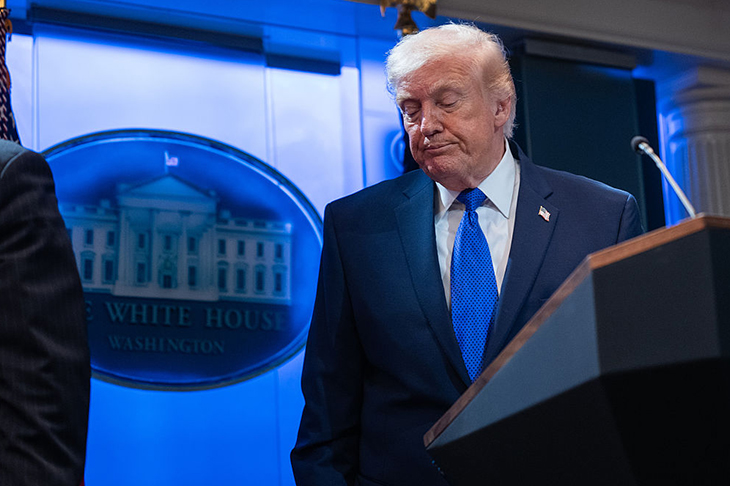
The only surprise with this case was that there were none. The outcome while not mandated, was largely predicted. And of course there was the utterly predictable – now getting very boring – reaction of the progressive media. The New York Times ran a headline declaring that the ruling amounted to a ‘Supreme Court’s Declaration of Independence’, casting the decision as some kind of judicial rebellion against Trump himself. Elsewhere, coverage focused primarily on Trump’s response, which was juvenile even by his standards. He lashed out personally at Justices Amy Coney Barrett and Neil Gorsuch – judges he himself had appointed – while sparing Justice Brett Kavanaugh, who dissented alongside Justices Thomas and Alito.
Yet all of this endless framing through a political lens misunderstands the nature of the decision, and indeed the nature of the Court itself.
This was not a constitutional revolution. It was a statutory interpretation case. The Court was asked to determine whether Congress, in the International Emergency Economic Powers Act, had granted the President authority to impose sweeping tariffs of the scale Trump had implemented. The administration argued that statutory authority to ‘regulate’ imports in response to national emergencies extended to the imposition of tariffs of vast economic and fiscal consequence. The Court, in a careful majority opinion authored by Chief Justice John Roberts, concluded that it did not.
The reasoning was both orthodox and rooted in constitutional first principles. As the Chief explained, the Constitution’s allocation of the taxing power was no accident. Having just fought a revolution motivated in large part by taxation imposed by an English king without legislative consent, the framers vested that power explicitly in Congress. The ability to reach directly into the pockets of citizens was to remain tied to legislative accountability. A big tick for that one.
That allocation remains as consequential today as it was in 1787.
Congress may delegate aspects of its authority, but where it does so – particularly in matters of immense economic significance – it must do so clearly and expressly. The statute at issue here did not contain such clarity. No president has ever used it for that purpose before. The absence of the legislature’s clear permission was decisive.
Trump’s tariff programme represented an ambitious and creative attempt to use broadly worded emergency powers as the legal foundation for a sweeping economic and strategic policy. It was, in effect, a legal gamble. And like all such gambles, it carried risk. It is inconceivable that the administration was not advised of the legal uncertainty.
Trump’s response, as is often the case, betrayed a deeper misunderstanding of the constitutional system he serves under. Judges do not owe loyalty to the presidents who appoint them. They owe loyalty to the Constitution they swore to uphold. The fact that Trump-appointed justices joined the majority against him is not evidence of betrayal. It is evidence that the system is working. This decision belongs to a longer pattern that critics have persistently refused to recognise.
The Court has ruled both for and against Trump when the law required it. In Trump v. United States, it affirmed the long-standing principle that presidents enjoy immunity from criminal prosecution for official acts — not as a favour to Trump personally, but as a structural protection essential to the functioning of the executive office itself. In Mazars, it upheld Congress’s authority to subpoena presidential records. Following the 2020 election, it gave short shrift to the unhinged efforts to relitigate the result through the courts.
Some decisions have been interpreted to assist the President. But this misunderstands what the Court is doing. More broadly, the Roberts Court has re-established constitutional boundaries in ways that transcend any single presidency. In Dobbs v. Jackson, it returned abortion policy to state legislatures rather than judicial decree. In Students for Fair Admissions v. Harvard, it reaffirmed the Fourteenth Amendment’s guarantee of equal protection under law. In ending the Chevron doctrine, it restored the judiciary’s responsibility to interpret the law rather than defer reflexively to an ever more assertive administrative state.
These decisions differ in subject matter, but they share a common method: a disciplined return to constitutional text, clarity, and institutional restraint. The judges seem intent on diffusing power, as was intended under the Constitution.
The tariff decision follows precisely this trajectory.
Hopefully this decision will abate the continuing hysteria around the suggestion that the Court is ‘Trump’s Court’. The decision – like several before it – demonstrates the opposite. The justices have shown themselves willing to uphold executive authority where law permits it, and equally willing to reject executive overreach where law does not.
The deeper significance of the decision lies in what it reveals about the continued strength of American constitutional institutions. I have said it before and I will say it again: at a time when political life in the United States appears increasingly polarised, and when public confidence in institutions has eroded across much of the democratic world, the Supreme Court has continued to operate with remarkable steadiness.
Its members disagree, sometimes sharply. Yet they share a commitment to the constitutional structure itself – to the principle that power must be exercised within legal limits, regardless of political pressure.
The continuity, coherence and commitment of the majority of the Court to the American constitutional system is reassuring. The US Constitution was designed precisely for moments such as this – moments of political intensity, institutional strain, and executive ambition. Its endurance has never depended on the absence of conflict – God knows the United States has always given us plenty of that – but on the existence of institutions capable of containing it.
This decision is a timely reminder that US institutions still hold – and that the American project, far from being in peril, endures.
Got something to add? Join the discussion and comment below.
You might disagree with half of it, but you’ll enjoy reading all of it. Try your first month for free, then just $2 a week for the remainder of your first year.