I confess to being one of Australia’s most pro-Israel law professors. Actually, change that to I proudly confess to being one of Australia’s most pro-Israel law professors. I admire how this tiny country is the only democracy in the entire Middle East. Surrounded by countries that want to wipe it from the face of the earth this minute Jewish homeland has defended itself from invasions and attacks that comfortably coddled Western countries haven’t experienced in eighty years. And be clear that Israel has restrained itself in doing this by orders of magnitude more than the Allies did when fighting Germany and Japan in the second world war. Starting a war has consequences, as the Nazis discovered. Yet those attacking Israel and slaughtering its citizens have been treated with kid gloves in comparison to the way Britain, the US and Allies (rightly in my view) bombed Dresden to the ground or finished the war with Japan. And all this while being the most liberal, rights-respecting country within hundreds, if not thousands, of miles. And all while producing world-leading companies and being a world leader in water conservation and having a fifth of the population who are Arabs with no desire whatsoever to leave the country.
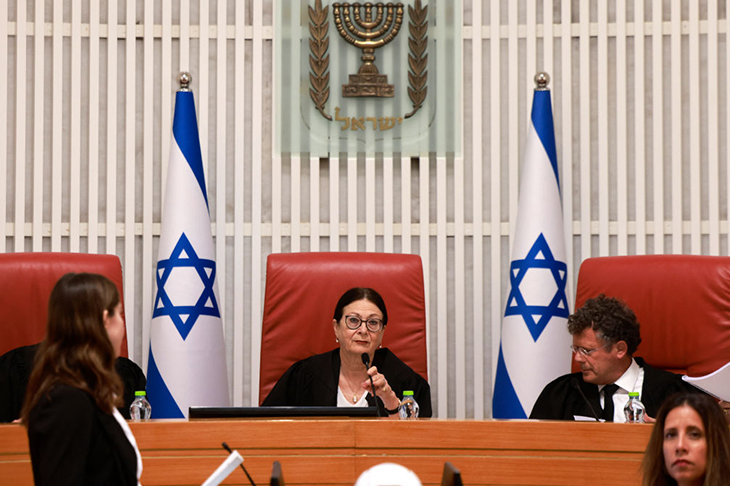
No country is perfect though. So for those of you who might be inclined to suggest I’m seeing Israel through rose-coloured glasses, let me tell you something the country gets badly, badly wrong. I refer to the top judges in Israel who have (to use the correct legal terminology) gone bananas, lost their marbles and succumbed to a puffed-up sanctimony that they know better than voters and elected governments. Israel is the home of the Philosopher King judge and judicial activism on steroids. I’ll put this in context. Over the last thirty or forty years judges across the common law Anglosphere world have become ever more willing to gainsay, second-guess and over-rule the democratically elected branches of government. Call this a raw usurpation of power. Or call it judicial activism on steroids. The fact is that the lawyerly caste has to a large extent lost faith in majoritarian democracy and a hefty chunk of the top judges plucked from its members have adopted unconstrained and laughably implausible interpretive techniques. It’s bad in Australia, yes. But it’s worse in New Zealand. Worse again in Britain. Worse still in Canada. The US, oddly, has always had uber-powerful judges but of late has gone through a counter-cyclical period of relative judicial restraint (for top American judges). And then there is Israel’s top court. They are in a solar system – or, more accurately, a galaxy – of their own labelled ‘juristocracy’.
In the American law journal Constitutional Commentary my review of a superb, magisterial 600-page dissection of this Israeli judicial power-usurping madness will soon appear. The book is by Israeli legal academic Yonatan Green. Let me give you the précis. Over the last three decades (with things getting exponentially worse of late) the top Israeli judges have started playing fast and loose with any and all legal texts. They have made-up wholly unconstraining interpretive approaches. They have transformed that country from being a parliamentary sovereignty jurisdiction like Britain or New Zealand – where unelected judges have no power to invalidate statutes passed by the democratically elected legislature, largely because such countries (Israel included) have no written constitutions giving the judges that power – into, well, something else. And that transmogrified, bootstrapping something else is a jurisdiction whose judges simply made themselves the overseers of what governments could do. Based on nothing more than their own sense of what is best. Israel’s judges have bootstrapped themselves to have more second-guessing and gainsaying power than the judiciaries have in Canada or in the United States (where there are written constitutions and entrenched bills of rights that came into being with observable, if varying, degrees of democratic legitimacy).
So the Israeli judiciary has gradually, over time, simply given itself this power to strike down the statutes of the elected legislature. There was no referendum giving it to them. There was no statute passed with a supermajority doing so. There was not even a statute garnering a bare majority of legislators bringing this massive change to the country’s rule of recognition into being. Nope, this was a judicial creation through and through. The top Israeli judges have even engineered a pseudo-veto on whom the government can appoint to the top court. Got that? If the elected government wants person X on the top court to try to wind back this madness that top court can say ‘no’. Because it just decided it had this power, too.
Needless to say, the lawyerly caste overwhelmingly supports the court. And how do the top judges and lawyers justify this judicially redrawn constitutional settlement? They simply redefine notions such as ‘the rule of law’ and ‘democracy’. They stuff both full of moral content, meaning the substantive end goals these judges happen to prefer, despite a majority of voters often disagreeing. In this way the rule of law simply becomes ‘rule by judges’. What the top court happens to want simply becomes, by definition, the democratic outcome in this new judicial (non-majoritarian) sense. It is Penn & Teller levels of misdirection hiding what amounts to a judicial coup. And if you think I’m being overly dramatic, I’m not. Read the book and weep. As one Israeli legal critic notes, this isn’t a million miles away from the unelected caste running Iran, absent the religious claims of course. Suffice it to say that Israel has become the modern world’s exemplar of a juristocracy or kritarchy. And for that I am more than happy to be a huge critic of Israel.
Still, this trend of rampant judicial activism or judicial usurpation of power from the elected branches is happening not just in Israel but everywhere, to varying extents (here in Australia included). In my native Canada the top court is about to consider a case on the use of what is known as the ‘notwithstanding clause’. This is section 33 in the Canadian Constitution that was put into the then new 1982 Constitution to give the elected parliaments across Canada the power to override judicial decisions about the bill of rights that was being added that year to the written constitution. Section 33 gives legislatures a power to override a judicial rights-related decision for five years, renewable.
But now, over forty years later, the top Canadian judges have accepted a case that asks them to wind back the ability to use this section 33. Poof! By judicial decree as it were, à la Israel. And, incredibly, the Canadian top court has opted to hear that case. And this despite the uncontested and true fact that without section 33 Canada would never have gone down the road of an entrenched, potent bill of rights.
As I have long said, you simply cannot trust the unelected judges with this sort of power. They get to like it too much. But at least in Canada it was politicians four decades ago who foolishly gave it to them by opting for a bill of rights. In Israel, the judges just gave it to themselves. Magicked it from nowhere. Then they shut off every single avenue of response by the elected politicians. That is one criticism of the country I’m happy to voice.
Got something to add? Join the discussion and comment below.
You might disagree with half of it, but you’ll enjoy reading all of it. Try your first month for free, then just $2 a week for the remainder of your first year.