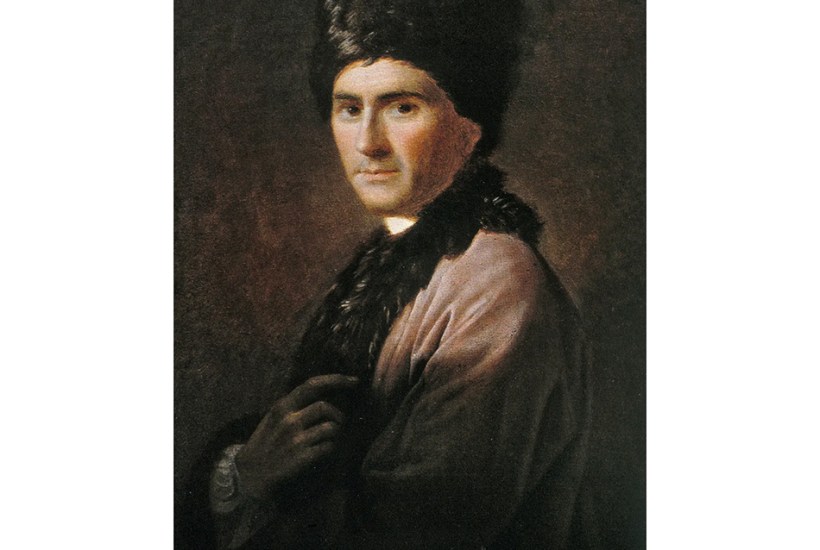
What biographer would pass up a time-travelling opportunity to meet their subject face to face? This novel’s protagonist, Gavin Mulvany, an academic specialising in Jean-Jacques Rousseau, is somehow able to slip back in time to 1777, a year before the fractious French writer died. He turns from irritating fan to close companion, accompanying Jean-Jacques on long philosophical rambles and coach journeys around Paris. They attend the premiere of Voltaire’s last play (as does Marie Antoinette), call on Benjamin Franklin and visit the Marquis de Sade in a lunatic asylum.
Gavin’s long-delayed book about Rousseau is concerned to solve the puzzle of why a passionate theorist on children’s education could dispatch his own five newborns to a foundling hospital, never to see them again. In one of many echoes between past and present, Gavin’s partner, Pedro, longs for children, while Gavin is less keen. As a gay man he also wants to challenge Rousseau’s homophobia and probe his curious attitude to sex. He has a murky relationship of his own to unravel, an obsession years before with his professor, Cyprien Abreo. Inserting himself into the family, Gavin became tutor to Cyprien’s rebellious teenage daughter Anne-Laure, where Rousseau’s pedagogy was of little help.
Like the epistolary novels of the period, Rousseau’s Lost Children is set out in the form of letters. There are 89 in total, between Gavin and Rousseau, Pedro, Cyprien and others, in an interweaving of narratives and time frames. The device entails long descriptions of events and conversations the recipients must already be aware of, but the effect is layered rather than clumsy. In any case, Gavin is fighting to keep a grip on his own psyche.
He has returned to the city after two decades, insistently calling on his old mentor, remembering how they liked to meet up in Père Lachaise cemetery at the tomb of Abelard and Heloise, in homage to Rousseau’s novel Julie, ou la Nouvelle Héloïse. The text is interrupted at intervals by a roughly drawn blob representing the périphérique, which Gavin attempts to circumambulate. He also inserts regular notes and excerpts from his work in progress.
Part novel, part biography, part philosophical workout, Rousseau’s Lost Children interrogates some of the wackier as well as most cherished Enlightenment principles. Gavin grapples with age-old conundrums: conflicts between desire and morality, ideology and practice, and self and society. Read the book with a Plan de Paris at hand and see the City of Light with fresh eyes.
Got something to add? Join the discussion and comment below.
You might disagree with half of it, but you’ll enjoy reading all of it. Try your first month for free, then just $2 a week for the remainder of your first year.