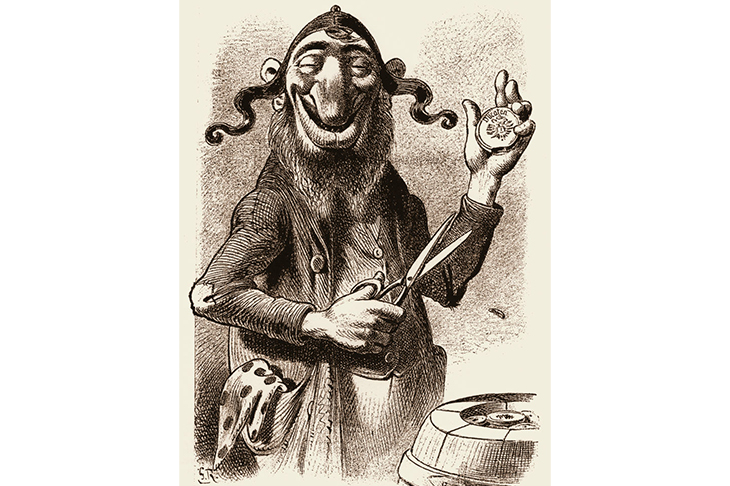
As Australia continues to suffer from the evil of antisemitism a phrase (or three phrases if you count the different versions) has emerged – ‘Jewish lobby’ (the variant versions are ‘Israel lobby’ and ‘Zionist lobby’). So, what does this mean? And where does it come from? The earliest written use of ‘Jewish lobby’ I’ve been able to find is from America from 1943 – but it’s undoubtedly older than that. This notorious expression is used pejoratively to allege disproportionate Jewish influence in politics and government, a variation of the old antisemitic lie about an ‘international Jewish conspiracy’. In other words, this term ‘Jewish/Israeli/Zionist lobby’ is the offensive claim that there is a lobby group that operates behind the scenes and pulls the strings controlling what is going on in a democracy. So, where does this come from? Almost certainly from a famous forgery called The Protocols of the Elders of Zion published in Russia in 1903, which claims to report the contents of so-called ‘secret documents and plans’ drawn up by Jewish leaders to take over the world banking system, and thus, the government of the whole world. This was not only (as I said) a forgery and deeply racist, but it was also always transparent nonsense. But Hitler believed it. Hitler even claimed that Jews were behind communism, and the whole communist movement was a Jewish front organisation. So you can see how absurd this all becomes. Tragically, there have been some prominent Australians who have used this offensive expression ‘Jewish lobby’ in the not-so-distant past. We can only hope they are too ashamed to ever use such language again.
It’s Australia Day once more, and with it the notorious distortion of the ‘black armband’ view of Australia’s glorious history. This expression was coined by distinguished Australian historian Geoffrey Blainey in 1993. It was popularised a decade later by Prime Minister John Howard. The expression comes from the frequent habit of wearing a black arm-band as an expression of mourning. So Blainey’s phrase targets those who mourn about Australian history. In his words this view represents the ‘swing of the pendulum from a position that had been too favourable to an opposite extreme that is decidedly jaundiced and “gloomy”’. We should bear this view in mind with the absurd ‘Invasion Day’ protests and their view that all Australians should be ashamed of all of Australian history. The alternative is that what arrived in Australia on 26 January 1788 was Western civilisation: courts and the rule of law, a written language, education, medicine, engineering and so on. John Harris’s book about the history of Christian missions to Aboriginal people is called Wish We’d Done Better. This title probably sums up the view of many Australians about Australian history – a balanced view that celebrates the good stuff while still wishing that the people of those earlier days had done better. And the best defence of this balanced view as against ‘black arm-band’ thinking is in Tony Abbott’s new book Australia: A History. (Which was my Christmas present this year, and a great read!)
Speccie reader Marcus asks about the expression ‘on the cusp’. Well, ‘cusp’ means a point of transition – it names the point where things change or shift in some way. In the 1500s it was sometimes used to name the entrance of a house (the point where you shift from being outside to being inside). Since 1908 we’ve used it exclusively to mean ‘point of transition’. It comes from the Latin word cuspis meaning ‘point’ (as in the point of a spear or javelin). So, from the pointy part of a weapon to naming something that’s about to shift or change – that appears to be the history of the word.
Got something to add? Join the discussion and comment below.
Contact Kel at ozwords.com.au
You might disagree with half of it, but you’ll enjoy reading all of it. Try your first month for free, then just $2 a week for the remainder of your first year.