If Robert Irwin had not existed, then Dan Brown, or better still Umberto Eco, would surely have had to invent him. In his Memoirs of a Dervish, the roller-blading, pinball-playing polymath reported: ‘It was in my first year in Oxford that I decided that I wanted to become a Muslim saint.’ Irwin, who died in 2024, first pursued that esoteric life goal in a Sufi monastery in Algeria. He returned to become not just a vastly erudite scholar of Arab Muslim culture but a madcap maverick of a novelist as well.
As a writer, he loved paradox, surprise and reversal. When in 2006 he controversially dismantled the flawed thesis and factual errors of Edward Said’s Orientalism in For Lust of Knowing, the ensuing quarrel pitched followers of a secular lapsed Protestant (Said) against an adept of Muslim mysticism (Irwin). It was the Sufi seeker who championed European studies of Islamic culture as the fruit of wonder and respect, not imperial design. On the criminal folly of western policy in the modern Middle East, Said and Irwin largely agreed.
Although he taught medieval Arab history at St Andrews for five years, Irwin lived for much of his career as a prolific freelance author. He twin-tracked scholarly endeavours – from The Arabian Nights: A Companion to a biography of the great 14th-century thinker Ibn Khaldun (another mystically inclined polymath) – with a series of ten novels. They blend arcane learning with twisty, almost pulpy plots and a riddling, ebullient wit. Although only The Arabian Nightmare (1983) directly mines his scholarly heartland, we can read several others as the work of a sort of Sufi G.K. Chesterton. Left unfinished, Rapture of the Deep concludes an informal trilogy of linked stories that began with The Runes Have Been Cast and Tom’s Version. The novelist Andrew Crumey has now completed the draft and explains in his Afterword: ‘Most of the plot is Irwin’s, and all of the vision.’
That vision, in the author’s signature style, unites silliness and sublimity. This ideas-rich romp gallops through a labyrinth of intrigues while pointing, as Crumey writes, towards ‘a reflection on literature itself’. Paul, our fragile hero, counts as one of Irwin’s innocent-abroad protagonists – a naive drifter thrust into a maze of mystery and menace, never sure of anything, even of his own sanity.
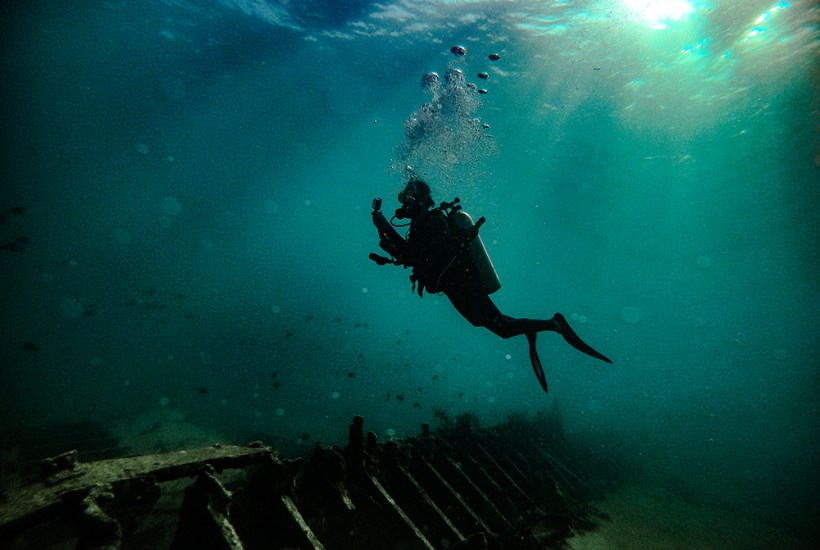
A lonely, low-ranking physicist at Loughborough’s (fictional) Institute for Ergonomic Studies, Paul spends his time in the swimming pool studying the ‘nitrogen narcosis’ that can make divers expire in a state of fatal bliss. As in a dream, or a farce, he tumbles from one outlandish encounter to another. We meet ‘F’, the wacky American redhead; Molly, the posh novelist, who in a casino seeks Paul’s help with the probabilities of baccarat and blackjack; Mortimer, the thuggish, violence-loving chauffeur, who used to work as fiction editor for the TLS; and Charles, the sinister retired US general. Charles appears to run a real-world role-play project called ‘the Story’, engendered by a loopy Oxford don.
Much of the action takes place in Loughborough, which the sanctimonious ogre Charles deems ‘remarkably free from sin’. Abandoned at Cambridge by a chilly heartbreaker named Julia, Paul now researches in his wetsuit and yearns for love, despite the crippling self-doubt bred by his mediocrity both of degree and penis size (so Julia alleged). Might his sensible colleague Sheila, with her golden retriever Jack, prove to be the one – or does this Taylor Swift lookalike covertly work for the Story too, with the friendly hound ‘a shape-shifting alien’? Paul distrusts literature that has no ‘solid ground’ beneath its inventions. Yet the anxious, solitary mind will hatch plots to outstrip the weirdest yarn.
Part-Hitchcock, part-Bond, part-Calvino, this preposterous entertainment races along. Irwin finds a place in it for quantum physics, chaos theory, time travel, chance and choice, the existence or otherwise of God, ‘the horror of the cosmos and the necessity of death’. He muses as well on fiction’s power to generate its own reality from ‘word strings’ alone. Paul, the scientific literalist who has no time for made-up narratives, ends up embedded in a knotted plot. For Mortimer, the Story is not some ‘tired metafiction’ or (as F thinks) ‘a silly mind game’. It is satire of the sort ‘that persuades one to think, without ever reaching a conclusion’. Readers could say the same about this book.
Rapture of the Deep might prompt us to think about the underlying plots and patterns the universe – or the ripples in a pool – may or may not possess. Paul’s adventures lead him to consider Pascal’s wager (have faith, and you can’t lose); Einstein’s belief that God ‘does not play dice’; and Heisenberg’s (apocryphal) axiom that the first draught of science nourishes atheism, but ‘at the bottom of the glass God is waiting for you’.
But let’s not get swept away. After all, the character who bangs on solemnly about the anthropic principle – ‘the universe wishes to be understood and marvelled at’ – is the sadistic God-botherer Charles, a tinpot idol who mistakes domination for order. If you seek enlightenment, Irwin’s novels suggest, flee from self-anointed gurus, sages and even saints. The secret, if it exists, lies in the free ebb and flow of the tale itself.
Got something to add? Join the discussion and comment below.
You might disagree with half of it, but you’ll enjoy reading all of it. Try your first month for free, then just $2 a week for the remainder of your first year.