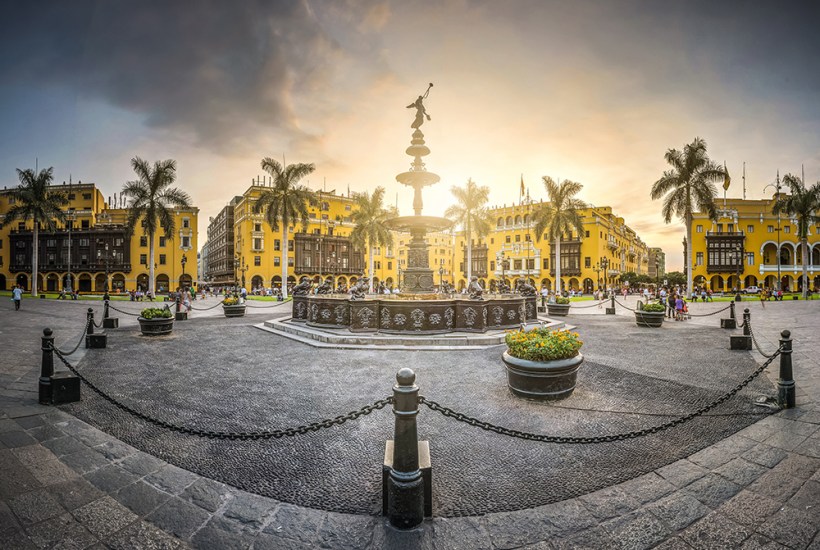
In the pantheon of South America’s great hotels, the Gran Hotel Bolivar’s place is assured. Stand anywhere in the Plaza San Martin, one of Lima’s historic central squares, and the proud art deco 1924 building – all 300 rooms and five storeys of it – glistens dazzling white over the promenaders, tourists and hawkers below.
These days it feels almost marooned, an island of elegant, old-fashioned opulence set in a sea of fuming traffic. The rich and sophisticated have deserted the old part of town for the cool condominiums and plate glass of modern Miraflores, but Miraflores has no memory. The Bolivar – every stone, every pane of stained glass, every monogrammed brass doorknob, even the black Model T Ford standing beside the reception desks – remembers its glory days. Comfortable, functional, friendly and well-run as it still is, the Bolivar is a monument to memory; and if the carpet on the central staircase is a little frayed, who cares?
The first time I visited, in the 1980s, the city was in a shocking state
Two Rolling Stones once descended those stairs, staying in rooms 428 and 430. It’s said they made rather a mess, but paid for the damage promptly and in full. Ernest Hemingway checked in here too, taking the Presidential Suite and breakfasting (the hotel tells us) on two hard-boiled eggs, buttered toast, and ‘mucho café’.
Our stay at the Bolivar this month was not our first. Years ago, not long after the hotel had been rescued from demise by a co-operative of its staff, we overnighted here before zig-zagging up into the Andes by train. On a whim, and because it wasn’t expensive, we’d booked the Presidential Suite. With our own lounge, a little office, a dressing room and a huge bedroom, we waved to nobody from the private balcony at which Robert Kennedy will once have stood. These were his rooms.
We admired – as the senator must have – the framed photograph of Marilyn Monroe. She never stayed here, though Ava Gardner (in 1940) and Julio Iglesias did. So did Orson Welles. Charles de Gaulle (on a grand tour of the continent in 1964) trod the elaborately patterned parquet flooring, and Walter and Lillian Disney occupied suite 310 in 1941. Clark Gable had taken room 408 the year before. Richard Nixon showed foresight on a visit in 1954: he chose the Presidential Suite.
All will have gasped, as we did, at the vast, cathedral-style dome, daylit through stained glass and supported by 12 marble pillars, roofing the reception hall from Lima’s almost perpetual Pacific fog. All will have taken the ornate wood-panelled lifts with their iron gates, brass fittings, elaborate marquetry and etched glass mirrors: the first working elevators in all Peru. And we sipped what I can say with confidence is the best pisco sour cocktail (clear spirit, fresh lime juice, a little syrup, topped with whipped egg white, a lime slice and the orange dot of Angostura bitters) on South America’s entire Pacific coast. Well, two of these cocktails actually, after which I remember entering the wrought-iron balcony bar, but do not remember leaving it.
Even the breakfast room has a marble-balustraded upper gallery from which a crooner, violinist or quintet could serenade diners toying with their papaya salads. The dining room itself has, above the grand fireplace, a 17th-century devotional Catholic oil painting of an angel, wings tucked behind, caressing an enormous musket: as eloquent a summary of Spanish imperialism as one could hope to find.
I love Lima – now. I didn’t, the first time I visited in the 1980s. The city was in a shocking state, and in my book, Inca-Kola, I described the chaos. The book’s still in print, but the chapter on Lima is horribly out of date. A man called Alan Garcia was president (years later he shot himself as the anti-corruption squad knocked at his door) and inflation was out of control, with Boeing 747s from Germany landing weekly, loaded with new banknotes. Money-changers on street corners needed suitcases. The murderous Maoist Sendero Luminoso (‘Shining Path’) terrorists were in the hills and the economy was wrecked.
Lima looked as if a bomb had hit it (later, several did), with traffic jams all the way from the airport to the city centre. The jams more resembled an extended car scrapyard than anything roadworthy: VW Beetles with no side panels, buses with the windows punched out, ancient Japanese pick-ups with chassis all but rusted away; one was carrying on down the potholed highway with a flat tyre shredding as it went. Everyone and everything seemed on their beam end, and Garcia, by then a laughing stock, was keeping llamas in the presidential garden. Peru was broken. The Hotel Gran Bolivar saw all that.
Today it sees a new Lima and a new Peru. The streets are swept, the fountains play and the squares’ lawns are cut. Business seems to be thriving, hyper-inflation is only a memory, Sendero Luminoso has been defeated and the markets are piled high with produce from the mountains. The country seems to have turned a corner. Miraflores looks more prosperous than ever, and tourists clutch their pilots as they paraglide along the line of great cliffs behind which the city hangs over the Pacific. Perhaps new crises will grip this potentially wealthy country, rich in minerals and agriculture, but for the moment all is well. That chapter in Inca-Kola reads as history. So much has changed.
And this, too, the Gran Hotel Bolivar sees. I hope it survives the flight from downtown to the suburbs. I hope it can avoid being swallowed up by a hotel chain. I hope the enthusiastic staff who have staked their hopes on its future carry on keeping up appearances. I hope the brass is as polished, the ceviche as rich and pisco sours as strong, as we found them on New Year’s Day.
This was the Bolivar’s 102nd new year. I raise my glass, lime garnish and all, to its next century.
Got something to add? Join the discussion and comment below.
You might disagree with half of it, but you’ll enjoy reading all of it. Try your first month for free, then just $2 a week for the remainder of your first year.