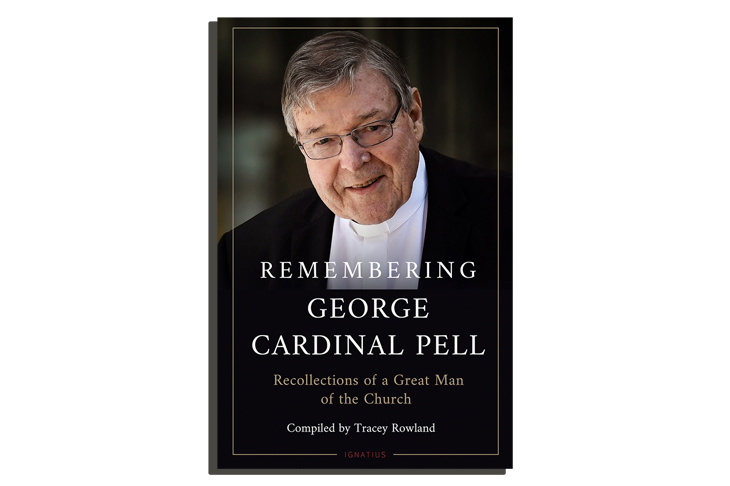
Just over three years have passed since the death of George Cardinal Pell. The publication of this tome, which Tracey Rowland describes as ‘a collection of memories by those who knew him well’, is therefore timely.
In compiling this collection, Rowland has assembled an all-star cast. The contributors, thirty-eight in total, include former prime minister Tony Abbott, Sky News Australia host Andrew Bolt, George Weigel (the biographer of Pope Saint John Paul II who wrote the foreword to the Cardinal’s Prison Journal), Anna Krohn, the Executive Director of the Thomas More Centre, Cardinal Gerhard Müller, the former Prefect of the Congregation of the Doctrine of the Faith, the Archbishop of Sydney, Anthony Fisher, the late Bishop Peter Elliott (who was Pell’s auxiliary bishop during his time as Archbishop of Melbourne), Monsignor Charles Portelli, Pell’s Master of Ceremonies at St Patrick’s Cathedral, Melbourne, the Australian’s Paul Kelly and Greg Sheridan, the Archbishop Emeritus of New York, Timothy Cardinal Dolan and former judge of the Victorian Court of Appeal Joseph Santamaria KC. There is also a touching recollection by Cardinal Pell’s younger brother, David, of the Cardinal’s life, growing up in Ballarat, the son of a publican who became a prince of the Church.
In addition to the personal reminiscences, the book contains an introduction by Rowland, as well as appendices containing the homily given by Archbishop Fisher for the Cardinal at his Solemn Requiem Mass in Sydney’s St Mary’s Cathedral on February 2, 2023 and the Words of Remembrance (eulogy) given at that Mass by Mr Abbott.
While not a hagiography, the book underscores the disconnect between the Cardinal’s public image and aspects of his personality that the media ignored. What is apparent in every contribution is that Pell was not the austere, distant, arrogant figure portrayed by his enemies both within and without the Church. On the contrary, he was a man of great warmth who had a deep affection not only for the Church, but especially for those in it, above all for the young, be they seminarians he continuously encouraged along the difficult journey to priesthood (the book includes such recollections at a personal level), to those educated in Catholic institutions which he saw as falling short of their central mission of teaching the faith to future generations.
As Rowland points out, it was the younger generation of Catholics in this country who cheered Pell’s demands for more intellectual rigour and fidelity to Catholic teaching, not their parents and grandparents who wanted to protect their social status with post-Christian elites. In this respect, Cardinal Pell’s patronage of the Australian Catholic Students’ Association, to whom the book is dedicated, is notable. Archbishop Fisher, former Hawthorn AFL player Steve Lawrence and others note that Cardinal Pell believed his greatest achievement was World Youth Day 2008, held in Sydney, which was an outstanding success.
On the first anniversary of Pell’s death, January 10, 2024, Cardinal Müller celebrated a Requiem Mass in the beautifully restored Chapel of St Peter Chanel at Domus Australia, the realisation of Pell’s dream of a guest house for pilgrims in Rome that was opened in 2011 by Pope Benedict XVI at his instigation. In his homily (included in the appendices), Müller recalled Pell’s ‘commitment to marriage and family in the spirit of Christ’s teachings against the relativisation by secularist-minded participants’. He also spoke of the persecution Pell had to undergo at the hands of his enemies. While he cared for victims of sexual abuse with empathy and compassion (Pell led the way in decisively dealing with this tragic issue with the promulgation of the Melbourne Protocol), he was relentlessly pursued by ‘a bloodthirsty mob and made a scapegoat by anti-Catholic agitators in the media and the police’.
Much has been said of Cardinal Pell’s wrongful conviction and imprisonment for 404 days in solitary confinement until the High Court quashed his conviction unanimously in a 7-0 judgment. However, Müller and other contributors note how Pell endured his suffering in prison as testimony to Christian patience, in line with his episcopal motto, ‘Be Not Afraid’, and never bore any malice to his accusers or those who bayed for his blood, outside the Victorian courts shrieking that he should ‘go to Hell’. The mob did the same outside his Funeral Mass. As Tony Abbott remarked wryly in his eulogy, this was ‘perhaps Saint George Pell’s first miracle, since they now believe in the afterlife!’.
There are no contributions from Greg Craven, Gerard Henderson, Fr Frank Brennan and the late Keith Windschuttle, who knew Cardinal Pell and defended him in the public square during his trial and through to his ultimate acquittal (often on enemy territory, notably the ABC, which was instrumental in the ‘Get Pell’ pile-on), perhaps because they were not asked. While their recollections could have added another dimension to what is arguably the greatest miscarriage of justice in Australian legal history, their absence may be because, as Rowland notes, the Cardinal was fighting on more than one front. As a defender of Catholic orthodoxy, he had enemies inside the Church as well as among anti-Christian intellectuals. His efforts to clean up the Vatican’s finances were constantly impeded.
Through all this, however, Pell remained a man of great kindness, humility and good humour, with many friends. He was a giant physically and intellectually. This boy from Ballarat gave up a promising career in Australian Rules football to dedicate himself to God and His Church, even though it meant being reviled for the sake of the Son of Man. As Pell remarked at B.A. Santamaria’s funeral, ‘It is a mark of a false prophet that all men speak well of him.’ The same could be said for the Cardinal, yet this book, as well as being of historical significance, reminds us, through the lens of those who knew him, how Pell’s clarity and conviction are sorely missed in these troubled times for the Church and the world.
Got something to add? Join the discussion and comment below.
You might disagree with half of it, but you’ll enjoy reading all of it. Try your first month for free, then just $2 a week for the remainder of your first year.