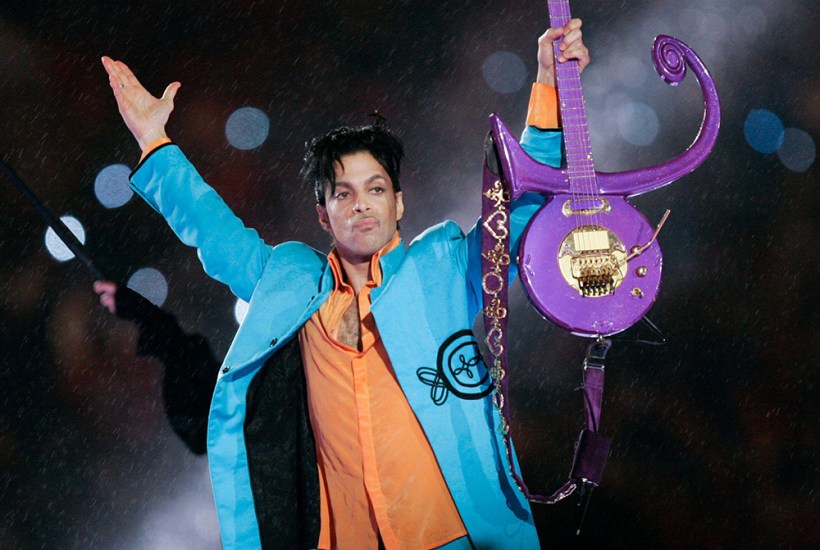
In June 1993, the Artist Who’d Just Decided He Didn’t Want to be Called Prince Any More handed his passport to his long-suffering tour manager Skip Johnson and told him to get the name on it changed to the squiggly symbol with which he’d decided to rebrand himself. It is ironic that he felt ‘oppressed’ by a name bestowed on him by others while insisting on renaming most of his colleagues and lovers.
The passport incident is one of the more comical demands listed in the exhausting catalogue of employee grievances that make up John McKie’s sprawling biography of Minnesota’s own Prince Rogers Nelson, the virtuosic visionary who died, aged 57, of an accidental Fentanyl overdose in 2016.
A former editor of both Smash Hits and Q magazine, McKie embarked on Project Prince back in 2017. He’d been commissioned to celebrate the 30th anniversary of the pop star’s 1987 double album Sign O’ The Times for the BBC and found that ‘the more sources I approached, the less clarity there was’ about a man whose rare, awkward interviews were littered with half-truths and evasions.
Failing to nail Prince for that article turned the late star into something of a white whale for McKie. He set off on a bold voyage to make sense of the pint-sized prodigy, interviewing more than 200 musicians, office assistants, wardrobe designers, studio engineers, hairdressers, security guards and roadies about their experiences with a man whose rock-pop-funk music defied racial and genre boundaries. They’ve all got their own take on the man behind hits such as ‘Purple Rain’ and ‘When Doves Cry’. And they also take the opportunity to voice their complaints about an employer who expected staff on call 24/7, responding to one damn whim after another.
By the time he’d transcribed their testimony, McKie must have felt more like a beleaguered union rep than a biographer. You wouldn’t have wanted to work in HR at Prince’s Paisley Park compound. While staff were forbidden to drink and swear, and were regularly lectured on godly behaviour by their Jehovah’s Witness boss, they were expected to either facilitate or turn a blind eye to Mr LoveSexy’s French farce of a love life. His girlfriends (mostly employees, reduced to addressing him as ‘Hey, you’ during his squiggle phase) often overlapped. He didn’t inform staff when he married. Male employees were expected to avert their eyes from his lovers – challenging when they walked around in see-through clothing.
Prince expected staff to be on call 24/7, responding to one damn whim after another
McKie struggles to find anyone who saw Prince less than impeccably dressed and expensively perfumed. He finds a housekeeper who washed Prince’s underwear – disproving the urban myth that the star wore new silk boxer shorts every day. The dancer Bruce Scott has a delicious memory of one night chez Prince in which the host greeted his guests ‘in his whole outfit, with the suit, gold buttons, jacket with shoulder pads, the matching four inch heels and stirrups. It’s all red’. When Prince announced ‘I’m going to change into something more comfortable’, Scott wondered if they’d finally see him in jeans. ‘But he walks back in and he’s in the exact same outfit in blue.’
The video director Steve Purcell recalls more oddity. He says while they were working on edits together, Prince regularly sent out for large boxes of his favourite chocolates. Then the star would ‘break every one off and eat the one he liked and put the rest in the trash. He would never offer me any. It was very strange. We were literally a foot from each other.’
Alas, anecdotal gems like these – alongside classic tales of Prince beating Michael Jackson at ping pong and playing songs backwards, perfectly – are at risk of getting lost in a book which eschews coherent, chronological structure because its author has chosen to stick to his original brief of celebrating Sign O’ The Times, using the album’s track listing to explore themes in Prince’s life. We end up with a lot of interesting material about how Prince made other people feel without getting deeper access to his own heart.
He was, after all, the damaged child of a hedonistic woman and violent father. He left his turbulent home aged 12; was hailed as a ‘genius’ and signed by a record label in his late teens; and buried his only child when he was 38. The baby boy, Amiir – with first wife Mayte Garcia – was just a few days old when he died. Shortly afterwards, the couple appeared on Oprah Winfrey and talked about him as though he were still alive. It seems Prince never really made emotional sense of all this – his own posthumously published autobiography is sketchy – and neither does McKie.
Online fan forums show many threads by those who believe Prince was autistic (his hit ‘Starfish & Coffee’ is about an autistic girl) and although journalists are not diagnosticians that does seem likely. But who knows? Not me or John McKie. And probably not the man whose passport was – despite Skip Johnson’s best efforts – never changed to read: O)+>.
Got something to add? Join the discussion and comment below.
You might disagree with half of it, but you’ll enjoy reading all of it. Try your first month for free, then just $2 a week for the remainder of your first year.