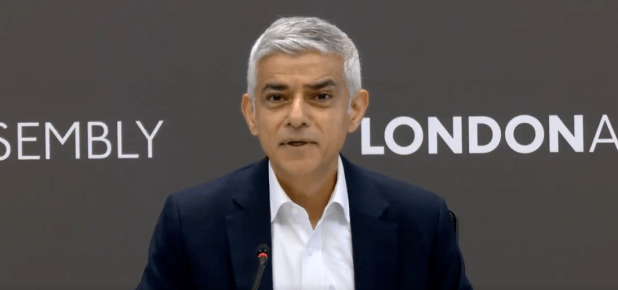
‘Whatever your business in London is’, claimed the capital’s police chief Mark Rowley yesterday, ‘we’re creating a safe environment for you to thrive.’ In fact, he argued, London is an ‘extraordinarily safe global city’. For his part in Monday’s media blitz, Mayor Sadiq Khan wrote in the Guardian that ‘Londoners are safer in their homes and on our streets.’
This analysis is at best extremely misleading – at worst, it is deliberately ignorant of the experiences and concerns shared by Londoners and visitors alike. Indeed, the facts suggest quite the opposite of Mayor Khan and Commissioner Rowley’s comments. Recent statistics show that our capital is experiencing a theft epidemic. The police are doing almost nothing to stop it.
In the year to June 2025, for example, the Met registered a record number of shoplifting offences – a 38 per cent rise to nearly 95,000, equivalent to 260 cases a day, or over ten an hour. Such numbers represent almost double the reported cases when Khan became mayor almost a decade ago.
There’s a similar story when it comes to ‘theft from the person’ (supposedly grabbing a wallet or stealing a bag is ‘non-violent’), which rose 41 per cent in 2024. Such a familiar, depressing tale is exemplified by phone thefts. Now, someone’s phone is stolen every five minutes in London.
What is more, this is not merely a question of volume. Rather, what makes these figures so damning is that police inaction – their inability to consistently arrest and charge those responsible – is making these crimes effectively legal. More than 9 in 10 shoplifting cases do not result in a charge, and there is only a 1 in 170 chance of getting caught if you steal a phone, purse, or handbag.
Even when offenders are caught, they don’t face harsh sentences. Fines are often small, and prison sentences (if given at all) are regularly extremely short, sometimes just weeks, often a matter of months, not years. The consequence is that it pays to be a professional, full-time criminal in London today. As a result, highly sophisticated, organised international networks of thieves are operating on our streets, stealing goods from us, and smuggling them overseas, where they are either resold or disassembled into parts.
So no, Sir Mark, London cannot be a safe environment for businesses to thrive if most shops are deciding to encase goods in plastic containers, behind glass barriers or having to put security tags on everyday items and employ security guards. And no, Sadiq, Londoners cannot be safe on our streets when 12 phones are stolen every hour, with known phone theft hotspots left without police presence. If our capital was actually safe, there would not be organised international gangs of thieves on the streets, anti-theft protections on everything from newspapers to meat, warnings in tube stations about thieves operating ‘in the area’, or a purple line on the floor of a busy shopping street warning people to ‘Mind the Grab’.
These failures have fostered a culture of impunity among London’s criminals, the consequences of which are two-fold. First, it has led to a collapse in confidence in the Met: from almost 9 in 10 Londoners saying they trusted police nearly a decade ago to around two in three reporting that they do not trust them in 2024. Second, this dramatic drop-off may have discouraged reports of criminal activity, meaning the extent of such crime is likely to be higher than the figures set out in official statistics.
We should not accept such incompetence from the authorities. There was nothing inevitable about London’s theft epidemic: the success and proliferation of organised international gangs on our streets did not have to happen. Such circumstances are the direct consequence of choices made by our politicians and senior police officers. If they choose to prioritise protecting the public above all else, we can return to safe streets in London.
First, the Met should focus on catching, convicting and imprisoning career criminals. These full-time offenders amount to less than 10 per cent of all criminals, yet account for the majority of crime. Imposing harsher sentences on those who have terrorised London’s streets can reduce criminal activity significantly – for example, when seven members of a bike theft gang in the City of London were arrested and imprisoned, the number of bike thefts fell by 90 per cent. By focusing on these people first, the Met could begin to rapidly improve the safety of our streets.
The decline is not irreversible
Those in Scotland Yard should also look north for inspiration: Sir Stephen Watson has turned Greater Manchester Police around, taking it out of special measures. Recently it was rated the most improved force in the country. By insisting that all crime must be investigated (a radical position in modern British police leadership) and a ‘back to basics’ approach to policing, including quadrupling the use of stop and search, Watson has overseen an area where reported crimes have fallen by 10,000 cases and the overall solved case rate has increased by 15 per cent.
Watson’s mantra, that ‘if you tackle the little things, the big things look after themselves’, should become the essence of the Met. As it emerges that rulings by diversity panels led to the employment of officers who committed rapes and assaults, it is clear that the Metropolitan Police has failed Londoners. Yesterday’s measly attempt by Sadiq Khan and Sir Mark Rowley to perpetuate an image of London that only deluded elites recognise has not fooled ordinary Londoners: the capital is rife with crime.
But they can decide to be different. They can decide to prioritise public safety by catching and imprisoning career criminals for longer. The decline is not irreversible. Policing works when it is focused, visible and unashamedly on the side of law-abiding citizens. London has the resources and the powers – what it has lacked is resolve and strong leadership.